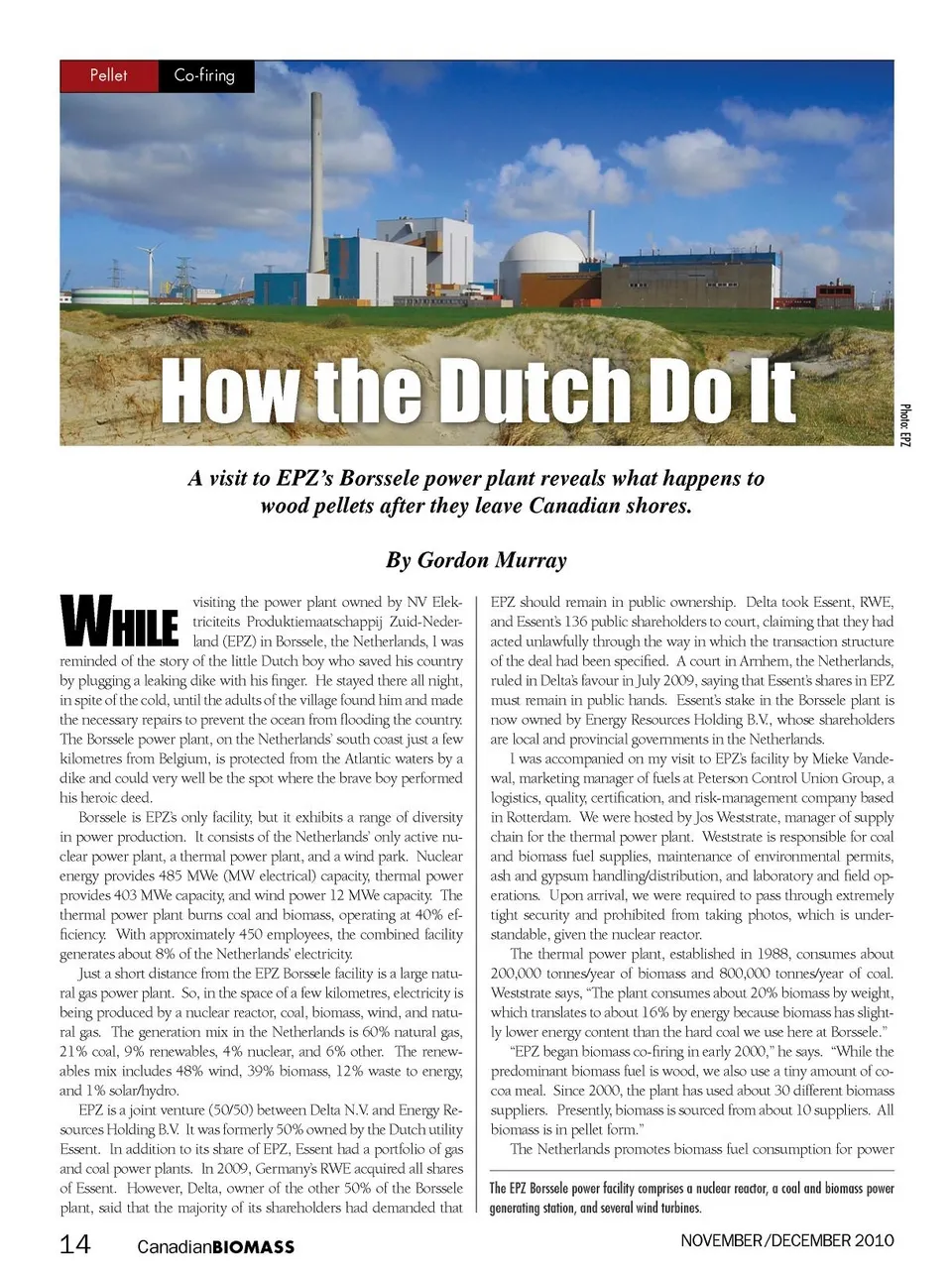
Pellet Co-firing How the Dutch Do It A visit to EPZ’s Borssele power plant reveals what happens to wood pellets after they leave Canadian shores. visiting the power plant owned by NV Elek-triciteits Produktiemaatschappij Zuid-Neder-land (EPZ) in Borssele, the Netherlands, I was reminded of the story of the little Dutch boy who saved his country by plugging a leaking dike with his finger. He stayed there all night, in spite of the cold, until the adults of the village found him and made the necessary repairs to prevent the ocean from flooding the country. The Borssele power plant, on the Netherlands’ south coast just a few kilometres from Belgium, is protected from the Atlantic waters by a dike and could very well be the spot where the brave boy performed his heroic deed. Borssele is EPZ’s only facility, but it exhibits a range of diversity in power production. It consists of the Netherlands’ only active nu-clear power plant, a thermal power plant, and a wind park. Nuclear energy provides 485 MWe (MW electrical) capacity, thermal power provides 403 MWe capacity, and wind power 12 MWe capacity. The thermal power plant burns coal and biomass, operating at 40% ef-ficiency. With approximately 450 employees, the combined facility generates about 8% of the Netherlands’ electricity. Just a short distance from the EPZ Borssele facility is a large natu-ral gas power plant. So, in the space of a few kilometres, electricity is being produced by a nuclear reactor, coal, biomass, wind, and natu-ral gas. The generation mix in the Netherlands is 60% natural gas, 21% coal, 9% renewables, 4% nuclear, and 6% other. The renew-ables mix includes 48% wind, 39% biomass, 12% waste to energy, and 1% solar/hydro. EPZ is a joint venture (50/50) between Delta N.V. and Energy Re-sources Holding B.V. It was formerly 50% owned by the Dutch utility Essent. In addition to its share of EPZ, Essent had a portfolio of gas and coal power plants. In 2009, Germany’s RWE acquired all shares of Essent. However, Delta, owner of the other 50% of the Borssele plant, said that the majority of its shareholders had demanded that Photo: EPZ W hile By Gordon Murray EPZ should remain in public ownership. Delta took Essent, RWE, and Essent’s 136 public shareholders to court, claiming that they had acted unlawfully through the way in which the transaction structure of the deal had been specified. A court in Arnhem, the Netherlands, ruled in Delta’s favour in July 2009, saying that Essent’s shares in EPZ must remain in public hands. Essent’s stake in the Borssele plant is now owned by Energy Resources Holding B.V., whose shareholders are local and provincial governments in the Netherlands. I was accompanied on my visit to EPZ’s facility by Mieke Vande-wal, marketing manager of fuels at Peterson Control Union Group, a logistics, quality, certification, and risk-management company based in Rotterdam. We were hosted by Jos Weststrate, manager of supply chain for the thermal power plant. Weststrate is responsible for coal and biomass fuel supplies, maintenance of environmental permits, ash and gypsum handling/distribution, and laboratory and field op-erations. Upon arrival, we were required to pass through extremely tight security and prohibited from taking photos, which is under-standable, given the nuclear reactor. The thermal power plant, established in 1988, consumes about 200,000 tonnes/year of biomass and 800,000 tonnes/year of coal. Weststrate says, “The plant consumes about 20% biomass by weight, which translates to about 16% by energy because biomass has slight-ly lower energy content than the hard coal we use here at Borssele.” “EPZ began biomass co-firing in early 2000,” he says. “While the predominant biomass fuel is wood, we also use a tiny amount of co-coa meal. Since 2000, the plant has used about 30 different biomass suppliers. Presently, biomass is sourced from about 10 suppliers. All biomass is in pellet form.” The Netherlands promotes biomass fuel consumption for power The EPZ Borssele power facility comprises a nuclear reactor, a coal and biomass power generating station, and several wind turbines. NOVEMBER/DECEMBER 2010 14 Canadian BIOMASS
Canadian Biomass November/December 2010: Page 14