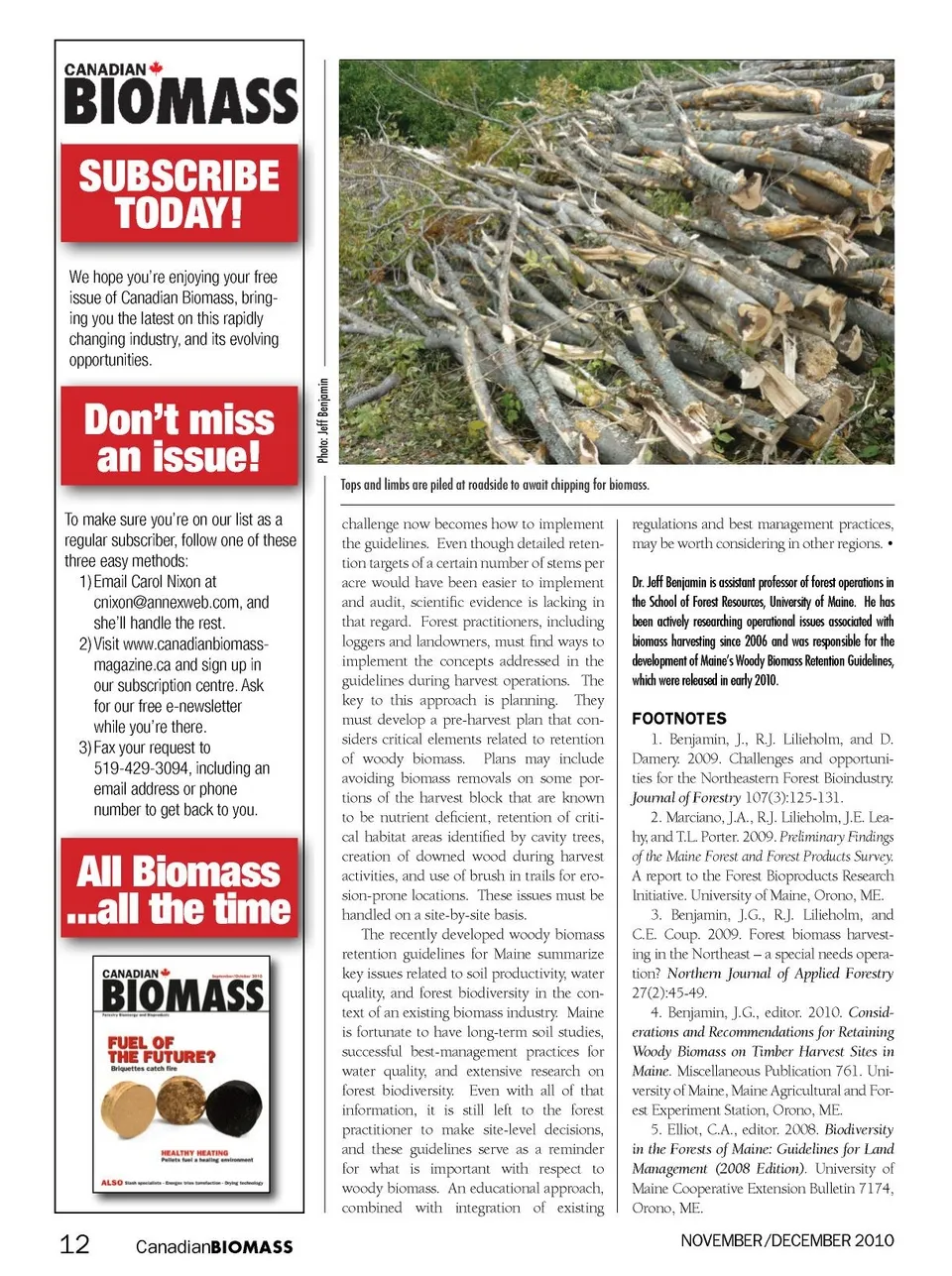
SUBSCRIBE TODAY! We hope you’re enjoying your free issue of Canadian Biomass, bring-ing you the latest on this rapidly changing industry, and its evolving opportunities. Don’t miss an issue! To make sure you’re on our list as a regular subscriber, follow one of these three easy methods: 1) Email Carol Nixon at [email protected], and she’ll handle the rest. 2) Visit www.canadianbiomass-magazine.ca and sign up in our subscription centre. Ask for our free e-newsletter while you’re there. 3) Fax your request to 519-429-3094, including an email address or phone number to get back to you. Photo: Jeff Benjamin Tops and limbs are piled at roadside to await chipping for biomass. All Biomass ...all the time challenge now becomes how to implement the guidelines. Even though detailed reten-tion targets of a certain number of stems per acre would have been easier to implement and audit, scientific evidence is lacking in that regard. Forest practitioners, including loggers and landowners, must find ways to implement the concepts addressed in the guidelines during harvest operations. The key to this approach is planning. They must develop a pre-harvest plan that con-siders critical elements related to retention of woody biomass. Plans may include avoiding biomass removals on some por-tions of the harvest block that are known to be nutrient deficient, retention of criti-cal habitat areas identified by cavity trees, creation of downed wood during harvest activities, and use of brush in trails for ero-sion-prone locations. These issues must be handled on a site-by-site basis. The recently developed woody biomass retention guidelines for Maine summarize key issues related to soil productivity, water quality, and forest biodiversity in the con-text of an existing biomass industry. Maine is fortunate to have long-term soil studies, successful best-management practices for water quality, and extensive research on forest biodiversity. Even with all of that information, it is still left to the forest practitioner to make site-level decisions, and these guidelines serve as a reminder for what is important with respect to woody biomass. An educational approach, combined with integration of existing regulations and best management practices, may be worth considering in other regions. • Dr. Jeff Benjamin is assistant professor of forest operations in the School of Forest Resources, University of Maine. He has been actively researching operational issues associated with biomass harvesting since 2006 and was responsible for the development of Maine’s Woody Biomass Retention Guidelines, which were released in early 2010. FootNotes 1. Benjamin, J., R.J. Lilieholm, and D. Damery. 2009. Challenges and opportuni-ties for the Northeastern Forest Bioindustry. Journal of Forestry 107(3):125-131. 2. Marciano, J.A., R.J. Lilieholm, J.E. Lea-hy, and T.L. Porter. 2009. Preliminary Findings of the Maine Forest and Forest Products Survey. A report to the Forest Bioproducts Research Initiative. University of Maine, Orono, ME. 3. Benjamin, J.G., R.J. Lilieholm, and C.E. Coup. 2009. Forest biomass harvest-ing in the Northeast – a special needs opera-tion? Northern Journal of Applied Forestry 27(2):45-49. 4. Benjamin, J.G., editor. 2010. Consid-erations and Recommendations for Retaining Woody Biomass on Timber Harvest Sites in Maine. Miscellaneous Publication 761. Uni-versity of Maine, Maine Agricultural and For-est Experiment Station, Orono, ME. 5. Elliot, C.A., editor. 2008. Biodiversity in the Forests of Maine: Guidelines for Land Management (2008 Edition). University of Maine Cooperative Extension Bulletin 7174, Orono, ME. NOVEMBER/DECEMBER 2010 12 Canadian BIOMASS 16/11/10 3:46 PM Cdn Biomass Subscription.indd 1
Canadian Biomass November/December 2010: Page 12