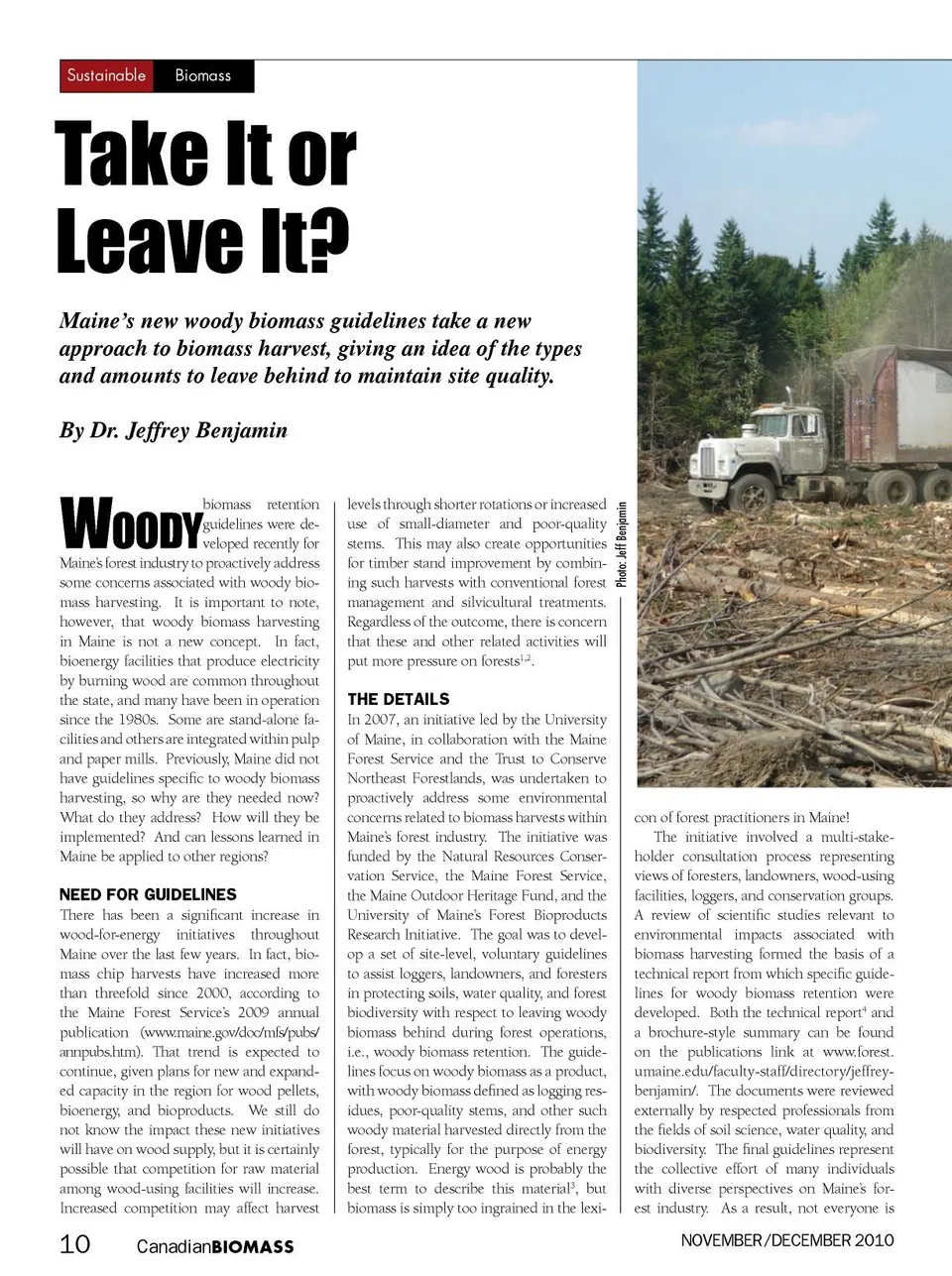
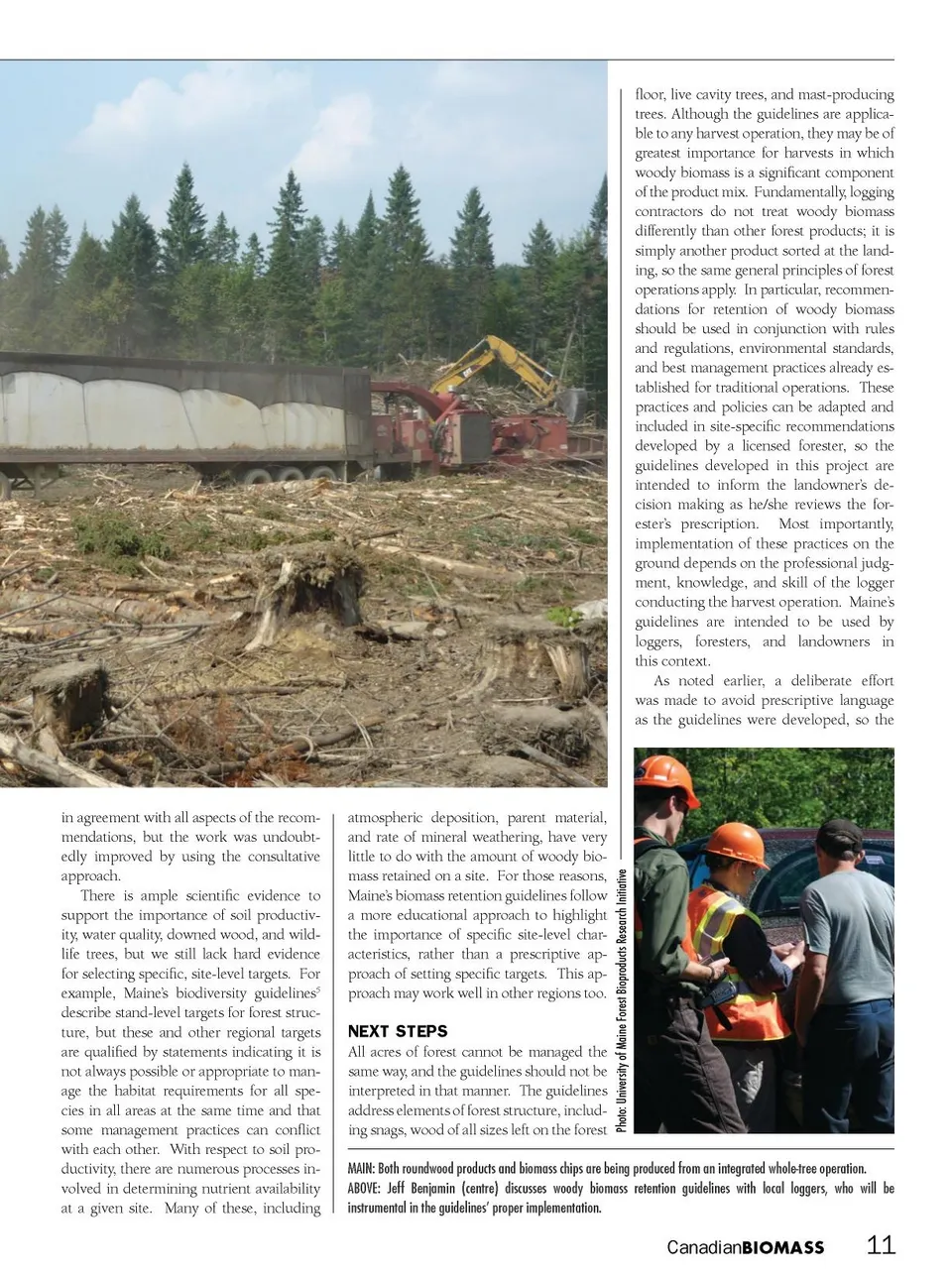
floor, live cavity trees, and mast-producing trees. Although the guidelines are applica-ble to any harvest operation, they may be of greatest importance for harvests in which woody biomass is a significant component of the product mix. Fundamentally, logging contractors do not treat woody biomass differently than other forest products; it is simply another product sorted at the land-ing, so the same general principles of forest operations apply. In particular, recommen-dations for retention of woody biomass should be used in conjunction with rules and regulations, environmental standards, and best management practices already es-tablished for traditional operations. These practices and policies can be adapted and included in site-specific recommendations developed by a licensed forester, so the guidelines developed in this project are intended to inform the landowner’s de-cision making as he/she reviews the for-ester’s prescription. Most importantly, implementation of these practices on the ground depends on the professional judg-ment, knowledge, and skill of the logger conducting the harvest operation. Maine’s guidelines are intended to be used by loggers, foresters, and landowners in this context. As noted earlier, a deliberate effort was made to avoid prescriptive language as the guidelines were developed, so the in agreement with all aspects of the recom-mendations, but the work was undoubt-edly improved by using the consultative approach. There is ample scientific evidence to support the importance of soil productiv-ity, water quality, downed wood, and wild-life trees, but we still lack hard evidence for selecting specific, site-level targets. For example, Maine’s biodiversity guidelines 5 describe stand-level targets for forest struc-ture, but these and other regional targets are qualified by statements indicating it is not always possible or appropriate to man-age the habitat requirements for all spe-cies in all areas at the same time and that some management practices can conflict with each other. With respect to soil pro-ductivity, there are numerous processes in-volved in determining nutrient availability at a given site. Many of these, including Next steps All acres of forest cannot be managed the same way, and the guidelines should not be interpreted in that manner. The guidelines address elements of forest structure, includ-ing snags, wood of all sizes left on the forest MAIN: Both roundwood products and biomass chips are being produced from an integrated whole-tree operation. ABOVE: Jeff Benjamin (centre) discusses woody biomass retention guidelines with local loggers, who will be instrumental in the guidelines’ proper implementation. Photo: University of Maine Forest Bioproducts Research Initiative atmospheric deposition, parent material, and rate of mineral weathering, have very little to do with the amount of woody bio-mass retained on a site. For those reasons, Maine’s biomass retention guidelines follow a more educational approach to highlight the importance of specific site-level char-acteristics, rather than a prescriptive ap-proach of setting specific targets. This ap-proach may work well in other regions too. Canadian BIOMASS 11
Canadian Biomass November/December 2010: Page 11