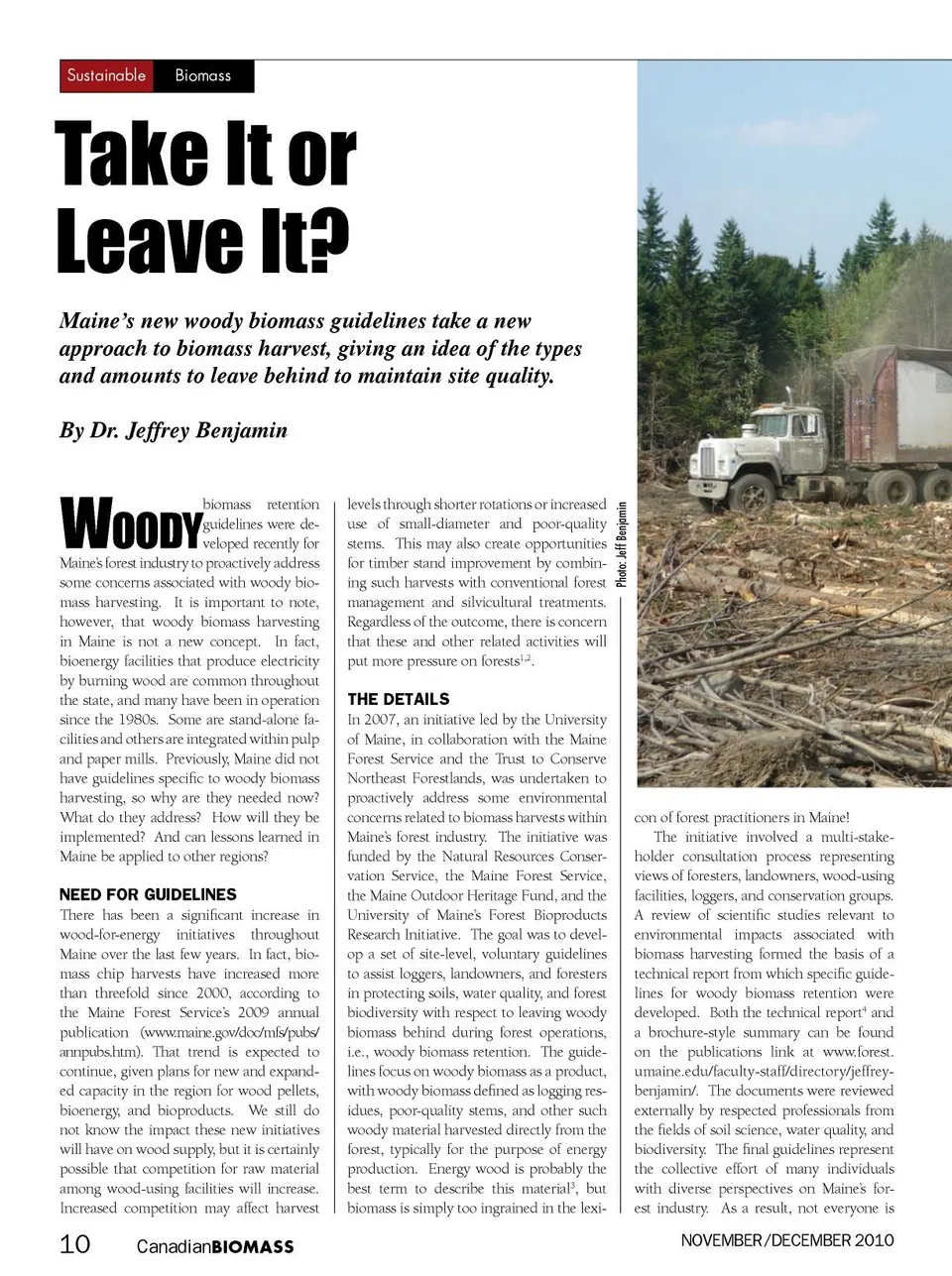
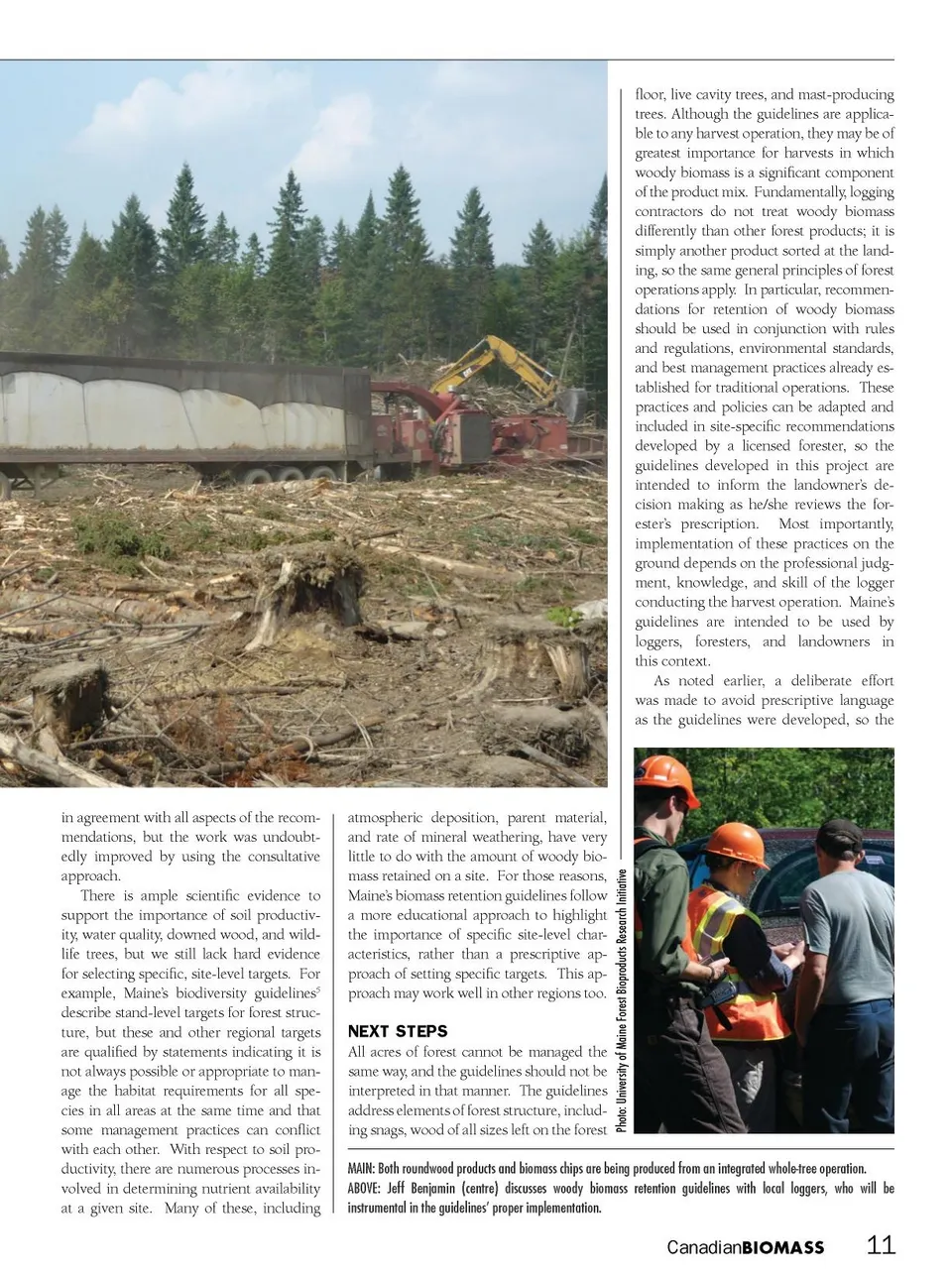
Sustainable Biomass T ake It or Briquettes Leave It? on Fire Maine’s new woody biomass guidelines take a new approach to biomass harvest, giving an idea of the types and amounts to leave behind to maintain site quality. By Dr. Jeffrey Benjamin biomass retention guidelines were de-veloped recently for Maine’s forest industry to proactively address some concerns associated with woody bio-mass harvesting. It is important to note, however, that woody biomass harvesting in Maine is not a new concept. In fact, bioenergy facilities that produce electricity by burning wood are common throughout the state, and many have been in operation since the 1980s. Some are stand-alone fa-cilities and others are integrated within pulp and paper mills. Previously, Maine did not have guidelines specific to woody biomass harvesting, so why are they needed now? What do they address? How will they be implemented? And can lessons learned in Maine be applied to other regions? Need For guIdelINes Photo: Jeff Benjamin W oody levels through shorter rotations or increased use of small-diameter and poor-quality stems. This may also create opportunities for timber stand improvement by combin-ing such harvests with conventional forest management and silvicultural treatments. Regardless of the outcome, there is concern that these and other related activities will put more pressure on forests 1,2 . the detaIls There has been a significant increase in wood-for-energy initiatives throughout Maine over the last few years. In fact, bio-mass chip harvests have increased more than threefold since 2000, according to the Maine Forest Service’s 2009 annual publication (www.maine.gov/doc/mfs/pubs/ annpubs.htm). That trend is expected to continue, given plans for new and expand-ed capacity in the region for wood pellets, bioenergy, and bioproducts. We still do not know the impact these new initiatives will have on wood supply, but it is certainly possible that competition for raw material among wood-using facilities will increase. Increased competition may affect harvest In 2007, an initiative led by the University of Maine, in collaboration with the Maine Forest Service and the Trust to Conserve Northeast Forestlands, was undertaken to proactively address some environmental concerns related to biomass harvests within Maine’s forest industry. The initiative was funded by the Natural Resources Conser-vation Service, the Maine Forest Service, the Maine Outdoor Heritage Fund, and the University of Maine’s Forest Bioproducts Research Initiative. The goal was to devel-op a set of site-level, voluntary guidelines to assist loggers, landowners, and foresters in protecting soils, water quality, and forest biodiversity with respect to leaving woody biomass behind during forest operations, i.e., woody biomass retention. The guide-lines focus on woody biomass as a product, with woody biomass defined as logging res-idues, poor-quality stems, and other such woody material harvested directly from the forest, typically for the purpose of energy production. Energy wood is probably the best term to describe this material 3 , but biomass is simply too ingrained in the lexi-con of forest practitioners in Maine! The initiative involved a multi-stake-holder consultation process representing views of foresters, landowners, wood-using facilities, loggers, and conservation groups. A review of scientific studies relevant to environmental impacts associated with biomass harvesting formed the basis of a technical report from which specific guide-lines for woody biomass retention were developed. Both the technical report 4 and a brochure-style summary can be found on the publications link at www.forest. umaine.edu/faculty-staff/directory/jeffrey-benjamin/. The documents were reviewed externally by respected professionals from the fields of soil science, water quality, and biodiversity. The final guidelines represent the collective effort of many individuals with diverse perspectives on Maine’s for-est industry. As a result, not everyone is NOVEMBER/DECEMBER 2010 10 Canadian BIOMASS
Canadian Biomass November/December 2010: Page 10