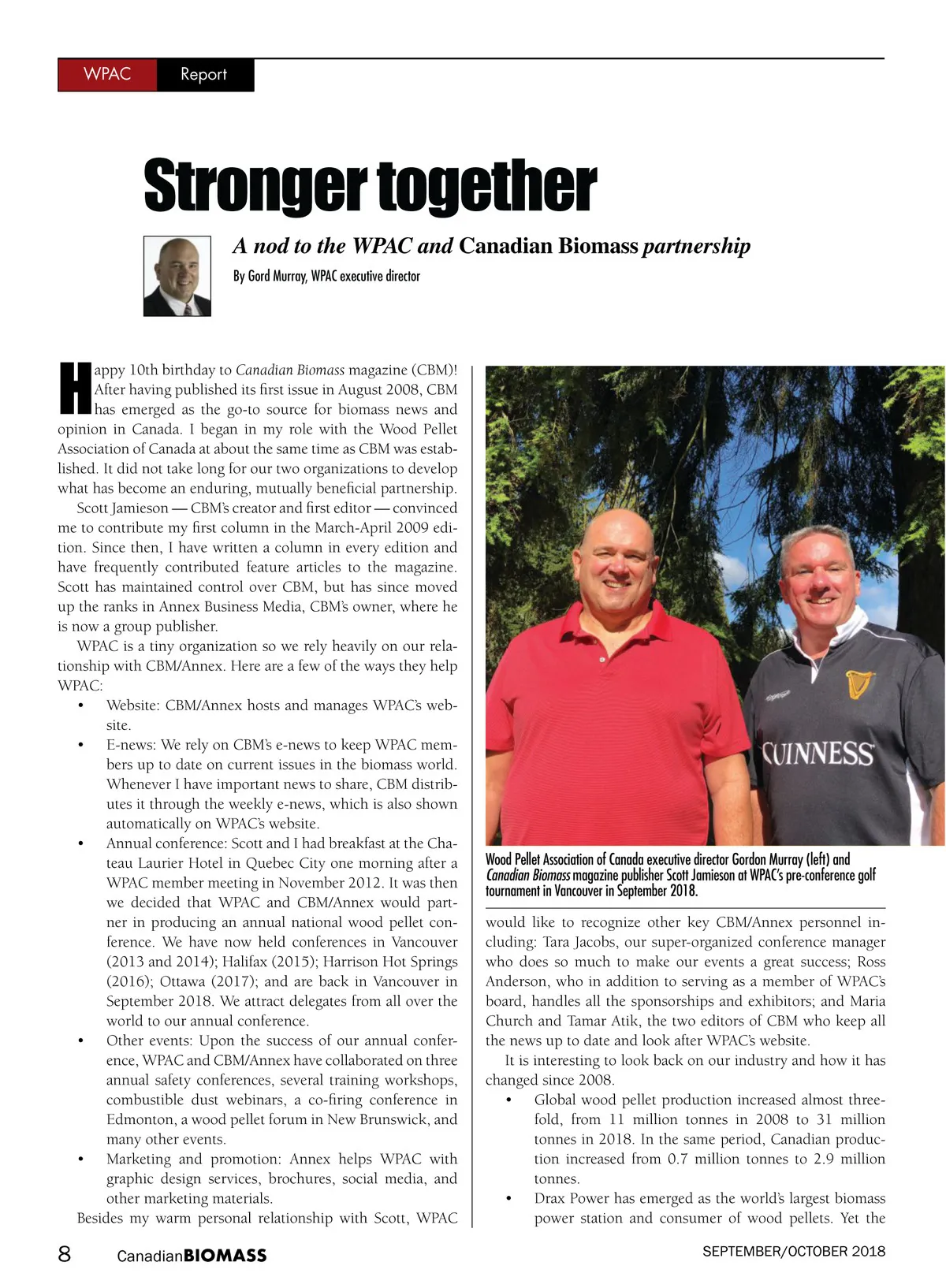
• • • • • • • • company did not begin wood pellet co-firing until 2009. It completed its first boiler con-version to 100 per cent biomass in 2013 and its fourth boiler in 2018. South Korea did not begin us-ing industrial wood pellets until 2012 and has now emerged as the largest wood pellet consumer in Asia, followed closely by Ja-pan, which is also growing rap-idly. Italy has emerged as the largest and fastest growing premium wood pellet market in Europe, currently about two million tonnes per year. I attended the inaugural meeting of the European Pellet Council in 2010, at which time we decid-ed to introduce the wood pellet quality scheme known as EN-plus. WPAC has remained the only non-European full voting member of the European Pellet Council. ENplus has grown to cover 70 per cent of the premium pellet market in Europe. In 2008 there were no interna-tional wood pellet standards. Since then, the ISO Technical Committee 238 has established the ISO 17225 quality standards and have developed many relat-ed physical and chemical test-ing standards. Recently the ISO 17225 standards were adopted by the Canadian Standards Asso-ciation. Ontario Power Generation con-verted two coal boilers to wood pellets and continues to operate the Atikokan boiler to this day. The company Rentech, which was so prominent in Ontario, has come and gone. In 2010, Green Circle operated the world’s largest wood pellet plant at 500,000 tonnes annual capacity. Since then, Green Circle was purchased by Enviva. Today, plants with 500,000 tonnes ca-pacity are commonplace. Pacific BioEnergy completely re-built its plant in Prince George, more than doubling capacity. The plant is now a leader in us-• • • ing forest harvesting residues as feedstock. In 2008, Pinnacle Renewable En-ergy was still owned by the Swaan family. Since then the company has multiplied its number of pro-duction facilities, was purchased by ONCAP, then underwent an IPO to become a publicly traded company, and expanded into Al-berta and Alabama. Shaw Resources and Groupe Savoie began exporting wood pellets through the Port of Belle-dune to Europe. Shaw’s Rene Landry and Belledune’s Jenna MacDonald have both served on WPAC’s board for many years, with Rene having served the past three years as president The Sustainable Biomass Pro-gram has emerged as the dom-inant European sustainability certification program for wood pellets. All Canadian exporters to Europe have either been certified or are in the process of becoming certified. • Until 2014, WPAC had minimal involvement in managing safety. In 2014, members asked WPAC to establish a safety committee. Since then, safety has become one of WPAC’s primary focus areas. The wood pellet industry has completely turned around its reputation favourably in the eyes of regulators. All of these changes to our industry have been chronicled in the pages of CBM and in the weekly e-news. After many years of effort by all wood pellet industry partic-ipants, we are now in a situation where demand for our product is strong; prices are fair; foreign exchange rates are favour-able; we having some success in convinc-ing our critics regarding our sustainability credentials and the greenhouse gas benefits of wood pellets; and our industry’s future looks bright. We are looking forward to continuing our strong partnership with CBM/Annex for many years to come. • Canadian BIOMASS CBM_Belldune_MayJune18_CSA.indd 1 9 2018-02-13 12:52 PM
Canadian Biomass September-October 2018: Page 9