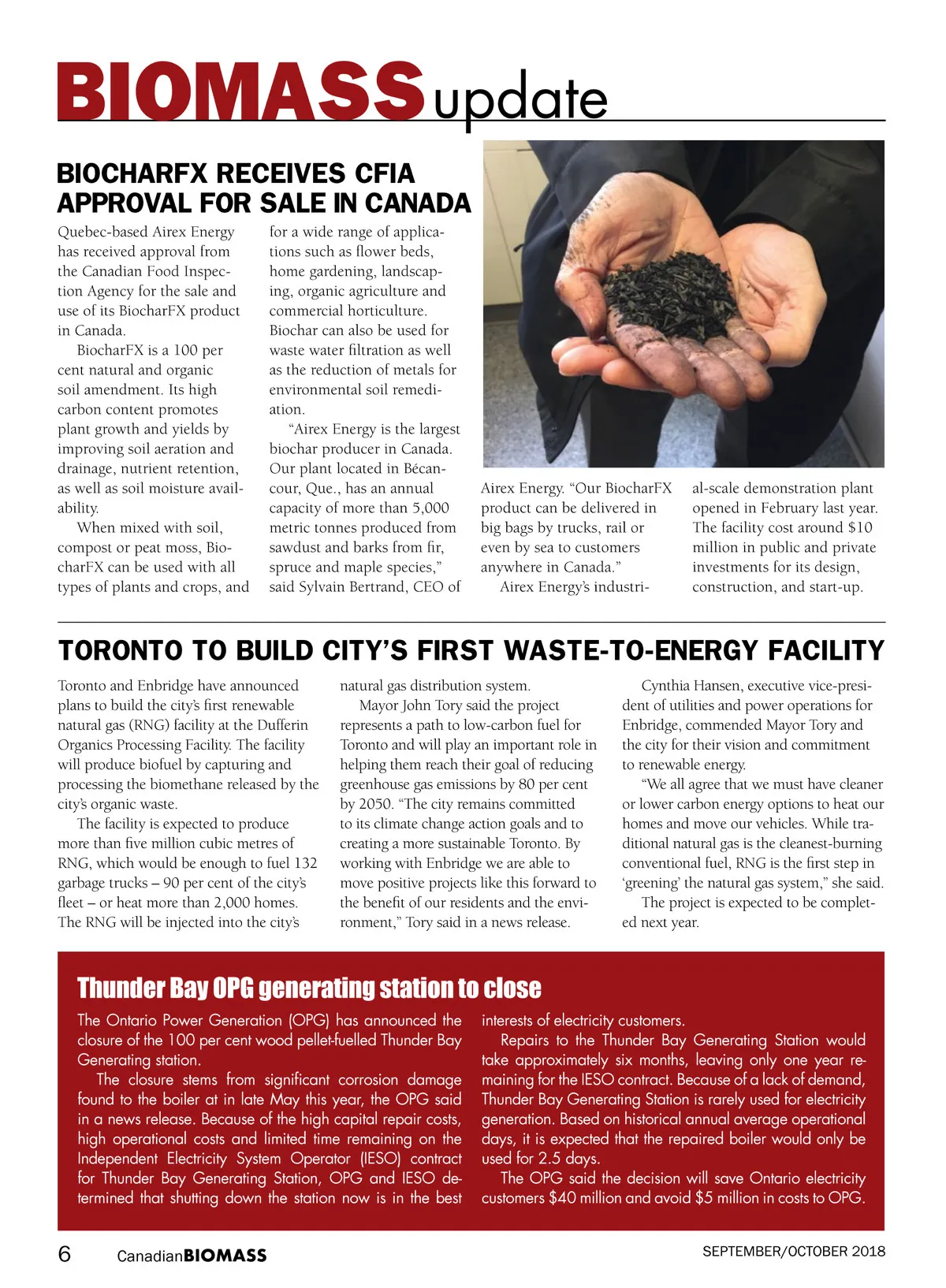
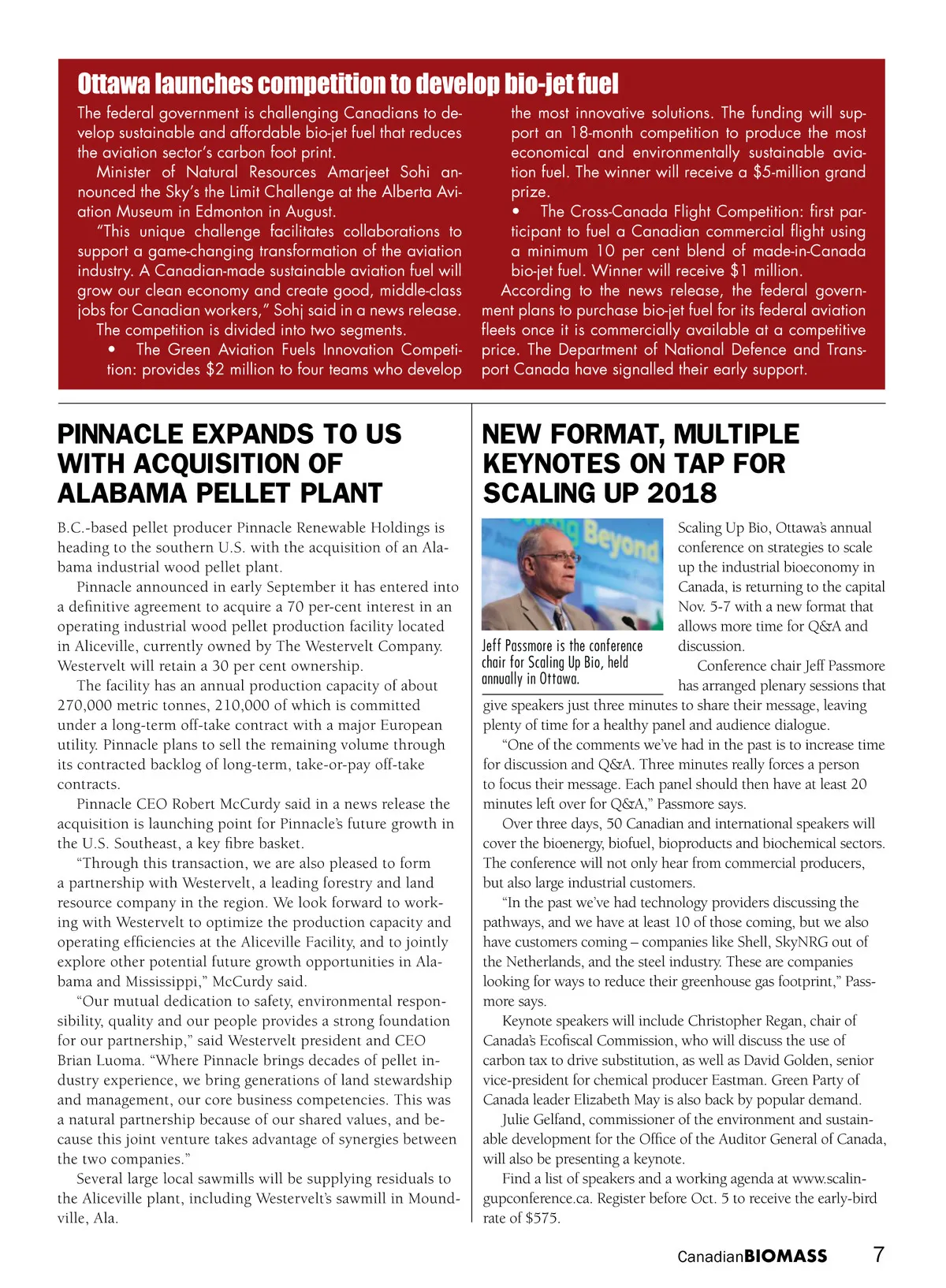
The federal government is challenging Canadians to de-velop sustainable and affordable bio-jet fuel that reduces the aviation sector’s carbon foot print. Minister of Natural Resources Amarjeet Sohi an-nounced the Sky’s the Limit Challenge at the Alberta Avi-ation Museum in Edmonton in August. “This unique challenge facilitates collaborations to support a game-changing transformation of the aviation industry. A Canadian-made sustainable aviation fuel will grow our clean economy and create good, middle-class jobs for Canadian workers,” Sohj said in a news release. The competition is divided into two segments. • The Green Aviation Fuels Innovation Competi-tion: provides $2 million to four teams who develop Ottawa launches competition to develop bio-jet fuel the most innovative solutions. The funding will sup-port an 18-month competition to produce the most economical and environmentally sustainable avia-tion fuel. The winner will receive a $5-million grand prize. • The Cross-Canada Flight Competition: first par-ticipant to fuel a Canadian commercial flight using a minimum 10 per cent blend of made-in-Canada bio-jet fuel. Winner will receive $1 million. According to the news release, the federal govern-ment plans to purchase bio-jet fuel for its federal aviation fleets once it is commercially available at a competitive price. The Department of National Defence and Trans-port Canada have signalled their early support. PINNACLE EXPANDS TO US WITH ACQUISITION OF ALABAMA PELLET PLANT B.C.-based pellet producer Pinnacle Renewable Holdings is heading to the southern U.S. with the acquisition of an Ala-bama industrial wood pellet plant. Pinnacle announced in early September it has entered into a definitive agreement to acquire a 70 per-cent interest in an operating industrial wood pellet production facility located in Aliceville, currently owned by The Westervelt Company. Westervelt will retain a 30 per cent ownership. The facility has an annual production capacity of about 270,000 metric tonnes, 210,000 of which is committed under a long-term off-take contract with a major European utility. Pinnacle plans to sell the remaining volume through its contracted backlog of long-term, take-or-pay off-take contracts. Pinnacle CEO Robert McCurdy said in a news release the acquisition is launching point for Pinnacle’s future growth in the U.S. Southeast, a key fibre basket. “Through this transaction, we are also pleased to form a partnership with Westervelt, a leading forestry and land resource company in the region. We look forward to work-ing with Westervelt to optimize the production capacity and operating efficiencies at the Aliceville Facility, and to jointly explore other potential future growth opportunities in Ala-bama and Mississippi,” McCurdy said. “Our mutual dedication to safety, environmental respon-sibility, quality and our people provides a strong foundation for our partnership,” said Westervelt president and CEO Brian Luoma. “Where Pinnacle brings decades of pellet in-dustry experience, we bring generations of land stewardship and management, our core business competencies. This was a natural partnership because of our shared values, and be-cause this joint venture takes advantage of synergies between the two companies.” Several large local sawmills will be supplying residuals to the Aliceville plant, including Westervelt’s sawmill in Mound-ville, Ala. NEW FORMAT, MULTIPLE KEYNOTES ON TAP FOR SCALING UP 2018 Scaling Up Bio, Ottawa’s annual conference on strategies to scale up the industrial bioeconomy in Canada, is returning to the capital Nov. 5-7 with a new format that allows more time for Q&A and discussion. Jeff Passmore is the conference chair for Scaling Up Bio, held Conference chair Jeff Passmore annually in Ottawa. has arranged plenary sessions that give speakers just three minutes to share their message, leaving plenty of time for a healthy panel and audience dialogue. “One of the comments we’ve had in the past is to increase time for discussion and Q&A. Three minutes really forces a person to focus their message. Each panel should then have at least 20 minutes left over for Q&A,” Passmore says. Over three days, 50 Canadian and international speakers will cover the bioenergy, biofuel, bioproducts and biochemical sectors. The conference will not only hear from commercial producers, but also large industrial customers. “In the past we’ve had technology providers discussing the pathways, and we have at least 10 of those coming, but we also have customers coming – companies like Shell, SkyNRG out of the Netherlands, and the steel industry. These are companies looking for ways to reduce their greenhouse gas footprint,” Pass-more says. Keynote speakers will include Christopher Regan, chair of Canada’s Ecofiscal Commission, who will discuss the use of carbon tax to drive substitution, as well as David Golden, senior vice-president for chemical producer Eastman. Green Party of Canada leader Elizabeth May is also back by popular demand. Julie Gelfand, commissioner of the environment and sustain-able development for the Office of the Auditor General of Canada, will also be presenting a keynote. Find a list of speakers and a working agenda at www.scalin-gupconference.ca. Register before Oct. 5 to receive the early-bird rate of $575. Canadian BIOMASS 7
Canadian Biomass September-October 2018: Page 7