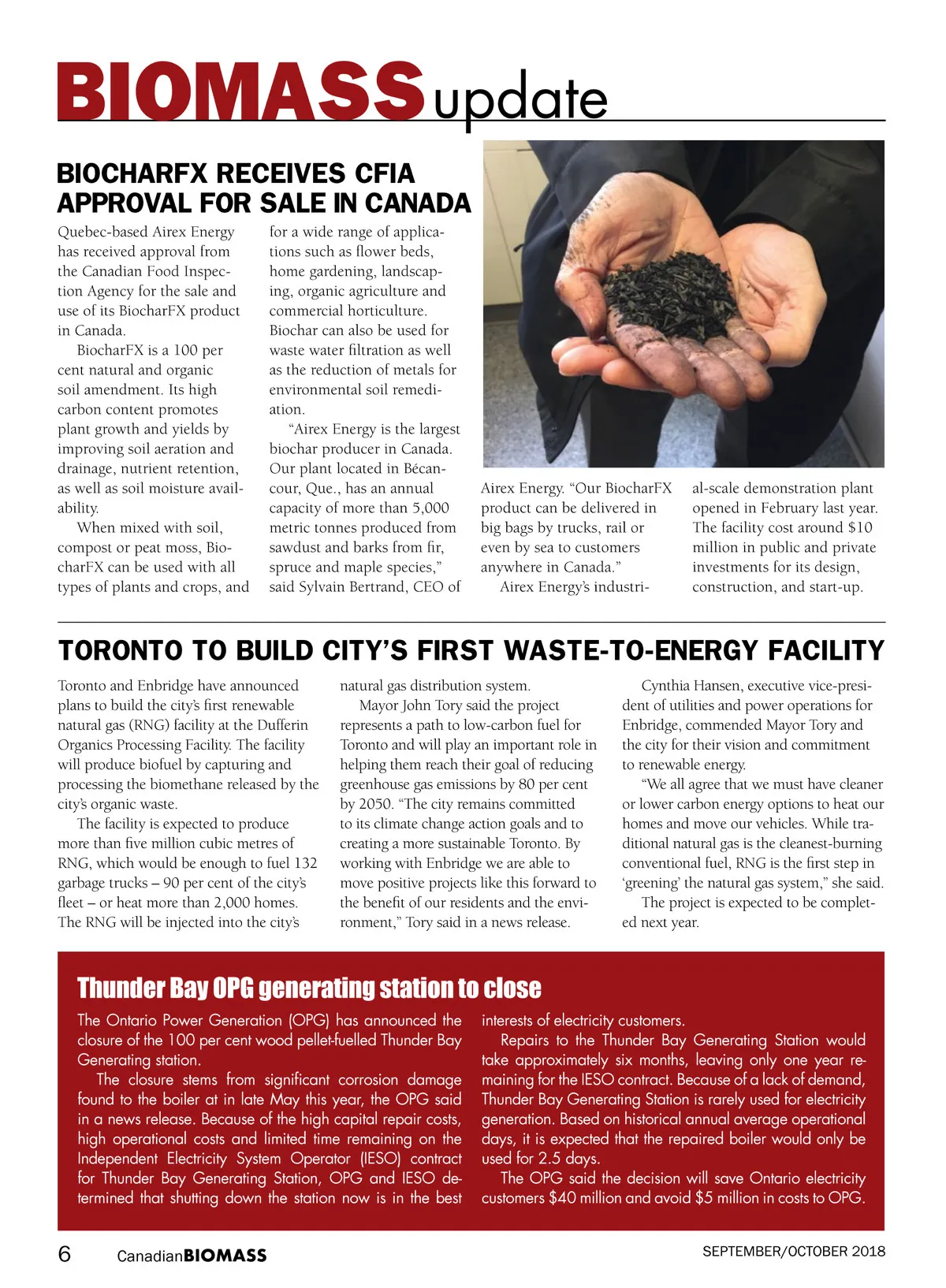
BIOMASS update BIOCHARFX RECEIVES CFIA APPROVAL FOR SALE IN CANADA Quebec-based Airex Energy has received approval from the Canadian Food Inspec-tion Agency for the sale and use of its BiocharFX product in Canada. BiocharFX is a 100 per cent natural and organic soil amendment. Its high carbon content promotes plant growth and yields by improving soil aeration and drainage, nutrient retention, as well as soil moisture avail-ability. When mixed with soil, compost or peat moss, Bio-charFX can be used with all types of plants and crops, and for a wide range of applica-tions such as flower beds, home gardening, landscap-ing, organic agriculture and commercial horticulture. Biochar can also be used for waste water filtration as well as the reduction of metals for environmental soil remedi-ation. “Airex Energy is the largest biochar producer in Canada. Our plant located in Bécan-cour, Que., has an annual capacity of more than 5,000 metric tonnes produced from sawdust and barks from fir, spruce and maple species,” said Sylvain Bertrand, CEO of Airex Energy. “Our BiocharFX product can be delivered in big bags by trucks, rail or even by sea to customers anywhere in Canada.” Airex Energy’s industri-al-scale demonstration plant opened in February last year. The facility cost around $10 million in public and private investments for its design, construction, and start-up. TORONTO TO BUILD CITY’S FIRST WASTE-TO-ENERGY FACILITY Toronto and Enbridge have announced plans to build the city’s first renewable natural gas (RNG) facility at the Dufferin Organics Processing Facility. The facility will produce biofuel by capturing and processing the biomethane released by the city’s organic waste. The facility is expected to produce more than five million cubic metres of RNG, which would be enough to fuel 132 garbage trucks – 90 per cent of the city’s fleet – or heat more than 2,000 homes. The RNG will be injected into the city’s natural gas distribution system. Mayor John Tory said the project represents a path to low-carbon fuel for Toronto and will play an important role in helping them reach their goal of reducing greenhouse gas emissions by 80 per cent by 2050. “The city remains committed to its climate change action goals and to creating a more sustainable Toronto. By working with Enbridge we are able to move positive projects like this forward to the benefit of our residents and the envi-ronment,” Tory said in a news release. Cynthia Hansen, executive vice-presi-dent of utilities and power operations for Enbridge, commended Mayor Tory and the city for their vision and commitment to renewable energy. “We all agree that we must have cleaner or lower carbon energy options to heat our homes and move our vehicles. While tra-ditional natural gas is the cleanest-burning conventional fuel, RNG is the first step in ‘greening’ the natural gas system,” she said. The project is expected to be complet-ed next year. Thunder Bay OPG generating station to close The Ontario Power Generation (OPG) has announced the closure of the 100 per cent wood pellet-fuelled Thunder Bay Generating station. The closure stems from significant corrosion damage found to the boiler at in late May this year, the OPG said in a news release. Because of the high capital repair costs, high operational costs and limited time remaining on the Independent Electricity System Operator (IESO) contract for Thunder Bay Generating Station, OPG and IESO de-termined that shutting down the station now is in the best interests of electricity customers. Repairs to the Thunder Bay Generating Station would take approximately six months, leaving only one year re-maining for the IESO contract. Because of a lack of demand, Thunder Bay Generating Station is rarely used for electricity generation. Based on historical annual average operational days, it is expected that the repaired boiler would only be used for 2.5 days. The OPG said the decision will save Ontario electricity customers $40 million and avoid $5 million in costs to OPG. SEPTEMBER/OCTOBER 2018 6 Canadian BIOMASS
Canadian Biomass September-October 2018: Page 6