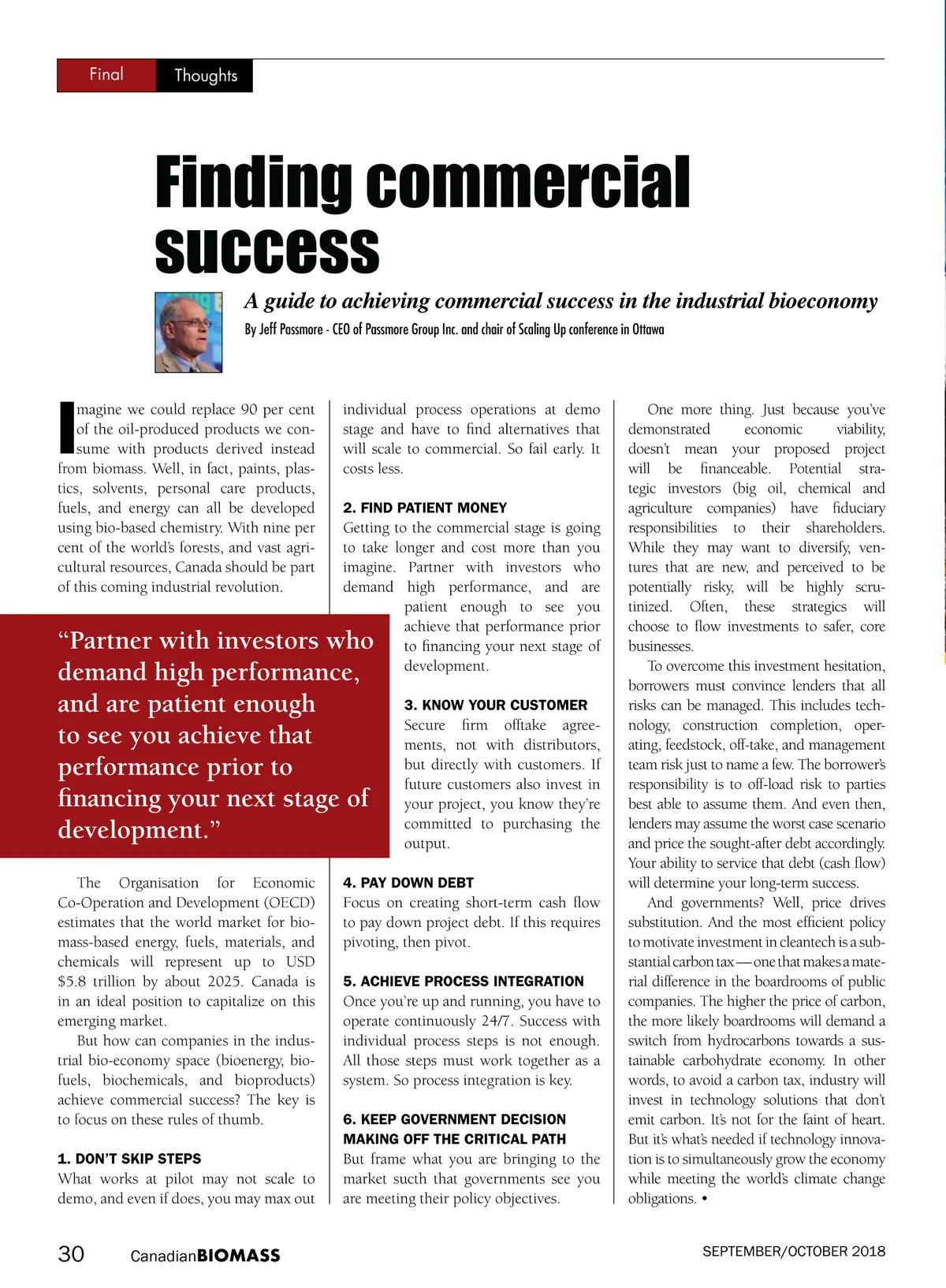
Final Thoughts Finding commercial success By Jeff Passmore -CEO of Passmore Group Inc. and chair of Scaling Up conference in Ottawa A guide to achieving commercial success in the industrial bioeconomy magine we could replace 90 per cent of the oil-produced products we con-sume with products derived instead from biomass. Well, in fact, paints, plas-tics, solvents, personal care products, fuels, and energy can all be developed using bio-based chemistry. With nine per cent of the world’s forests, and vast agri-cultural resources, Canada should be part of this coming industrial revolution. I individual process operations at demo stage and have to find alternatives that will scale to commercial. So fail early. It costs less. 2. FIND PATIENT MONEY “Partner with investors who demand high performance, and are patient enough to see you achieve that performance prior to financing your next stage of development.” The Organisation for Economic Co-Operation and Development (OECD) estimates that the world market for bio-mass-based energy, fuels, materials, and chemicals will represent up to USD $5.8 trillion by about 2025. Canada is in an ideal position to capitalize on this emerging market. But how can companies in the indus-trial bio-economy space (bioenergy, bio-fuels, biochemicals, and bioproducts) achieve commercial success? The key is to focus on these rules of thumb. 1. DON’T SKIP STEPS Getting to the commercial stage is going to take longer and cost more than you imagine. Partner with investors who demand high performance, and are patient enough to see you achieve that performance prior to financing your next stage of development. 3. KNOW YOUR CUSTOMER Secure firm offtake agree-ments, not with distributors, but directly with customers. If future customers also invest in your project, you know they’re committed to purchasing the output. 4. PAY DOWN DEBT Focus on creating short-term cash flow to pay down project debt. If this requires pivoting, then pivot. 5. ACHIEVE PROCESS INTEGRATION Once you’re up and running, you have to operate continuously 24/7. Success with individual process steps is not enough. All those steps must work together as a system. So process integration is key. 6. KEEP GOVERNMENT DECISION MAKING OFF THE CRITICAL PATH What works at pilot may not scale to demo, and even if does, you may max out But frame what you are bringing to the market sucth that governments see you are meeting their policy objectives. One more thing. Just because you’ve demonstrated economic viability, doesn’t mean your proposed project will be financeable. Potential stra-tegic investors (big oil, chemical and agriculture companies) have fiduciary responsibilities to their shareholders. While they may want to diversify, ven-tures that are new, and perceived to be potentially risky, will be highly scru-tinized. Often, these strategics will choose to flow investments to safer, core businesses. To overcome this investment hesitation, borrowers must convince lenders that all risks can be managed. This includes tech-nology, construction completion, oper-ating, feedstock, off-take, and management team risk just to name a few. The borrower’s responsibility is to off-load risk to parties best able to assume them. And even then, lenders may assume the worst case scenario and price the sought-after debt accordingly. Your ability to service that debt (cash flow) will determine your long-term success. And governments? Well, price drives substitution. And the most efficient policy to motivate investment in cleantech is a sub-stantial carbon tax — one that makes a mate-rial difference in the boardrooms of public companies. The higher the price of carbon, the more likely boardrooms will demand a switch from hydrocarbons towards a sus-tainable carbohydrate economy. In other words, to avoid a carbon tax, industry will invest in technology solutions that don’t emit carbon. It’s not for the faint of heart. But it’s what’s needed if technology innova-tion is to simultaneously grow the economy while meeting the world’s climate change obligations. • SEPTEMBER/OCTOBER 2018 30 Canadian BIOMASS
Canadian Biomass September-October 2018: Page 30