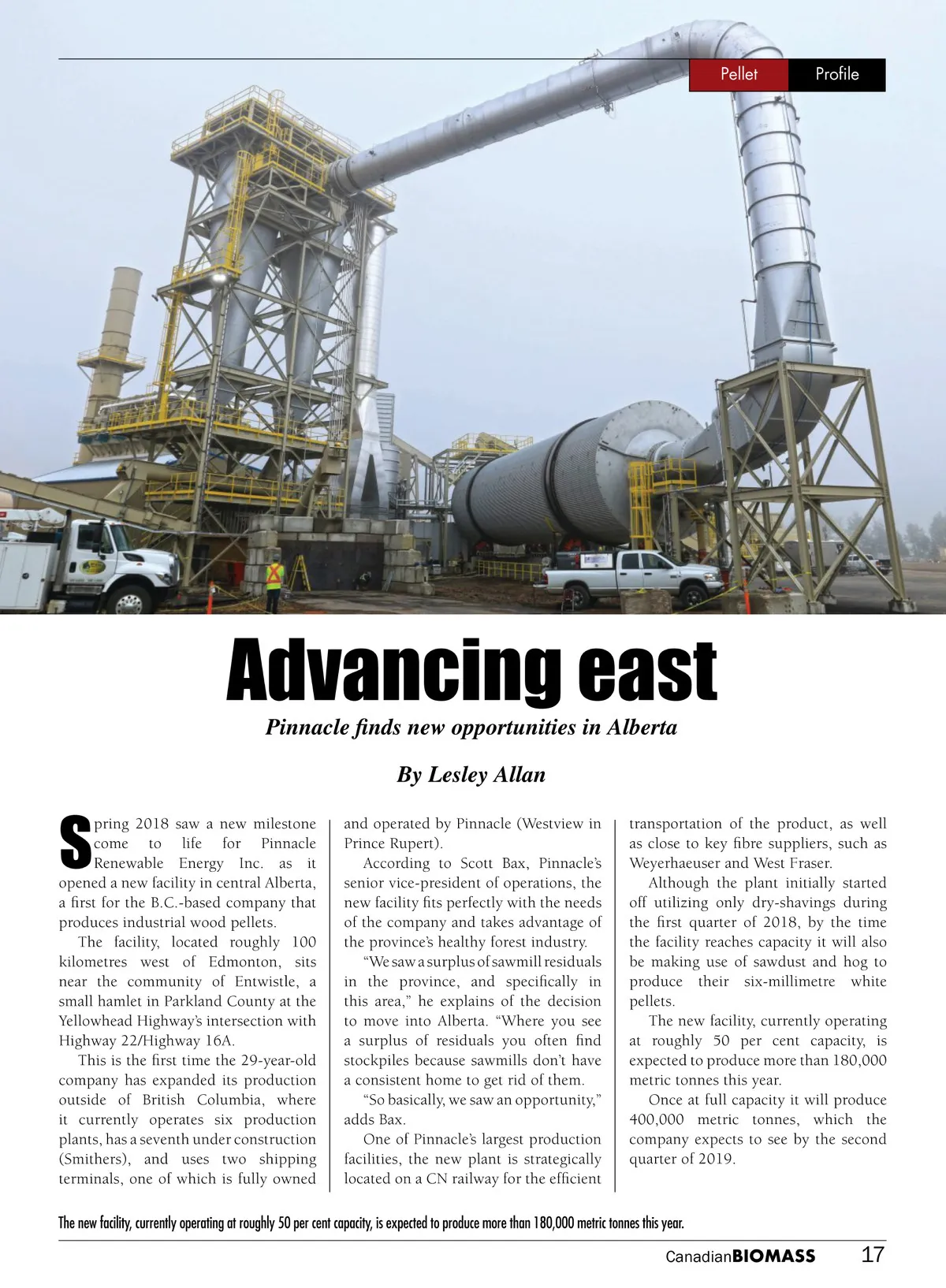
Pellet Profile Advancing east Pinnacle finds new opportunities in Alberta By Lesley Allan S pring 2018 saw a new milestone come to life for Pinnacle Renewable Energy Inc. as it opened a new facility in central Alberta, a first for the B.C.-based company that produces industrial wood pellets. The facility, located roughly 100 kilometres west of Edmonton, sits near the community of Entwistle, a small hamlet in Parkland County at the Yellowhead Highway’s intersection with Highway 22/Highway 16A. This is the first time the 29-year-old company has expanded its production outside of British Columbia, where it currently operates six production plants, has a seventh under construction (Smithers), and uses two shipping terminals, one of which is fully owned and operated by Pinnacle (Westview in Prince Rupert). According to Scott Bax, Pinnacle’s senior vice-president of operations, the new facility fits perfectly with the needs of the company and takes advantage of the province’s healthy forest industry. “We saw a surplus of sawmill residuals in the province, and specifically in this area,” he explains of the decision to move into Alberta. “Where you see a surplus of residuals you often find stockpiles because sawmills don’t have a consistent home to get rid of them. “So basically, we saw an opportunity,” adds Bax. One of Pinnacle’s largest production facilities, the new plant is strategically located on a CN railway for the efficient transportation of the product, as well as close to key fibre suppliers, such as Weyerhaeuser and West Fraser. Although the plant initially started off utilizing only dry-shavings during the first quarter of 2018, by the time the facility reaches capacity it will also be making use of sawdust and hog to produce their six-millimetre white pellets. The new facility, currently operating at roughly 50 per cent capacity, is expected to produce more than 180,000 metric tonnes this year. Once at full capacity it will produce 400,000 metric tonnes, which the company expects to see by the second quarter of 2019. The new facility, currently operating at roughly 50 per cent capacity, is expected to produce more than 180,000 metric tonnes this year. Canadian BIOMASS 17
Canadian Biomass September-October 2018: Page 17