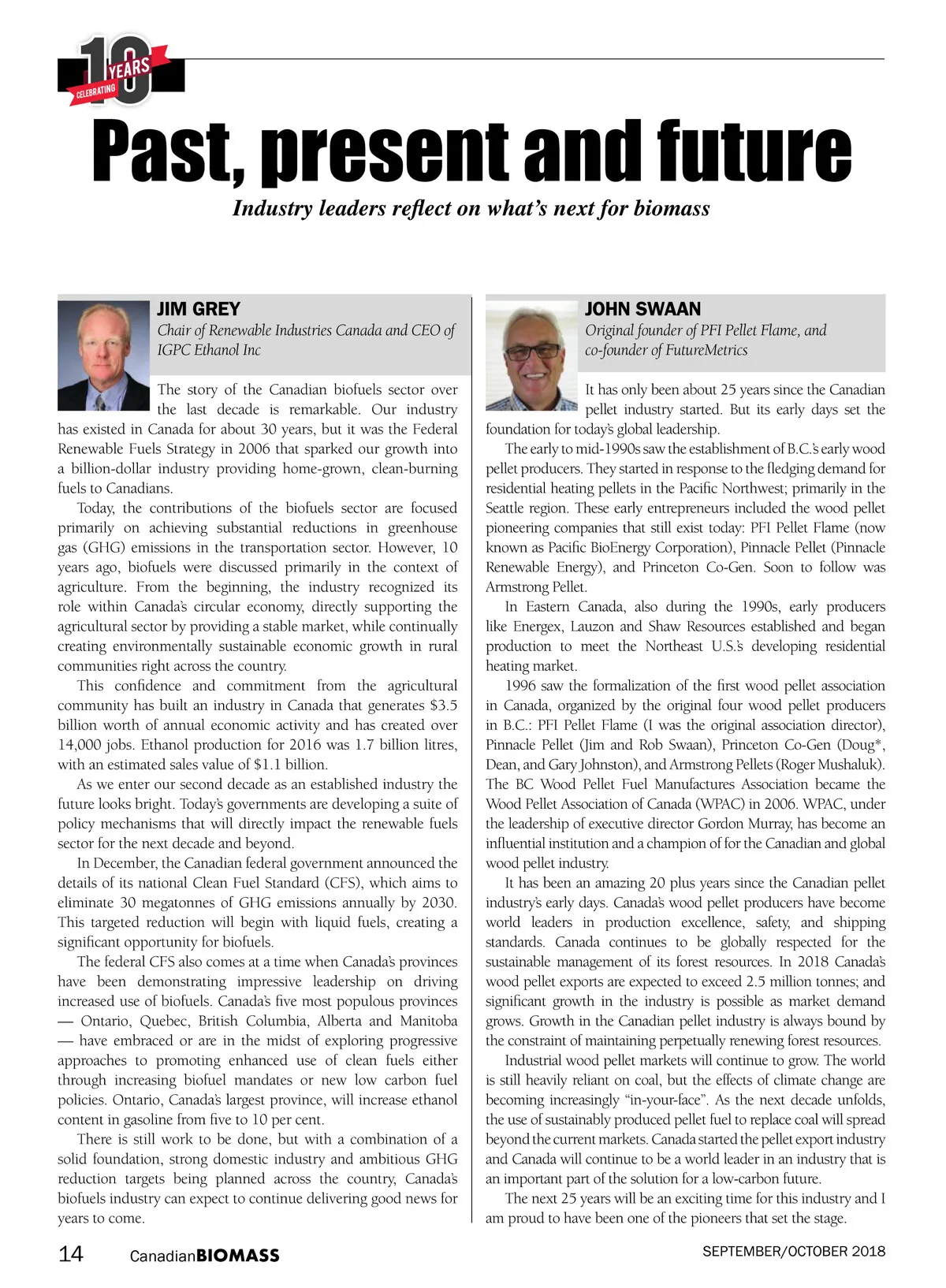
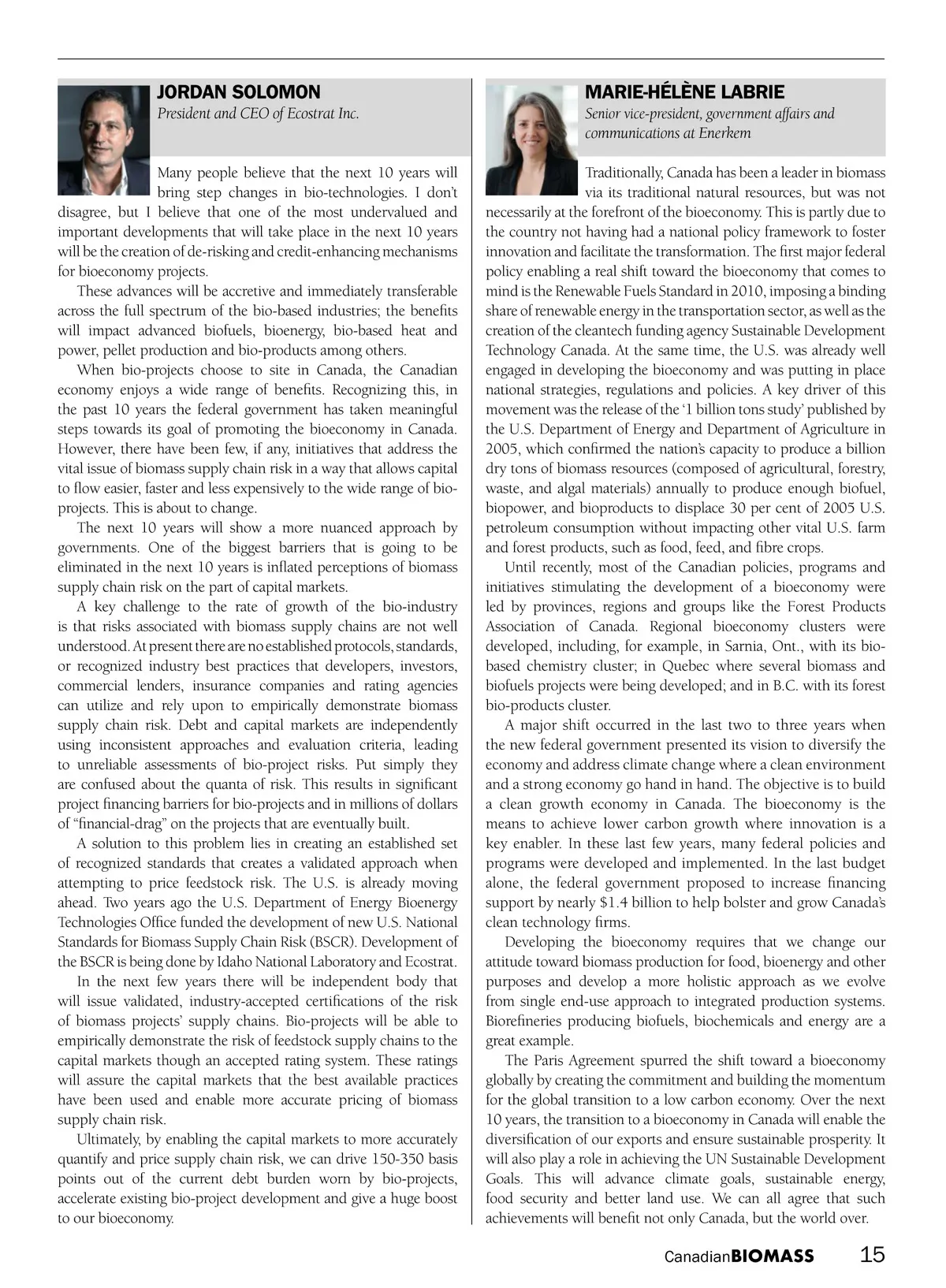
JORDAN SOLOMON President and CEO of Ecostrat Inc. MARIE-HÉLÈNE LABRIE Senior vice-president, government affairs and communications at Enerkem Many people believe that the next 10 years will bring step changes in bio-technologies. I don’t disagree, but I believe that one of the most undervalued and important developments that will take place in the next 10 years will be the creation of de-risking and credit-enhancing mechanisms for bioeconomy projects. These advances will be accretive and immediately transferable across the full spectrum of the bio-based industries; the benefits will impact advanced biofuels, bioenergy, bio-based heat and power, pellet production and bio-products among others. When bio-projects choose to site in Canada, the Canadian economy enjoys a wide range of benefits. Recognizing this, in the past 10 years the federal government has taken meaningful steps towards its goal of promoting the bioeconomy in Canada. However, there have been few, if any, initiatives that address the vital issue of biomass supply chain risk in a way that allows capital to flow easier, faster and less expensively to the wide range of bio-projects. This is about to change. The next 10 years will show a more nuanced approach by governments. One of the biggest barriers that is going to be eliminated in the next 10 years is inflated perceptions of biomass supply chain risk on the part of capital markets. A key challenge to the rate of growth of the bio-industry is that risks associated with biomass supply chains are not well understood. At present there are no established protocols, standards, or recognized industry best practices that developers, investors, commercial lenders, insurance companies and rating agencies can utilize and rely upon to empirically demonstrate biomass supply chain risk. Debt and capital markets are independently using inconsistent approaches and evaluation criteria, leading to unreliable assessments of bio-project risks. Put simply they are confused about the quanta of risk. This results in significant project financing barriers for bio-projects and in millions of dollars of “financial-drag” on the projects that are eventually built. A solution to this problem lies in creating an established set of recognized standards that creates a validated approach when attempting to price feedstock risk. The U.S. is already moving ahead. Two years ago the U.S. Department of Energy Bioenergy Technologies Office funded the development of new U.S. National Standards for Biomass Supply Chain Risk (BSCR). Development of the BSCR is being done by Idaho National Laboratory and Ecostrat. In the next few years there will be independent body that will issue validated, industry-accepted certifications of the risk of biomass projects’ supply chains. Bio-projects will be able to empirically demonstrate the risk of feedstock supply chains to the capital markets though an accepted rating system. These ratings will assure the capital markets that the best available practices have been used and enable more accurate pricing of biomass supply chain risk. Ultimately, by enabling the capital markets to more accurately quantify and price supply chain risk, we can drive 150-350 basis points out of the current debt burden worn by bio-projects, accelerate existing bio-project development and give a huge boost to our bioeconomy. Traditionally, Canada has been a leader in biomass via its traditional natural resources, but was not necessarily at the forefront of the bioeconomy. This is partly due to the country not having had a national policy framework to foster innovation and facilitate the transformation. The first major federal policy enabling a real shift toward the bioeconomy that comes to mind is the Renewable Fuels Standard in 2010, imposing a binding share of renewable energy in the transportation sector, as well as the creation of the cleantech funding agency Sustainable Development Technology Canada. At the same time, the U.S. was already well engaged in developing the bioeconomy and was putting in place national strategies, regulations and policies. A key driver of this movement was the release of the ‘1 billion tons study’ published by the U.S. Department of Energy and Department of Agriculture in 2005, which confirmed the nation’s capacity to produce a billion dry tons of biomass resources (composed of agricultural, forestry, waste, and algal materials) annually to produce enough biofuel, biopower, and bioproducts to displace 30 per cent of 2005 U.S. petroleum consumption without impacting other vital U.S. farm and forest products, such as food, feed, and fibre crops. Until recently, most of the Canadian policies, programs and initiatives stimulating the development of a bioeconomy were led by provinces, regions and groups like the Forest Products Association of Canada. Regional bioeconomy clusters were developed, including, for example, in Sarnia, Ont., with its bio-based chemistry cluster; in Quebec where several biomass and biofuels projects were being developed; and in B.C. with its forest bio-products cluster. A major shift occurred in the last two to three years when the new federal government presented its vision to diversify the economy and address climate change where a clean environment and a strong economy go hand in hand. The objective is to build a clean growth economy in Canada. The bioeconomy is the means to achieve lower carbon growth where innovation is a key enabler. In these last few years, many federal policies and programs were developed and implemented. In the last budget alone, the federal government proposed to increase financing support by nearly $1.4 billion to help bolster and grow Canada’s clean technology firms. Developing the bioeconomy requires that we change our attitude toward biomass production for food, bioenergy and other purposes and develop a more holistic approach as we evolve from single end-use approach to integrated production systems. Biorefineries producing biofuels, biochemicals and energy are a great example. The Paris Agreement spurred the shift toward a bioeconomy globally by creating the commitment and building the momentum for the global transition to a low carbon economy. Over the next 10 years, the transition to a bioeconomy in Canada will enable the diversification of our exports and ensure sustainable prosperity. It will also play a role in achieving the UN Sustainable Development Goals. This will advance climate goals, sustainable energy, food security and better land use. We can all agree that such achievements will benefit not only Canada, but the world over. Canadian BIOMASS 15
Canadian Biomass September-October 2018: Page 15