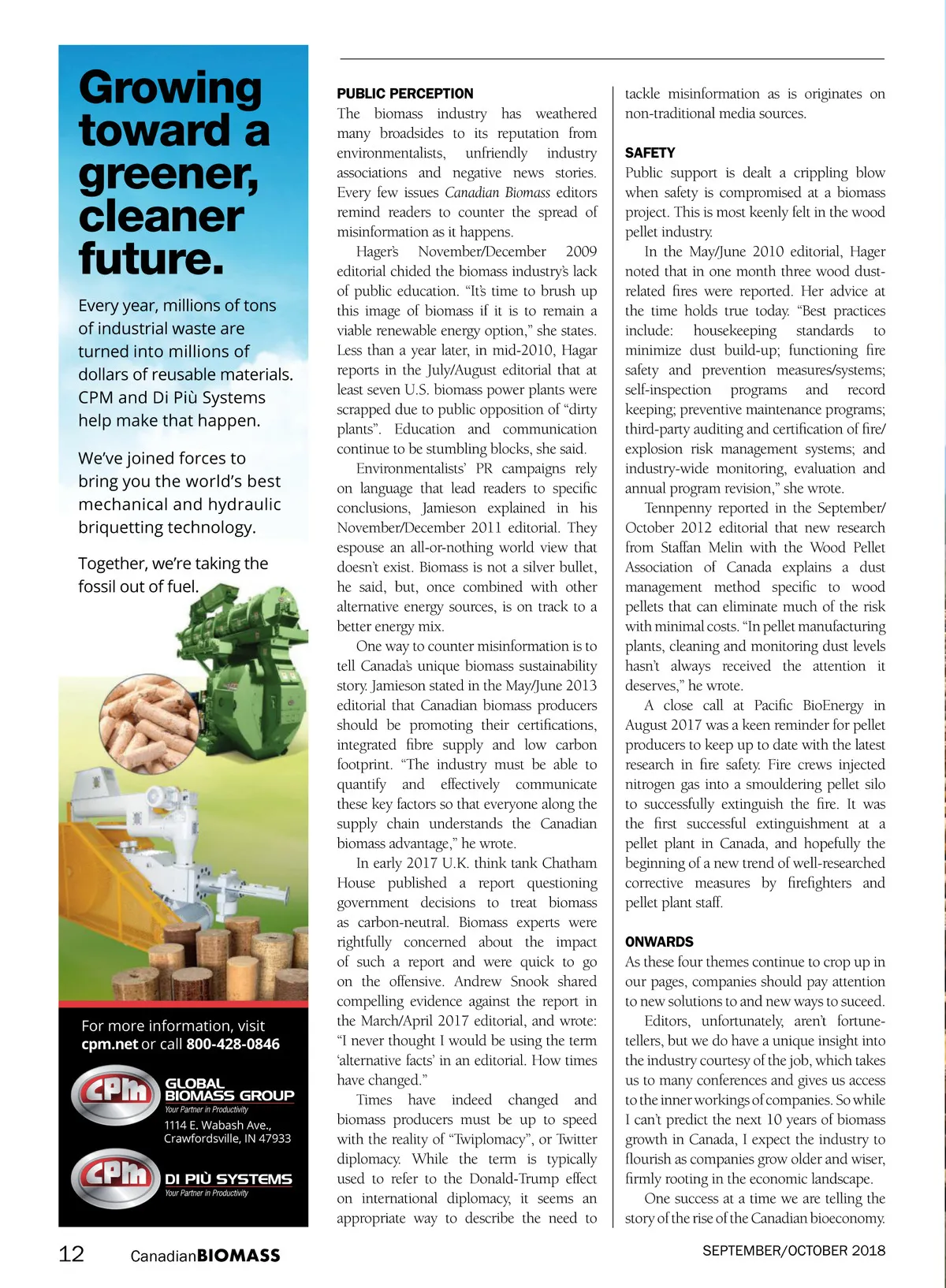
Growing toward a greener, cleaner future. Every year, millions of tons of industrial waste are turned into millions of dollars of reusable materials. CPM and Di Più Systems help make that happen. We’ve joined forces to bring you the world’s best mechanical and hydraulic briquetting technology. Together, we’re taking the fossil out of fuel. PUBLIC PERCEPTION For more information, visit cpm.net or call 800-428-0846 1114 E. Wabash Ave., Crawfordsville, IN 47933 The biomass industry has weathered many broadsides to its reputation from environmentalists, unfriendly industry associations and negative news stories. Every few issues Canadian Biomass editors remind readers to counter the spread of misinformation as it happens. Hager’s November/December 2009 editorial chided the biomass industry’s lack of public education. “It’s time to brush up this image of biomass if it is to remain a viable renewable energy option,” she states. Less than a year later, in mid-2010, Hagar reports in the July/August editorial that at least seven U.S. biomass power plants were scrapped due to public opposition of “dirty plants”. Education and communication continue to be stumbling blocks, she said. Environmentalists’ PR campaigns rely on language that lead readers to specific conclusions, Jamieson explained in his November/December 2011 editorial. They espouse an all-or-nothing world view that doesn’t exist. Biomass is not a silver bullet, he said, but, once combined with other alternative energy sources, is on track to a better energy mix. One way to counter misinformation is to tell Canada’s unique biomass sustainability story. Jamieson stated in the May/June 2013 editorial that Canadian biomass producers should be promoting their certifications, integrated fibre supply and low carbon footprint. “The industry must be able to quantify and effectively communicate these key factors so that everyone along the supply chain understands the Canadian biomass advantage,” he wrote. In early 2017 U.K. think tank Chatham House published a report questioning government decisions to treat biomass as carbon-neutral. Biomass experts were rightfully concerned about the impact of such a report and were quick to go on the offensive. Andrew Snook shared compelling evidence against the report in the March/April 2017 editorial, and wrote: “I never thought I would be using the term ‘alternative facts’ in an editorial. How times have changed.” Times have indeed changed and biomass producers must be up to speed with the reality of “Twiplomacy”, or Twitter diplomacy. While the term is typically used to refer to the Donald-Trump effect on international diplomacy, it seems an appropriate way to describe the need to tackle misinformation as is originates on non-traditional media sources. SAFETY Public support is dealt a crippling blow when safety is compromised at a biomass project. This is most keenly felt in the wood pellet industry. In the May/June 2010 editorial, Hager noted that in one month three wood dust-related fires were reported. Her advice at the time holds true today. “Best practices include: housekeeping standards to minimize dust build-up; functioning fire safety and prevention measures/systems; self-inspection programs and record keeping; preventive maintenance programs; third-party auditing and certification of fire/ explosion risk management systems; and industry-wide monitoring, evaluation and annual program revision,” she wrote. Tennpenny reported in the September/ October 2012 editorial that new research from Staffan Melin with the Wood Pellet Association of Canada explains a dust management method specific to wood pellets that can eliminate much of the risk with minimal costs. “In pellet manufacturing plants, cleaning and monitoring dust levels hasn’t always received the attention it deserves,” he wrote. A close call at Pacific BioEnergy in August 2017 was a keen reminder for pellet producers to keep up to date with the latest research in fire safety. Fire crews injected nitrogen gas into a smouldering pellet silo to successfully extinguish the fire. It was the first successful extinguishment at a pellet plant in Canada, and hopefully the beginning of a new trend of well-researched corrective measures by firefighters and pellet plant staff. ONWARDS As these four themes continue to crop up in our pages, companies should pay attention to new solutions to and new ways to suceed. Editors, unfortunately, aren’t fortune-tellers, but we do have a unique insight into the industry courtesy of the job, which takes us to many conferences and gives us access to the inner workings of companies. So while I can’t predict the next 10 years of biomass growth in Canada, I expect the industry to flourish as companies grow older and wiser, firmly rooting in the economic landscape. One success at a time we are telling the story of the rise of the Canadian bioeconomy. SEPTEMBER/OCTOBER 2018 Client: Global Biomass Group 12 BIOMASS Publication: Canadian Canadian Biomass CBM_CPMGlobal_SeptOct18_CSA.indd 1 Order: 1012 Line: 6 2018-09-07 2:03 PM
Canadian Biomass September-October 2018: Page 12