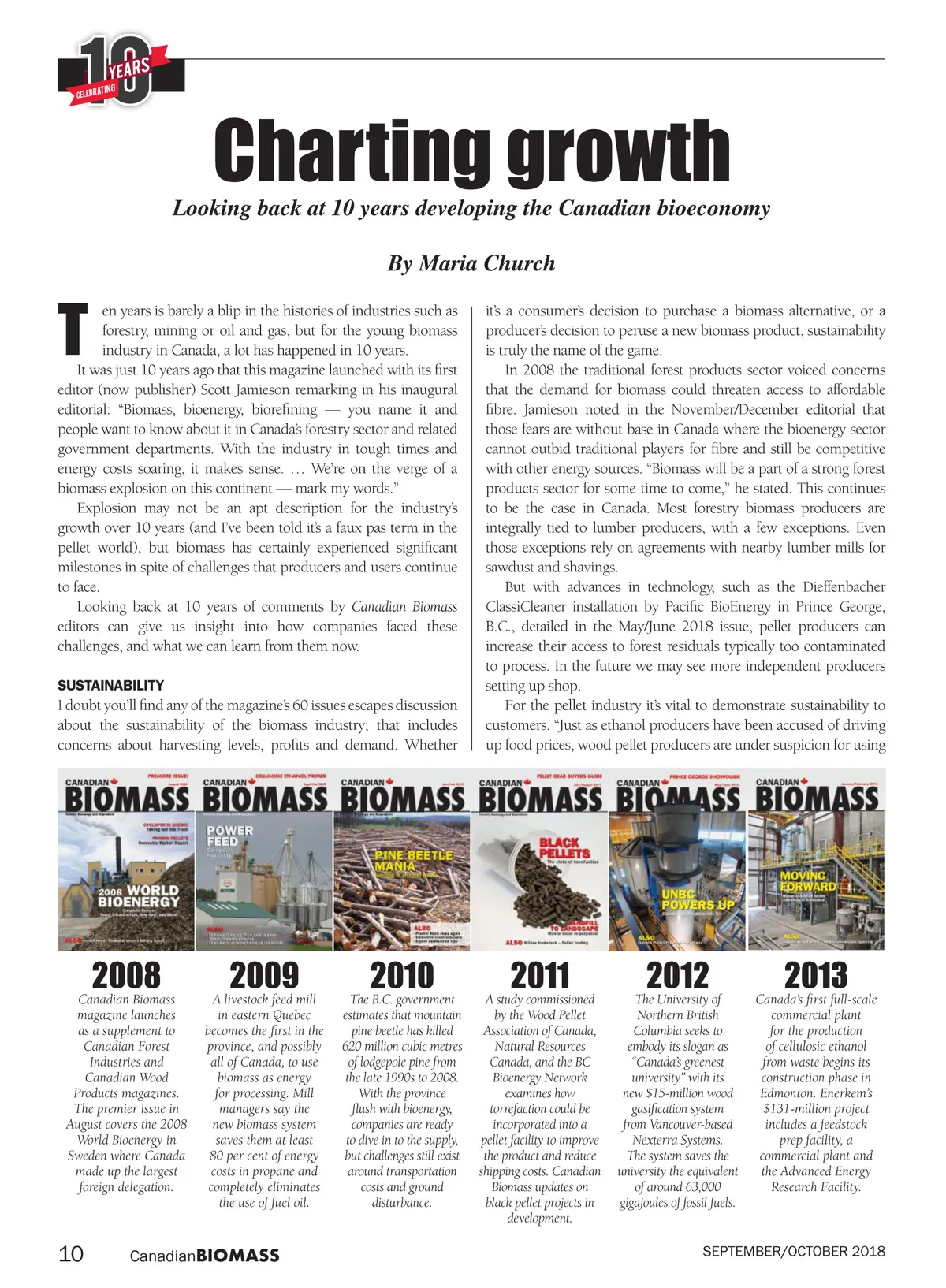
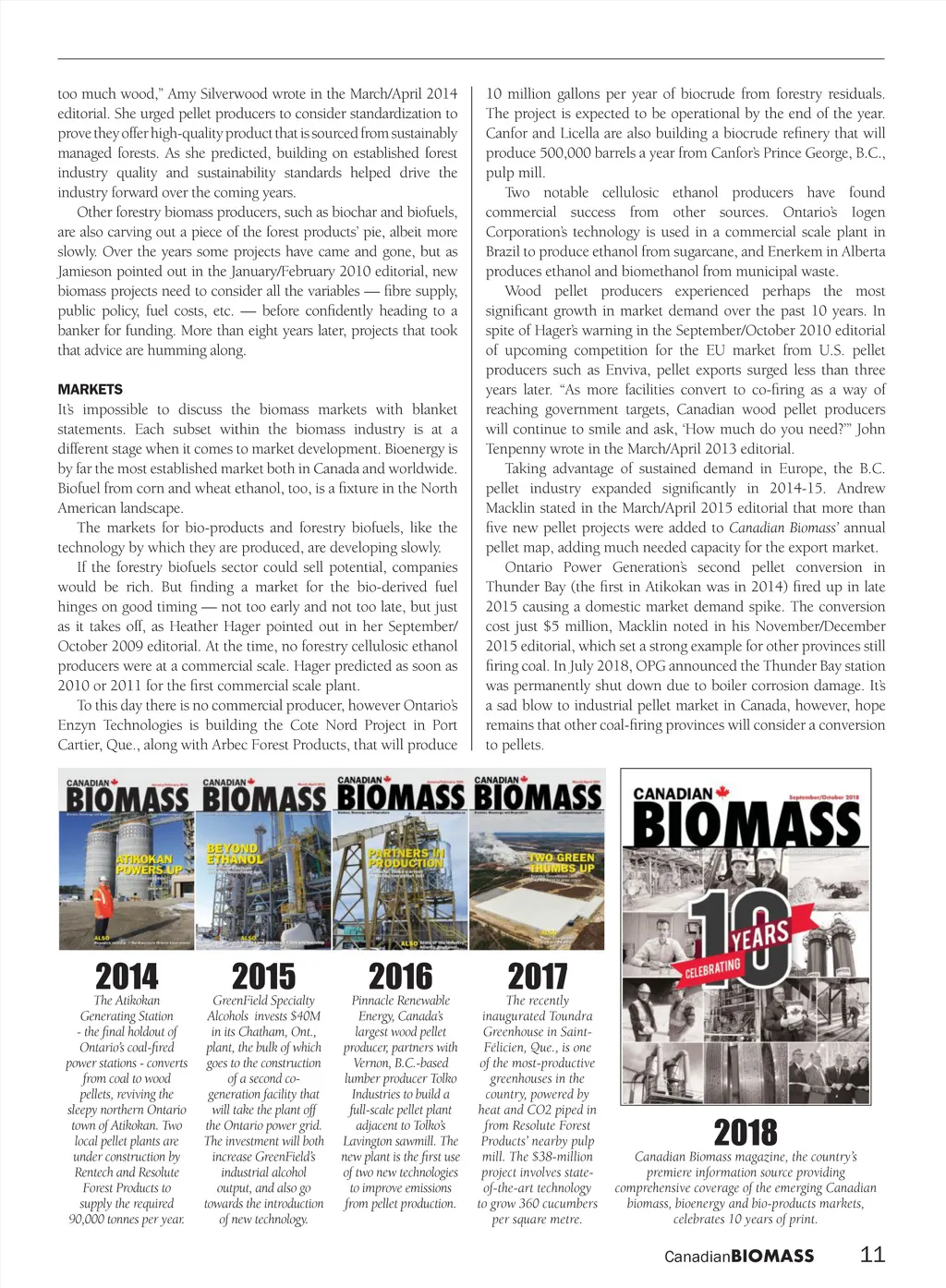
too much wood,” Amy Silverwood wrote in the March/April 2014 editorial. She urged pellet producers to consider standardization to prove they offer high-quality product that is sourced from sustainably managed forests. As she predicted, building on established forest industry quality and sustainability standards helped drive the industry forward over the coming years. Other forestry biomass producers, such as biochar and biofuels, are also carving out a piece of the forest products’ pie, albeit more slowly. Over the years some projects have came and gone, but as Jamieson pointed out in the January/February 2010 editorial, new biomass projects need to consider all the variables — fibre supply, public policy, fuel costs, etc. — before confidently heading to a banker for funding. More than eight years later, projects that took that advice are humming along. MARKETS It’s impossible to discuss the biomass markets with blanket statements. Each subset within the biomass industry is at a different stage when it comes to market development. Bioenergy is by far the most established market both in Canada and worldwide. Biofuel from corn and wheat ethanol, too, is a fixture in the North American landscape. The markets for bio-products and forestry biofuels, like the technology by which they are produced, are developing slowly. If the forestry biofuels sector could sell potential, companies would be rich. But finding a market for the bio-derived fuel hinges on good timing — not too early and not too late, but just as it takes off, as Heather Hager pointed out in her September/ October 2009 editorial. At the time, no forestry cellulosic ethanol producers were at a commercial scale. Hager predicted as soon as 2010 or 2011 for the first commercial scale plant. To this day there is no commercial producer, however Ontario’s Enzyn Technologies is building the Cote Nord Project in Port Cartier, Que., along with Arbec Forest Products, that will produce 10 million gallons per year of biocrude from forestry residuals. The project is expected to be operational by the end of the year. Canfor and Licella are also building a biocrude refinery that will produce 500,000 barrels a year from Canfor’s Prince George, B.C., pulp mill. Two notable cellulosic ethanol producers have found commercial success from other sources. Ontario’s Iogen Corporation’s technology is used in a commercial scale plant in Brazil to produce ethanol from sugarcane, and Enerkem in Alberta produces ethanol and biomethanol from municipal waste. Wood pellet producers experienced perhaps the most significant growth in market demand over the past 10 years. In spite of Hager’s warning in the September/October 2010 editorial of upcoming competition for the EU market from U.S. pellet producers such as Enviva, pellet exports surged less than three years later. “As more facilities convert to co-firing as a way of reaching government targets, Canadian wood pellet producers will continue to smile and ask, ‘How much do you need?’” John Tenpenny wrote in the March/April 2013 editorial. Taking advantage of sustained demand in Europe, the B.C. pellet industry expanded significantly in 2014-15. Andrew Macklin stated in the March/April 2015 editorial that more than five new pellet projects were added to Canadian Biomass’ annual pellet map, adding much needed capacity for the export market. Ontario Power Generation’s second pellet conversion in Thunder Bay (the first in Atikokan was in 2014) fired up in late 2015 causing a domestic market demand spike. The conversion cost just $5 million, Macklin noted in his November/December 2015 editorial, which set a strong example for other provinces still firing coal. In July 2018, OPG announced the Thunder Bay station was permanently shut down due to boiler corrosion damage. It’s a sad blow to industrial pellet market in Canada, however, hope remains that other coal-firing provinces will consider a conversion to pellets. The Atikokan Generating Station -the final holdout of Ontario’s coal-fired power stations -converts from coal to wood pellets, reviving the sleepy northern Ontario town of Atikokan. Two local pellet plants are under construction by Rentech and Resolute Forest Products to supply the required 90,000 tonnes per year. 2014 GreenField Specialty Alcohols invests $40M in its Chatham, Ont., plant, the bulk of which goes to the construction of a second co-generation facility that will take the plant off the Ontario power grid. The investment will both increase GreenField’s industrial alcohol output, and also go towards the introduction of new technology. 2015 Pinnacle Renewable Energy, Canada’s largest wood pellet producer, partners with Vernon, B.C.-based lumber producer Tolko Industries to build a full-scale pellet plant adjacent to Tolko’s Lavington sawmill. The new plant is the first use of two new technologies to improve emissions from pellet production. 2016 The recently inaugurated Toundra Greenhouse in Saint-Félicien, Que., is one of the most-productive greenhouses in the country, powered by heat and CO2 piped in from Resolute Forest Products’ nearby pulp mill. The $38-million project involves state-of-the-art technology to grow 360 cucumbers per square metre. 2017 Canadian Biomass magazine, the country’s premiere information source providing comprehensive coverage of the emerging Canadian biomass, bioenergy and bio-products markets, celebrates 10 years of print. 2018 Canadian BIOMASS 11
Canadian Biomass September-October 2018: Page 11