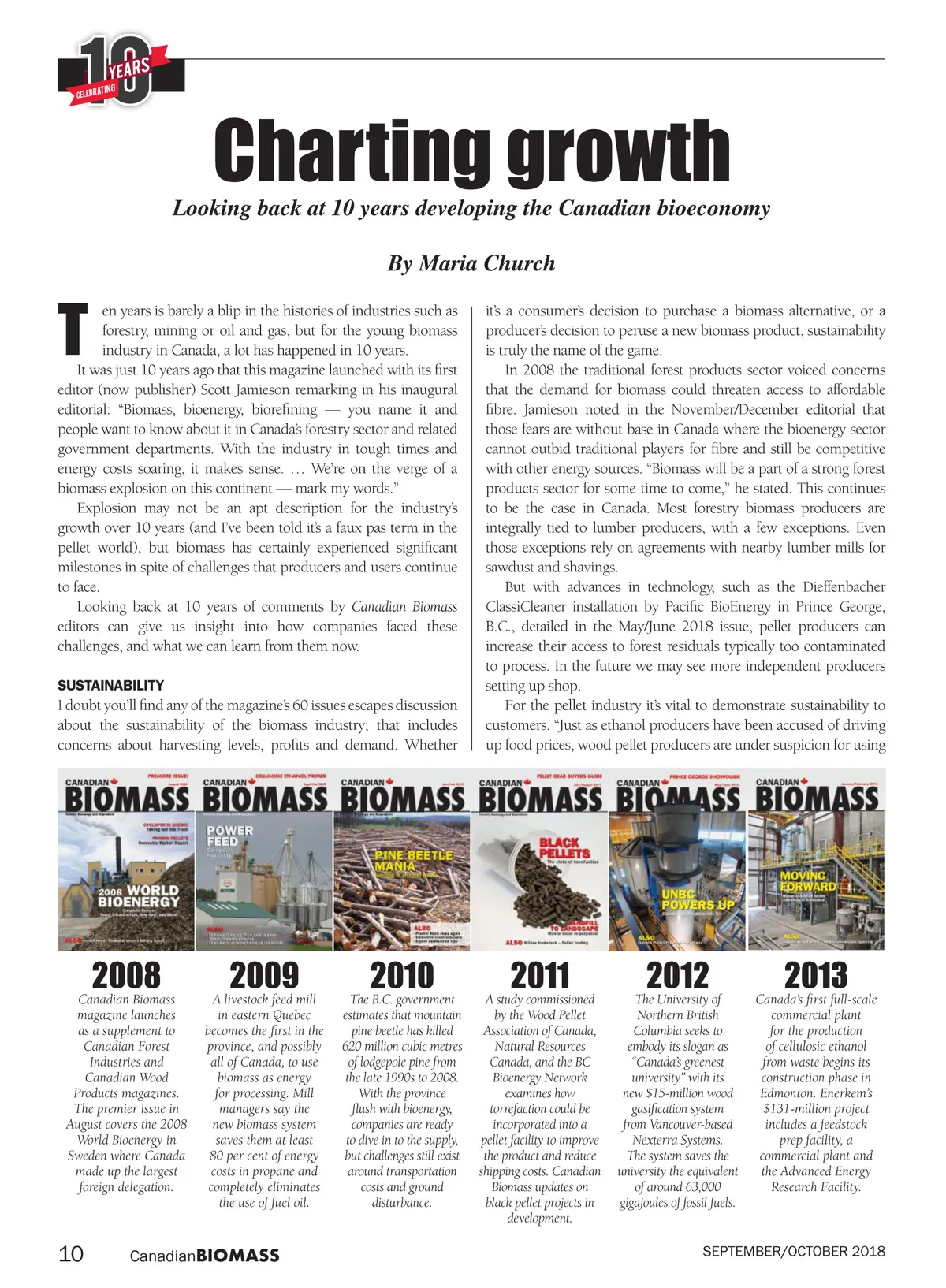
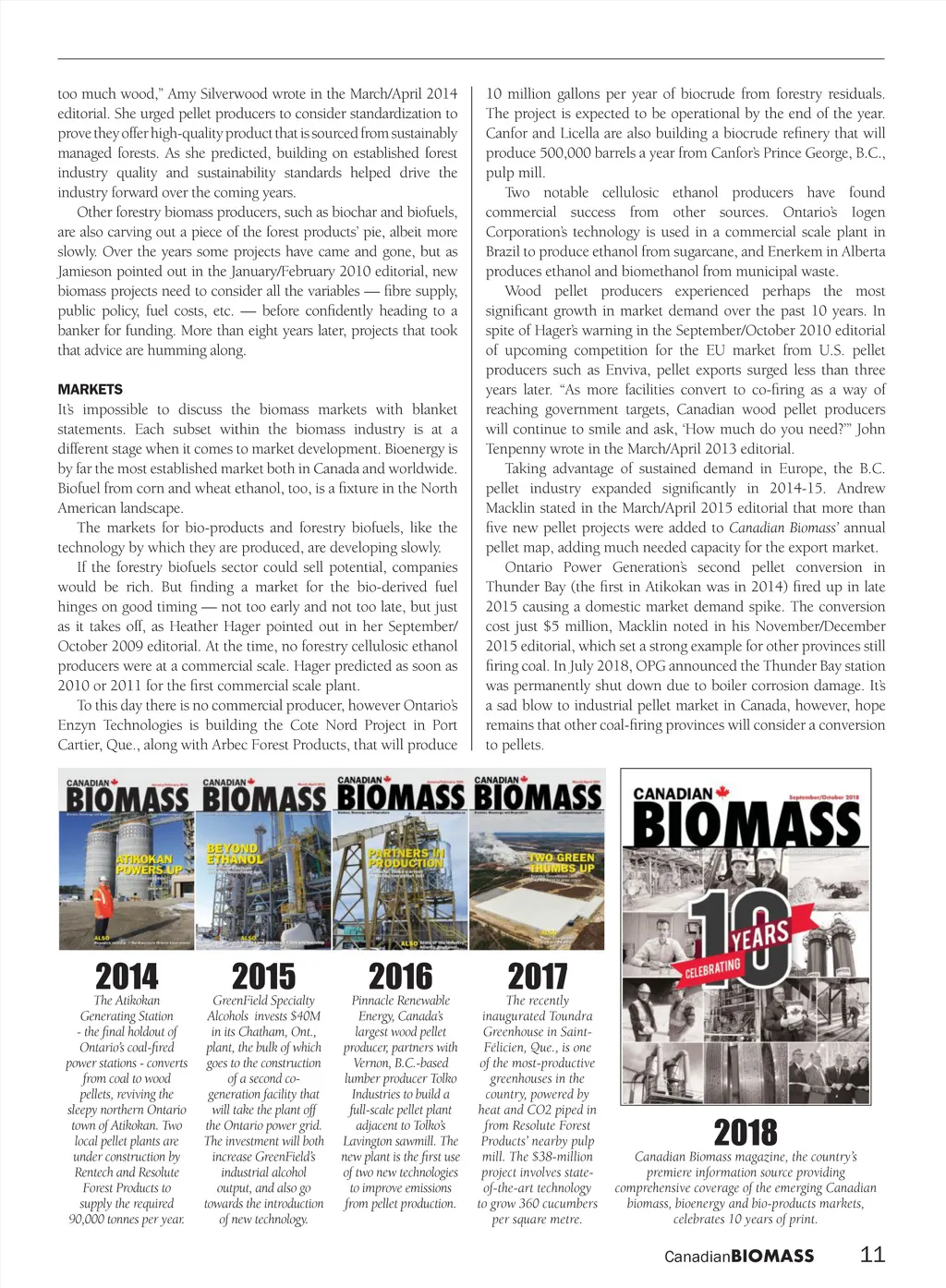
Charting growth Looking back at 10 years developing the Canadian bioeconomy By Maria Church en years is barely a blip in the histories of industries such as forestry, mining or oil and gas, but for the young biomass industry in Canada, a lot has happened in 10 years. It was just 10 years ago that this magazine launched with its first editor (now publisher) Scott Jamieson remarking in his inaugural editorial: “Biomass, bioenergy, biorefining — you name it and people want to know about it in Canada’s forestry sector and related government departments. With the industry in tough times and energy costs soaring, it makes sense. … We’re on the verge of a biomass explosion on this continent — mark my words.” Explosion may not be an apt description for the industry’s growth over 10 years (and I’ve been told it’s a faux pas term in the pellet world), but biomass has certainly experienced significant milestones in spite of challenges that producers and users continue to face. Looking back at 10 years of comments by Canadian Biomass editors can give us insight into how companies faced these challenges, and what we can learn from them now. SUSTAINABILITY T I doubt you’ll find any of the magazine’s 60 issues escapes discussion about the sustainability of the biomass industry; that includes concerns about harvesting levels, profits and demand. Whether it’s a consumer’s decision to purchase a biomass alternative, or a producer’s decision to peruse a new biomass product, sustainability is truly the name of the game. In 2008 the traditional forest products sector voiced concerns that the demand for biomass could threaten access to affordable fibre. Jamieson noted in the November/December editorial that those fears are without base in Canada where the bioenergy sector cannot outbid traditional players for fibre and still be competitive with other energy sources. “Biomass will be a part of a strong forest products sector for some time to come,” he stated. This continues to be the case in Canada. Most forestry biomass producers are integrally tied to lumber producers, with a few exceptions. Even those exceptions rely on agreements with nearby lumber mills for sawdust and shavings. But with advances in technology, such as the Dieffenbacher ClassiCleaner installation by Pacific BioEnergy in Prince George, B.C., detailed in the May/June 2018 issue, pellet producers can increase their access to forest residuals typically too contaminated to process. In the future we may see more independent producers setting up shop. For the pellet industry it’s vital to demonstrate sustainability to customers. “Just as ethanol producers have been accused of driving up food prices, wood pellet producers are under suspicion for using Canadian Biomass magazine launches as a supplement to Canadian Forest Industries and Canadian Wood Products magazines. The premier issue in August covers the 2008 World Bioenergy in Sweden where Canada made up the largest foreign delegation. 2008 A livestock feed mill in eastern Quebec becomes the first in the province, and possibly all of Canada, to use biomass as energy for processing. Mill managers say the new biomass system saves them at least 80 per cent of energy costs in propane and completely eliminates the use of fuel oil. 2009 The B.C. government estimates that mountain pine beetle has killed 620 million cubic metres of lodgepole pine from the late 1990s to 2008. With the province flush with bioenergy, companies are ready to dive in to the supply, but challenges still exist around transportation costs and ground disturbance. 2010 A study commissioned by the Wood Pellet Association of Canada, Natural Resources Canada, and the BC Bioenergy Network examines how torrefaction could be incorporated into a pellet facility to improve the product and reduce shipping costs. Canadian Biomass updates on black pellet projects in development. 2011 The University of Northern British Columbia seeks to embody its slogan as “Canada’s greenest university” with its new $15-million wood gasification system from Vancouver-based Nexterra Systems. The system saves the university the equivalent of around 63,000 gigajoules of fossil fuels. 2012 Canada’s first full-scale commercial plant for the production of cellulosic ethanol from waste begins its construction phase in Edmonton. Enerkem’s $131-million project includes a feedstock prep facility, a commercial plant and the Advanced Energy Research Facility. 2013 10 Canadian BIOMASS SEPTEMBER/OCTOBER 2018
Canadian Biomass September-October 2018: Page 10