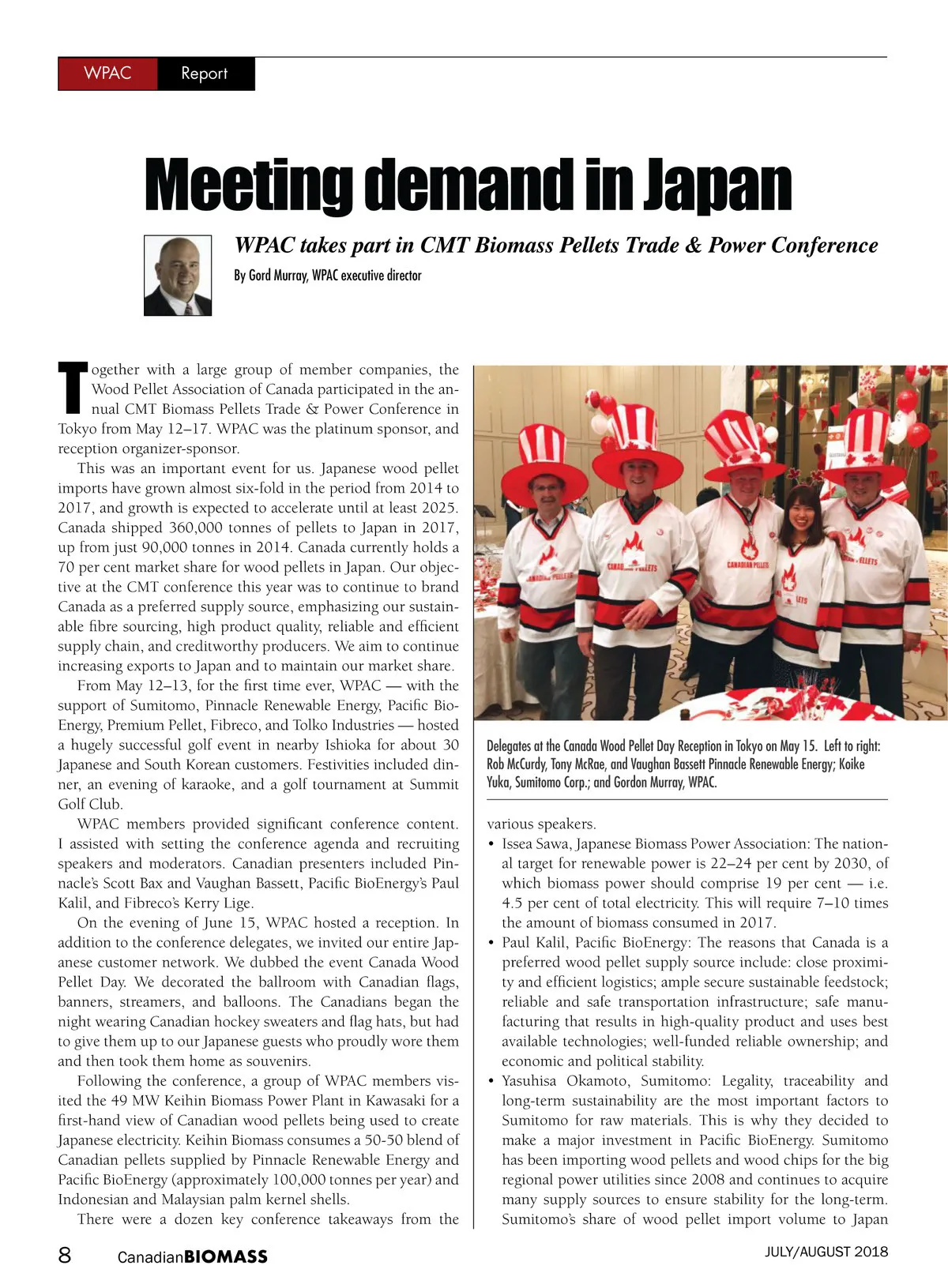
WPAC Report Meeting demand in Japan By Gord Murray, WPAC executive director WPAC takes part in CMT Biomass Pellets Trade & Power Conference ogether with a large group of member companies, the Wood Pellet Association of Canada participated in the an-nual CMT Biomass Pellets Trade & Power Conference in Tokyo from May 12–17. WPAC was the platinum sponsor, and reception organizer-sponsor. This was an important event for us. Japanese wood pellet imports have grown almost six-fold in the period from 2014 to 2017, and growth is expected to accelerate until at least 2025. Canada shipped 360,000 tonnes of pellets to Japan in 2017, up from just 90,000 tonnes in 2014. Canada currently holds a 70 per cent market share for wood pellets in Japan. Our objec-tive at the CMT conference this year was to continue to brand Canada as a preferred supply source, emphasizing our sustain-able fibre sourcing, high product quality, reliable and efficient supply chain, and creditworthy producers. We aim to continue increasing exports to Japan and to maintain our market share. From May 12–13, for the first time ever, WPAC — with the support of Sumitomo, Pinnacle Renewable Energy, Pacific Bio-Energy, Premium Pellet, Fibreco, and Tolko Industries — hosted a hugely successful golf event in nearby Ishioka for about 30 Japanese and South Korean customers. Festivities included din-ner, an evening of karaoke, and a golf tournament at Summit Golf Club. WPAC members provided significant conference content. I assisted with setting the conference agenda and recruiting speakers and moderators. Canadian presenters included Pin-nacle’s Scott Bax and Vaughan Bassett, Pacific BioEnergy’s Paul Kalil, and Fibreco’s Kerry Lige. On the evening of June 15, WPAC hosted a reception. In addition to the conference delegates, we invited our entire Jap-anese customer network. We dubbed the event Canada Wood Pellet Day. We decorated the ballroom with Canadian flags, banners, streamers, and balloons. The Canadians began the night wearing Canadian hockey sweaters and flag hats, but had to give them up to our Japanese guests who proudly wore them and then took them home as souvenirs. Following the conference, a group of WPAC members vis-ited the 49 MW Keihin Biomass Power Plant in Kawasaki for a first-hand view of Canadian wood pellets being used to create Japanese electricity. Keihin Biomass consumes a 50-50 blend of Canadian pellets supplied by Pinnacle Renewable Energy and Pacific BioEnergy (approximately 100,000 tonnes per year) and Indonesian and Malaysian palm kernel shells. There were a dozen key conference takeaways from the T Delegates at the Canada Wood Pellet Day Reception in Tokyo on May 15. Left to right: Rob McCurdy, Tony McRae, and Vaughan Bassett Pinnacle Renewable Energy; Koike Yuka, Sumitomo Corp.; and Gordon Murray, WPAC. various speakers. • Issea Sawa, Japanese Biomass Power Association: The nation-al target for renewable power is 22–24 per cent by 2030, of which biomass power should comprise 19 per cent — i.e. 4.5 per cent of total electricity. This will require 7–10 times the amount of biomass consumed in 2017. • Paul Kalil, Pacific BioEnergy: The reasons that Canada is a preferred wood pellet supply source include: close proximi-ty and efficient logistics; ample secure sustainable feedstock; reliable and safe transportation infrastructure; safe manu-facturing that results in high-quality product and uses best available technologies; well-funded reliable ownership; and economic and political stability. • Yasuhisa Okamoto, Sumitomo: Legality, traceability and long-term sustainability are the most important factors to Sumitomo for raw materials. This is why they decided to make a major investment in Pacific BioEnergy. Sumitomo has been importing wood pellets and wood chips for the big regional power utilities since 2008 and continues to acquire many supply sources to ensure stability for the long-term. Sumitomo’s share of wood pellet import volume to Japan JULY/AUGUST 2018 8 Canadian BIOMASS
Canadian Biomass JulyAugust 2018: Page 8