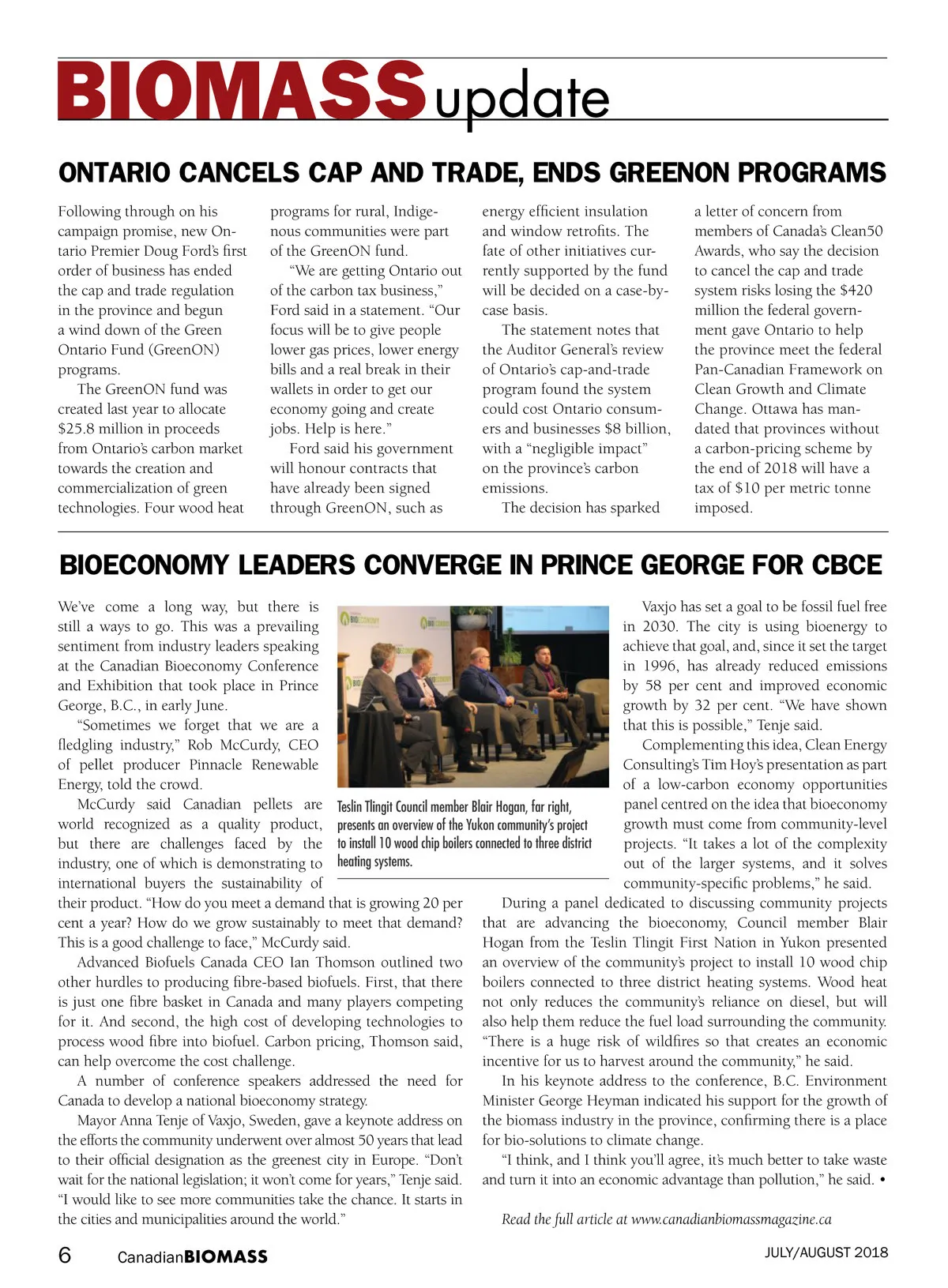
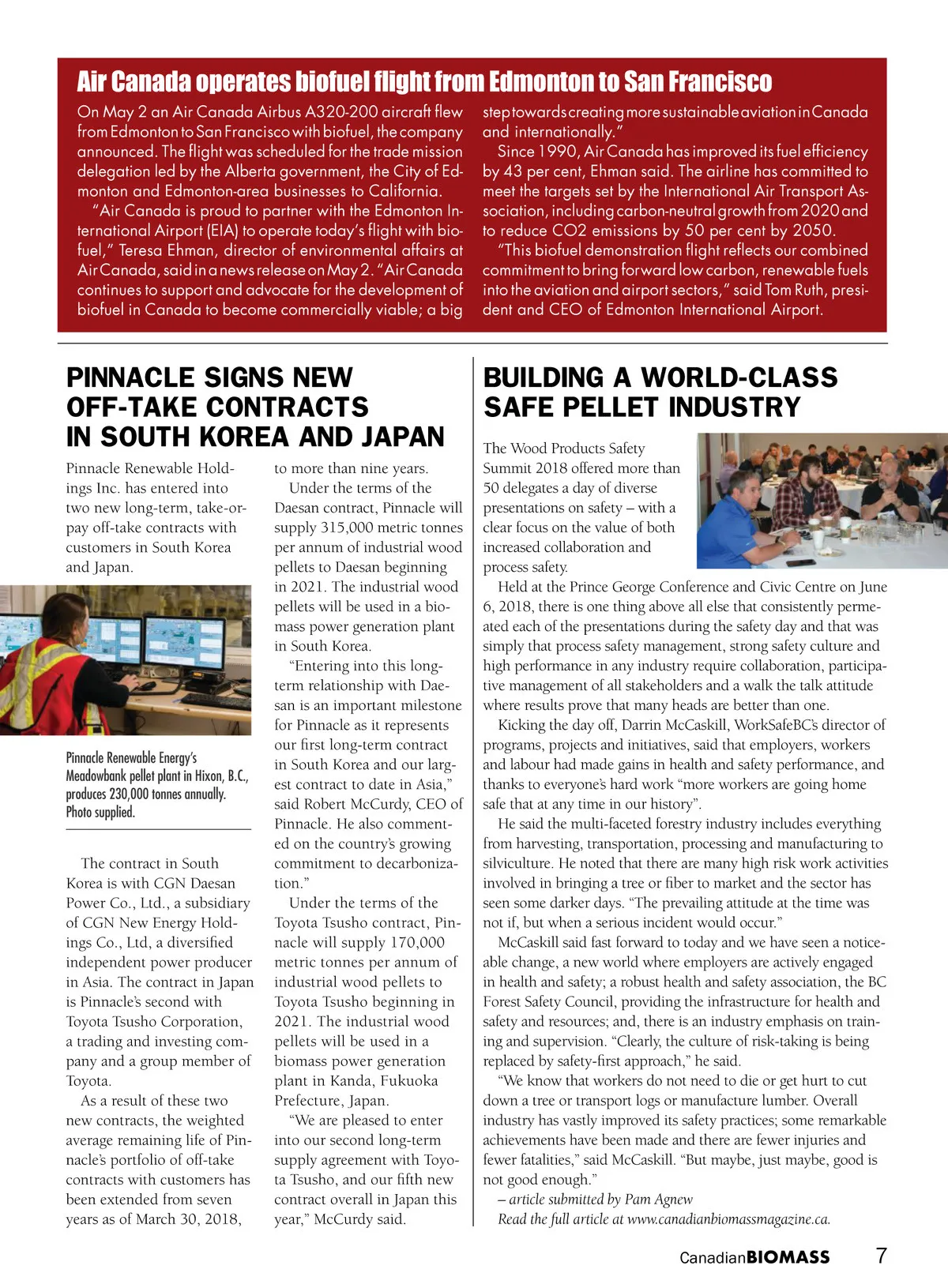
Air Canada operates biofuel flight from Edmonton to San Francisco On May 2 an Air Canada Airbus A320-200 aircraft flew from Edmonton to San Francisco with biofuel, the company announced. The flight was scheduled for the trade mission delegation led by the Alberta government, the City of Ed-monton and Edmonton-area businesses to California. “Air Canada is proud to partner with the Edmonton In-ternational Airport (EIA) to operate today’s flight with bio-fuel,” Teresa Ehman, director of environmental affairs at Air Canada, said in a news release on May 2. “Air Canada continues to support and advocate for the development of biofuel in Canada to become commercially viable; a big step towards creating more sustainable aviation in Canada and internationally.” Since 1990, Air Canada has improved its fuel efficiency by 43 per cent, Ehman said. The airline has committed to meet the targets set by the International Air Transport As-sociation, including carbon-neutral growth from 2020 and to reduce CO2 emissions by 50 per cent by 2050. “This biofuel demonstration flight reflects our combined commitment to bring forward low carbon, renewable fuels into the aviation and airport sectors,” said Tom Ruth, presi-dent and CEO of Edmonton International Airport. PINNACLE SIGNS NEW OFF-TAKE CONTRACTS IN SOUTH KOREA AND JAPAN Pinnacle Renewable Hold-ings Inc. has entered into two new long-term, take-or-pay off-take contracts with customers in South Korea and Japan. to more than nine years. Under the terms of the Daesan contract, Pinnacle will supply 315,000 metric tonnes per annum of industrial wood pellets to Daesan beginning in 2021. The industrial wood pellets will be used in a bio-mass power generation plant in South Korea. “Entering into this long-term relationship with Dae-san is an important milestone for Pinnacle as it represents our first long-term contract in South Korea and our larg-est contract to date in Asia,” said Robert McCurdy, CEO of Pinnacle. He also comment-ed on the country’s growing commitment to decarboniza-tion.” Under the terms of the Toyota Tsusho contract, Pin-nacle will supply 170,000 metric tonnes per annum of industrial wood pellets to Toyota Tsusho beginning in 2021. The industrial wood pellets will be used in a biomass power generation plant in Kanda, Fukuoka Prefecture, Japan. “We are pleased to enter into our second long-term supply agreement with Toyo-ta Tsusho, and our fifth new contract overall in Japan this year,” McCurdy said. BUILDING A WORLD-CLASS SAFE PELLET INDUSTRY The Wood Products Safety Summit 2018 offered more than 50 delegates a day of diverse presentations on safety – with a clear focus on the value of both increased collaboration and process safety. Held at the Prince George Conference and Civic Centre on June 6, 2018, there is one thing above all else that consistently perme-ated each of the presentations during the safety day and that was simply that process safety management, strong safety culture and high performance in any industry require collaboration, participa-tive management of all stakeholders and a walk the talk attitude where results prove that many heads are better than one. Kicking the day off, Darrin McCaskill, WorkSafeBC’s director of programs, projects and initiatives, said that employers, workers and labour had made gains in health and safety performance, and thanks to everyone’s hard work “more workers are going home safe that at any time in our history”. He said the multi-faceted forestry industry includes everything from harvesting, transportation, processing and manufacturing to silviculture. He noted that there are many high risk work activities involved in bringing a tree or fiber to market and the sector has seen some darker days. “The prevailing attitude at the time was not if, but when a serious incident would occur.” McCaskill said fast forward to today and we have seen a notice-able change, a new world where employers are actively engaged in health and safety; a robust health and safety association, the BC Forest Safety Council, providing the infrastructure for health and safety and resources; and, there is an industry emphasis on train-ing and supervision. “Clearly, the culture of risk-taking is being replaced by safety-first approach,” he said. “We know that workers do not need to die or get hurt to cut down a tree or transport logs or manufacture lumber. Overall industry has vastly improved its safety practices; some remarkable achievements have been made and there are fewer injuries and fewer fatalities,” said McCaskill. “But maybe, just maybe, good is not good enough.” – article submitted by Pam Agnew Read the full article at www.canadianbiomassmagazine.ca. Pinnacle Renewable Energy’s Meadowbank pellet plant in Hixon, B.C., produces 230,000 tonnes annually. Photo supplied. The contract in South Korea is with CGN Daesan Power Co., Ltd., a subsidiary of CGN New Energy Hold-ings Co., Ltd, a diversified independent power producer in Asia. The contract in Japan is Pinnacle’s second with Toyota Tsusho Corporation, a trading and investing com-pany and a group member of Toyota. As a result of these two new contracts, the weighted average remaining life of Pin-nacle’s portfolio of off-take contracts with customers has been extended from seven years as of March 30, 2018, Canadian BIOMASS 7
Canadian Biomass JulyAugust 2018: Page 7