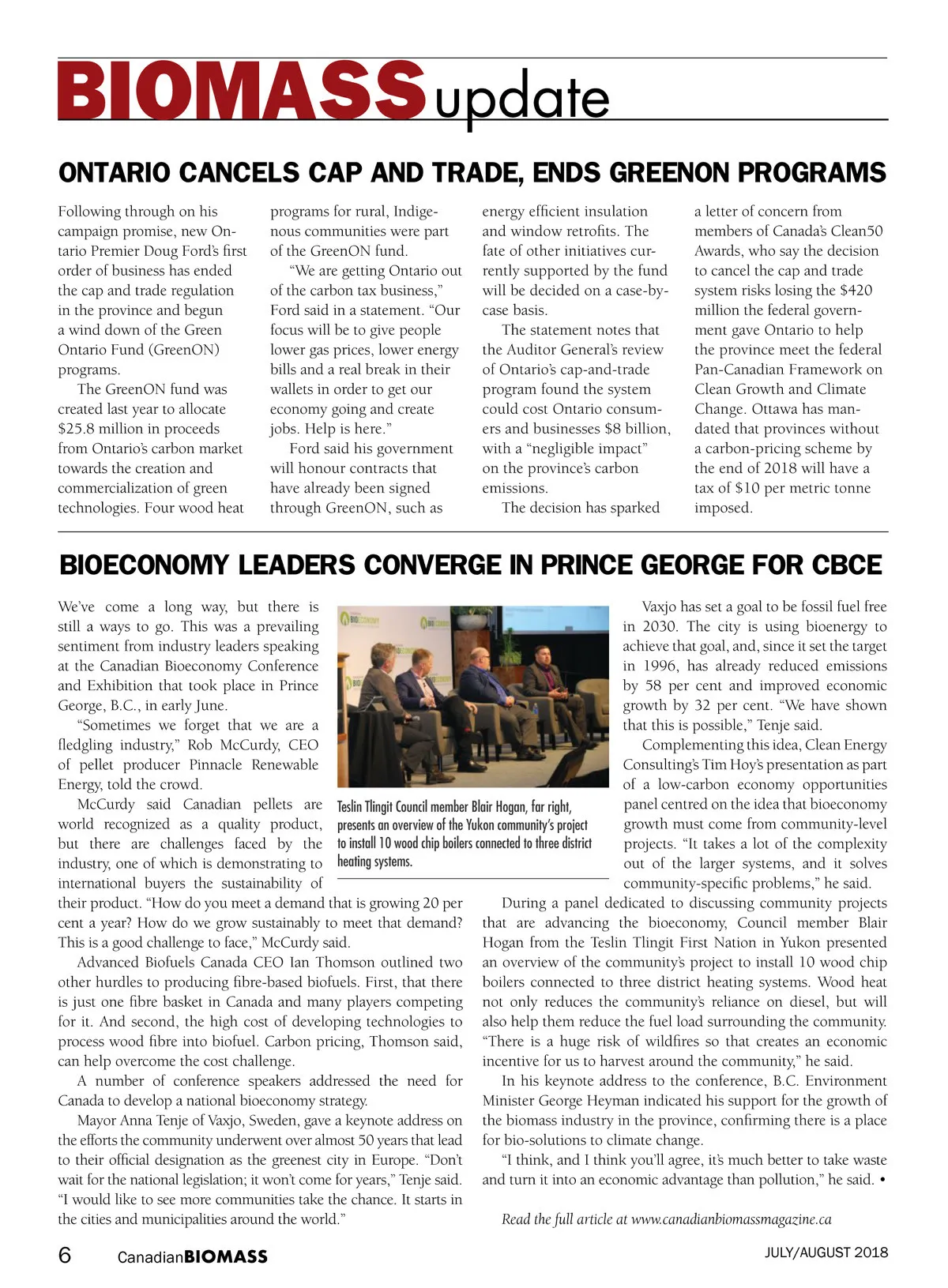
BIOMASS update ONTARIO CANCELS CAP AND TRADE, ENDS GREENON PROGRAMS Following through on his campaign promise, new On-tario Premier Doug Ford’s first order of business has ended the cap and trade regulation in the province and begun a wind down of the Green Ontario Fund (GreenON) programs. The GreenON fund was created last year to allocate $25.8 million in proceeds from Ontario’s carbon market towards the creation and commercialization of green technologies. Four wood heat programs for rural, Indige-nous communities were part of the GreenON fund. “We are getting Ontario out of the carbon tax business,” Ford said in a statement. “Our focus will be to give people lower gas prices, lower energy bills and a real break in their wallets in order to get our economy going and create jobs. Help is here.” Ford said his government will honour contracts that have already been signed through GreenON, such as energy efficient insulation and window retrofits. The fate of other initiatives cur-rently supported by the fund will be decided on a case-by-case basis. The statement notes that the Auditor General’s review of Ontario’s cap-and-trade program found the system could cost Ontario consum-ers and businesses $8 billion, with a “negligible impact” on the province’s carbon emissions. The decision has sparked a letter of concern from members of Canada’s Clean50 Awards, who say the decision to cancel the cap and trade system risks losing the $420 million the federal govern-ment gave Ontario to help the province meet the federal Pan-Canadian Framework on Clean Growth and Climate Change. Ottawa has man-dated that provinces without a carbon-pricing scheme by the end of 2018 will have a tax of $10 per metric tonne imposed. BIOECONOMY LEADERS CONVERGE IN PRINCE GEORGE FOR CBCE Vaxjo has set a goal to be fossil fuel free We’ve come a long way, but there is in 2030. The city is using bioenergy to still a ways to go. This was a prevailing achieve that goal, and, since it set the target sentiment from industry leaders speaking in 1996, has already reduced emissions at the Canadian Bioeconomy Conference by 58 per cent and improved economic and Exhibition that took place in Prince growth by 32 per cent. “We have shown George, B.C., in early June. that this is possible,” Tenje said. “Sometimes we forget that we are a Complementing this idea, Clean Energy fledgling industry,” Rob McCurdy, CEO Consulting’s Tim Hoy’s presentation as part of pellet producer Pinnacle Renewable of a low-carbon economy opportunities Energy, told the crowd. panel centred on the idea that bioeconomy McCurdy said Canadian pellets are Teslin Tlingit Council member Blair Hogan, far right, growth must come from community-level world recognized as a quality product, presents an overview of the Yukon community’s project projects. “It takes a lot of the complexity but there are challenges faced by the to install 10 wood chip boilers connected to three district out of the larger systems, and it solves industry, one of which is demonstrating to heating systems. community-specific problems,” he said. international buyers the sustainability of During a panel dedicated to discussing community projects their product. “How do you meet a demand that is growing 20 per cent a year? How do we grow sustainably to meet that demand? that are advancing the bioeconomy, Council member Blair Hogan from the Teslin Tlingit First Nation in Yukon presented This is a good challenge to face,” McCurdy said. Advanced Biofuels Canada CEO Ian Thomson outlined two an overview of the community’s project to install 10 wood chip other hurdles to producing fibre-based biofuels. First, that there boilers connected to three district heating systems. Wood heat is just one fibre basket in Canada and many players competing not only reduces the community’s reliance on diesel, but will for it. And second, the high cost of developing technologies to also help them reduce the fuel load surrounding the community. process wood fibre into biofuel. Carbon pricing, Thomson said, “There is a huge risk of wildfires so that creates an economic incentive for us to harvest around the community,” he said. can help overcome the cost challenge. In his keynote address to the conference, B.C. Environment A number of conference speakers addressed the need for Minister George Heyman indicated his support for the growth of Canada to develop a national bioeconomy strategy. Mayor Anna Tenje of Vaxjo, Sweden, gave a keynote address on the biomass industry in the province, confirming there is a place the efforts the community underwent over almost 50 years that lead for bio-solutions to climate change. “I think, and I think you’ll agree, it’s much better to take waste to their official designation as the greenest city in Europe. “Don’t wait for the national legislation; it won’t come for years,” Tenje said. and turn it into an economic advantage than pollution,” he said. • “I would like to see more communities take the chance. It starts in Read the full article at www.canadianbiomassmagazine.ca the cities and municipalities around the world.” 6 Canadian BIOMASS JULY/AUGUST 2018
Canadian Biomass JulyAugust 2018: Page 6