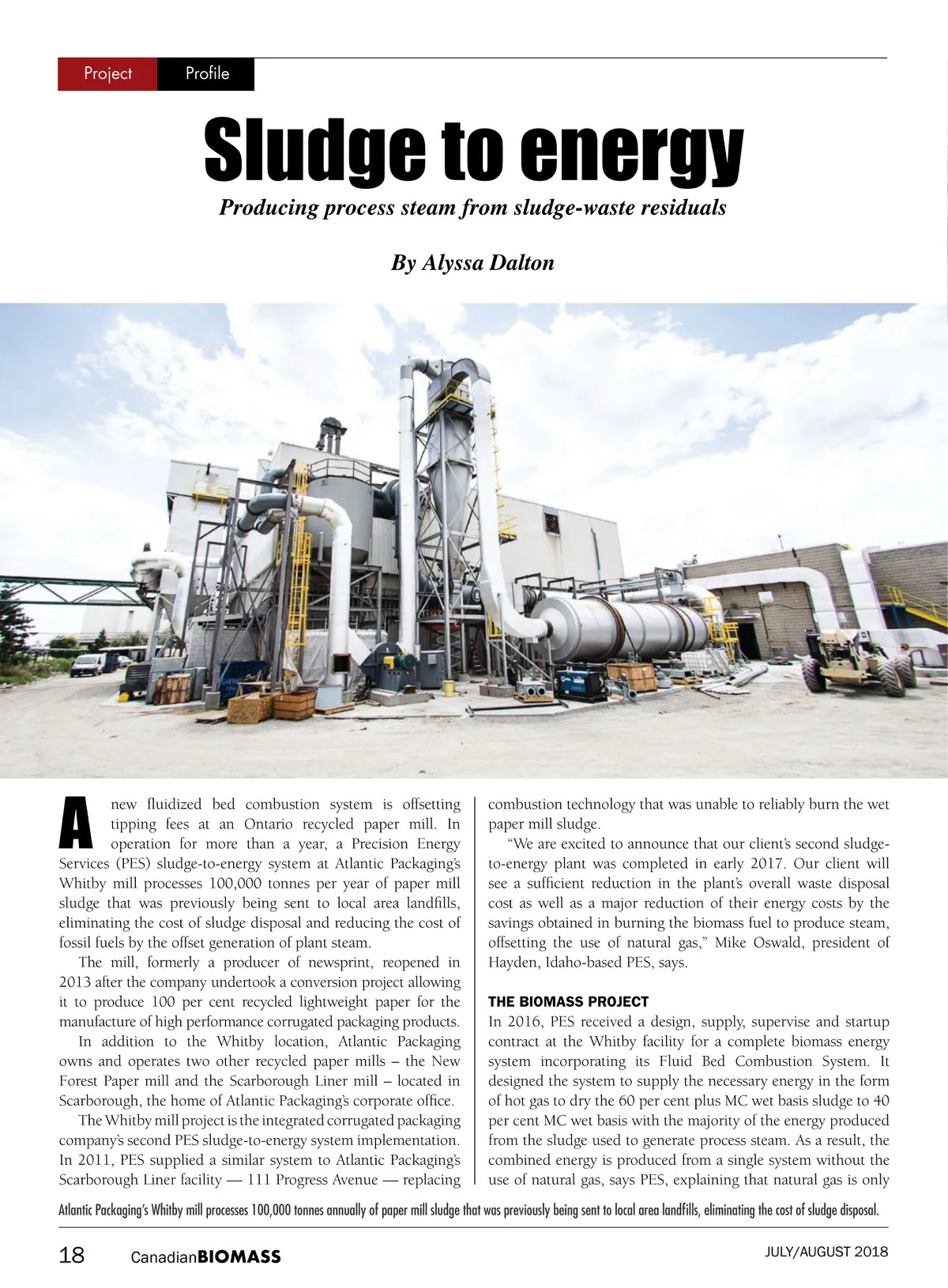
Project Profile Sludge to energy Producing process steam from sludge-waste residuals By Alyssa Dalton A new fluidized bed combustion system is offsetting tipping fees at an Ontario recycled paper mill. In operation for more than a year, a Precision Energy Services (PES) sludge-to-energy system at Atlantic Packaging’s Whitby mill processes 100,000 tonnes per year of paper mill sludge that was previously being sent to local area landfills, eliminating the cost of sludge disposal and reducing the cost of fossil fuels by the offset generation of plant steam. The mill, formerly a producer of newsprint, reopened in 2013 after the company undertook a conversion project allowing it to produce 100 per cent recycled lightweight paper for the manufacture of high performance corrugated packaging products. In addition to the Whitby location, Atlantic Packaging owns and operates two other recycled paper mills – the New Forest Paper mill and the Scarborough Liner mill – located in Scarborough, the home of Atlantic Packaging’s corporate office. The Whitby mill project is the integrated corrugated packaging company’s second PES sludge-to-energy system implementation. In 2011, PES supplied a similar system to Atlantic Packaging’s Scarborough Liner facility — 111 Progress Avenue — replacing combustion technology that was unable to reliably burn the wet paper mill sludge. “We are excited to announce that our client’s second sludge-to-energy plant was completed in early 2017. Our client will see a sufficient reduction in the plant’s overall waste disposal cost as well as a major reduction of their energy costs by the savings obtained in burning the biomass fuel to produce steam, offsetting the use of natural gas,” Mike Oswald, president of Hayden, Idaho-based PES, says. THE BIOMASS PROJECT In 2016, PES received a design, supply, supervise and startup contract at the Whitby facility for a complete biomass energy system incorporating its Fluid Bed Combustion System. It designed the system to supply the necessary energy in the form of hot gas to dry the 60 per cent plus MC wet basis sludge to 40 per cent MC wet basis with the majority of the energy produced from the sludge used to generate process steam. As a result, the combined energy is produced from a single system without the use of natural gas, says PES, explaining that natural gas is only Atlantic Packaging’s Whitby mill processes 100,000 tonnes annually of paper mill sludge that was previously being sent to local area landfills, eliminating the cost of sludge disposal. 18 Canadian BIOMASS JULY/AUGUST 2018
Canadian Biomass JulyAugust 2018: Page 18