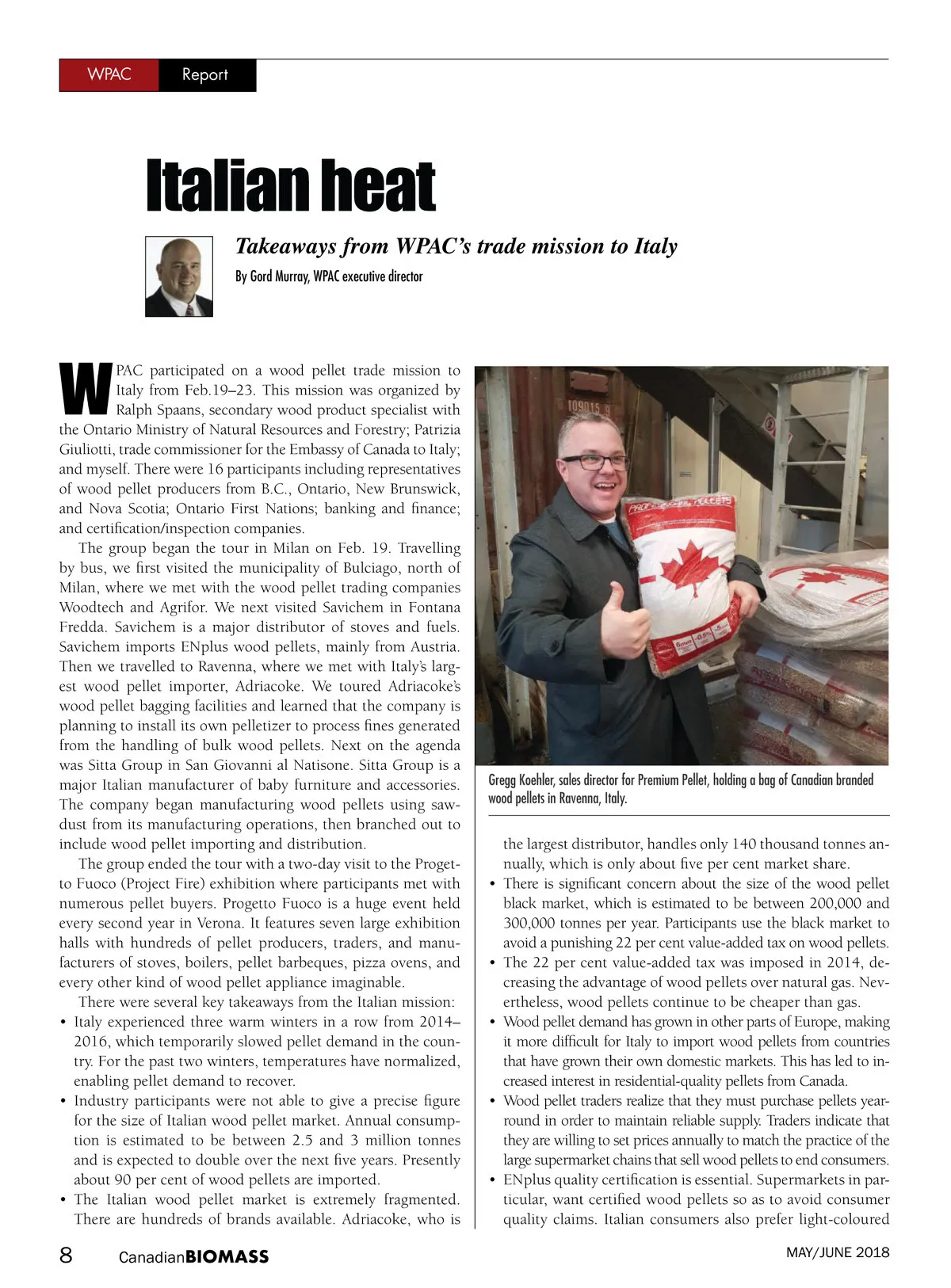
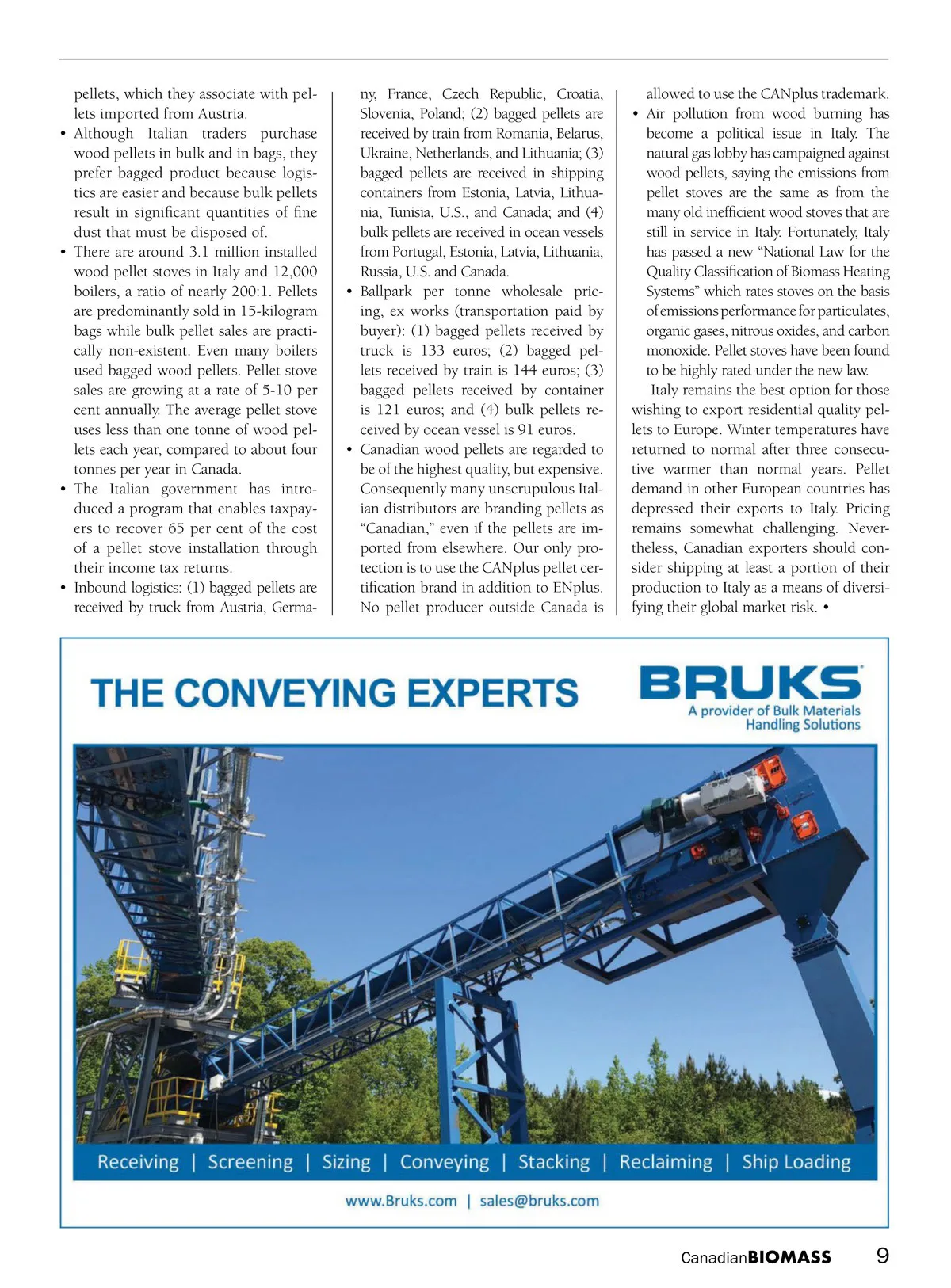
WPAC Report Italian heat By Gord Murray, WPAC executive director Takeaways from WPAC’s trade mission to Italy W PAC participated on a wood pellet trade mission to Italy from Feb.19–23. This mission was organized by Ralph Spaans, secondary wood product specialist with the Ontario Ministry of Natural Resources and Forestry; Patrizia Giuliotti, trade commissioner for the Embassy of Canada to Italy; and myself. There were 16 participants including representatives of wood pellet producers from B.C., Ontario, New Brunswick, and Nova Scotia; Ontario First Nations; banking and finance; and certification/inspection companies. The group began the tour in Milan on Feb. 19. Travelling by bus, we first visited the municipality of Bulciago, north of Milan, where we met with the wood pellet trading companies Woodtech and Agrifor. We next visited Savichem in Fontana Fredda. Savichem is a major distributor of stoves and fuels. Savichem imports ENplus wood pellets, mainly from Austria. Then we travelled to Ravenna, where we met with Italy’s larg-est wood pellet importer, Adriacoke. We toured Adriacoke’s wood pellet bagging facilities and learned that the company is planning to install its own pelletizer to process fines generated from the handling of bulk wood pellets. Next on the agenda was Sitta Group in San Giovanni al Natisone. Sitta Group is a major Italian manufacturer of baby furniture and accessories. The company began manufacturing wood pellets using saw-dust from its manufacturing operations, then branched out to include wood pellet importing and distribution. The group ended the tour with a two-day visit to the Proget-to Fuoco (Project Fire) exhibition where participants met with numerous pellet buyers. Progetto Fuoco is a huge event held every second year in Verona. It features seven large exhibition halls with hundreds of pellet producers, traders, and manu-facturers of stoves, boilers, pellet barbeques, pizza ovens, and every other kind of wood pellet appliance imaginable. There were several key takeaways from the Italian mission: • Italy experienced three warm winters in a row from 2014– 2016, which temporarily slowed pellet demand in the coun-try. For the past two winters, temperatures have normalized, enabling pellet demand to recover. • Industry participants were not able to give a precise figure for the size of Italian wood pellet market. Annual consump-tion is estimated to be between 2.5 and 3 million tonnes and is expected to double over the next five years. Presently about 90 per cent of wood pellets are imported. • The Italian wood pellet market is extremely fragmented. There are hundreds of brands available. Adriacoke, who is Gregg Koehler, sales director for Premium Pellet, holding a bag of Canadian branded wood pellets in Ravenna, Italy. • • • • • the largest distributor, handles only 140 thousand tonnes an-nually, which is only about five per cent market share. There is significant concern about the size of the wood pellet black market, which is estimated to be between 200,000 and 300,000 tonnes per year. Participants use the black market to avoid a punishing 22 per cent value-added tax on wood pellets. The 22 per cent value-added tax was imposed in 2014, de-creasing the advantage of wood pellets over natural gas. Nev-ertheless, wood pellets continue to be cheaper than gas. Wood pellet demand has grown in other parts of Europe, making it more difficult for Italy to import wood pellets from countries that have grown their own domestic markets. This has led to in-creased interest in residential-quality pellets from Canada. Wood pellet traders realize that they must purchase pellets year-round in order to maintain reliable supply. Traders indicate that they are willing to set prices annually to match the practice of the large supermarket chains that sell wood pellets to end consumers. ENplus quality certification is essential. Supermarkets in par-ticular, want certified wood pellets so as to avoid consumer quality claims. Italian consumers also prefer light-coloured MAY/JUNE 2018 8 Canadian BIOMASS
Canadian Biomass MayJune 2018: Page 8