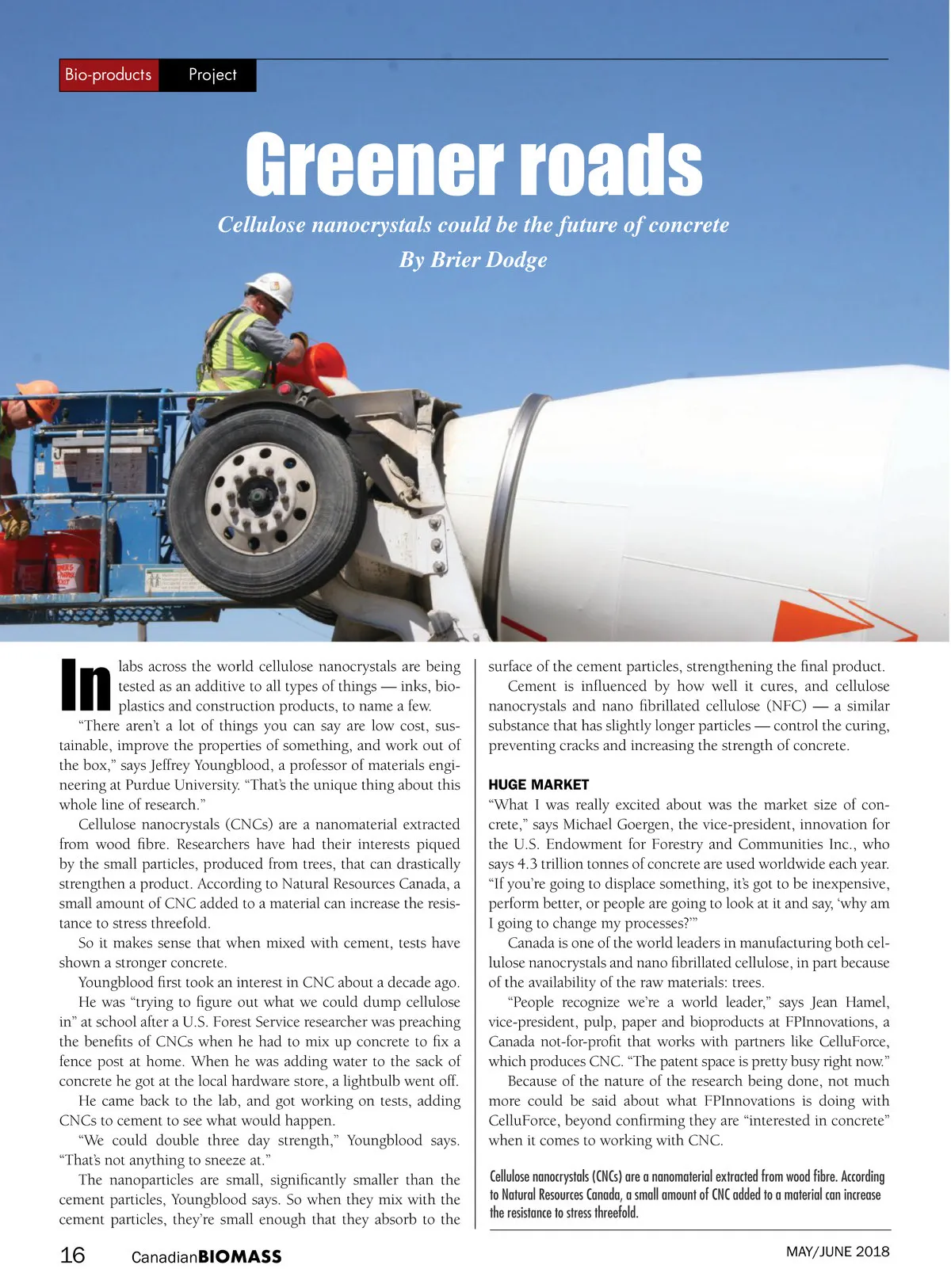
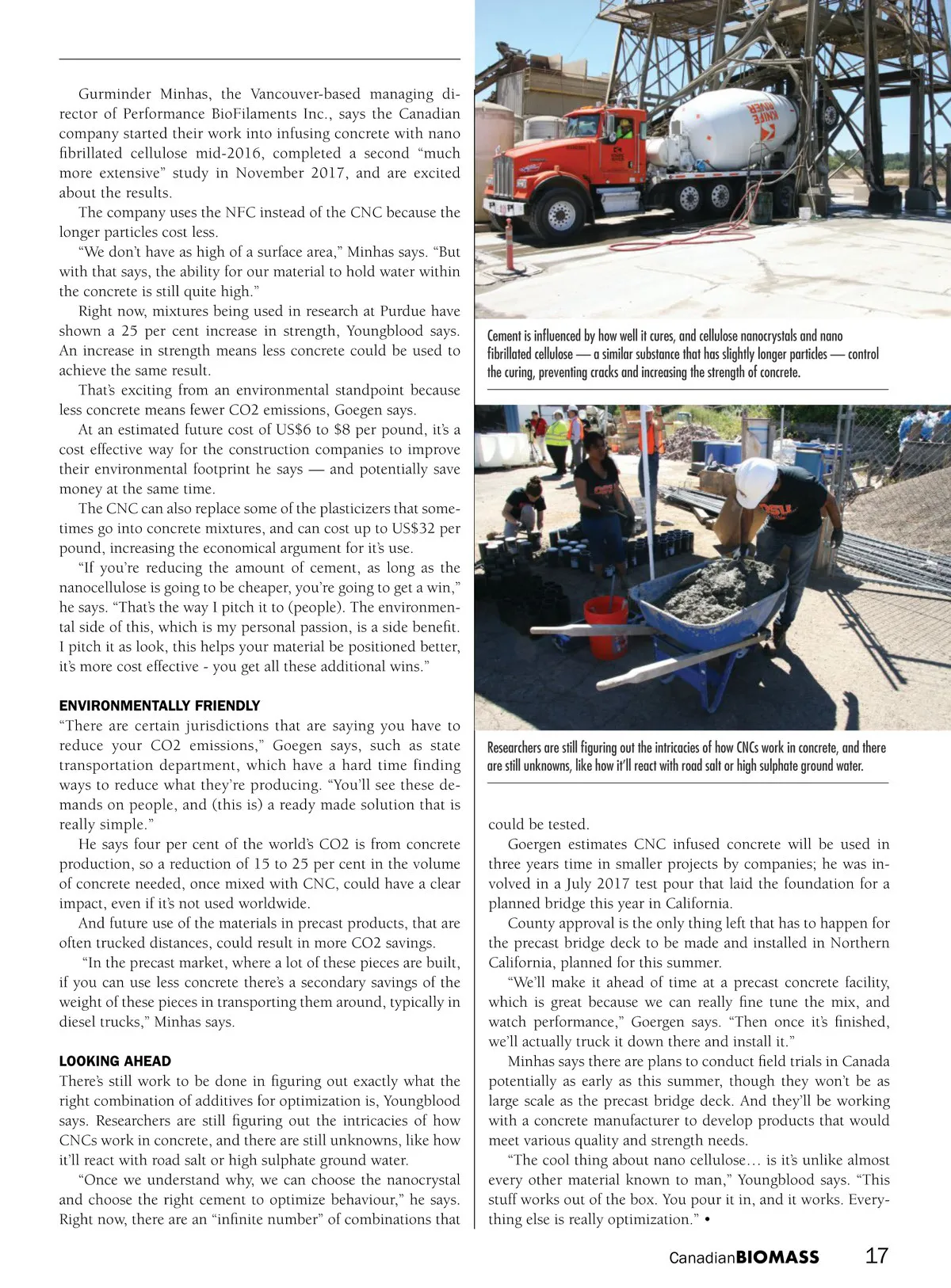
Gurminder Minhas, the Vancouver-based managing di-rector of Performance BioFilaments Inc., says the Canadian company started their work into infusing concrete with nano fibrillated cellulose mid-2016, completed a second “much more extensive” study in November 2017, and are excited about the results. The company uses the NFC instead of the CNC because the longer particles cost less. “We don’t have as high of a surface area,” Minhas says. “But with that says, the ability for our material to hold water within the concrete is still quite high.” Right now, mixtures being used in research at Purdue have shown a 25 per cent increase in strength, Youngblood says. An increase in strength means less concrete could be used to achieve the same result. That’s exciting from an environmental standpoint because less concrete means fewer CO2 emissions, Goegen says. At an estimated future cost of US$6 to $8 per pound, it’s a cost effective way for the construction companies to improve their environmental footprint he says — and potentially save money at the same time. The CNC can also replace some of the plasticizers that some-times go into concrete mixtures, and can cost up to US$32 per pound, increasing the economical argument for it’s use. “If you’re reducing the amount of cement, as long as the nanocellulose is going to be cheaper, you’re going to get a win,” he says. “That’s the way I pitch it to (people). The environmen-tal side of this, which is my personal passion, is a side benefit. I pitch it as look, this helps your material be positioned better, it’s more cost effective -you get all these additional wins.” ENVIRONMENTALLY FRIENDLY Cement is influenced by how well it cures, and cellulose nanocrystals and nano fibrillated cellulose — a similar substance that has slightly longer particles — control the curing, preventing cracks and increasing the strength of concrete. “There are certain jurisdictions that are saying you have to reduce your CO2 emissions,” Goegen says, such as state transportation department, which have a hard time finding ways to reduce what they’re producing. “You’ll see these de-mands on people, and (this is) a ready made solution that is really simple.” He says four per cent of the world’s CO2 is from concrete production, so a reduction of 15 to 25 per cent in the volume of concrete needed, once mixed with CNC, could have a clear impact, even if it’s not used worldwide. And future use of the materials in precast products, that are often trucked distances, could result in more CO2 savings. “In the precast market, where a lot of these pieces are built, if you can use less concrete there’s a secondary savings of the weight of these pieces in transporting them around, typically in diesel trucks,” Minhas says. LOOKING AHEAD Researchers are still figuring out the intricacies of how CNCs work in concrete, and there are still unknowns, like how it’ll react with road salt or high sulphate ground water. There’s still work to be done in figuring out exactly what the right combination of additives for optimization is, Youngblood says. Researchers are still figuring out the intricacies of how CNCs work in concrete, and there are still unknowns, like how it’ll react with road salt or high sulphate ground water. “Once we understand why, we can choose the nanocrystal and choose the right cement to optimize behaviour,” he says. Right now, there are an “infinite number” of combinations that could be tested. Goergen estimates CNC infused concrete will be used in three years time in smaller projects by companies; he was in-volved in a July 2017 test pour that laid the foundation for a planned bridge this year in California. County approval is the only thing left that has to happen for the precast bridge deck to be made and installed in Northern California, planned for this summer. “We’ll make it ahead of time at a precast concrete facility, which is great because we can really fine tune the mix, and watch performance,” Goergen says. “Then once it’s finished, we’ll actually truck it down there and install it.” Minhas says there are plans to conduct field trials in Canada potentially as early as this summer, though they won’t be as large scale as the precast bridge deck. And they’ll be working with a concrete manufacturer to develop products that would meet various quality and strength needs. “The cool thing about nano cellulose… is it’s unlike almost every other material known to man,” Youngblood says. “This stuff works out of the box. You pour it in, and it works. Every-thing else is really optimization.” • Canadian BIOMASS 17
Canadian Biomass MayJune 2018: Page 17