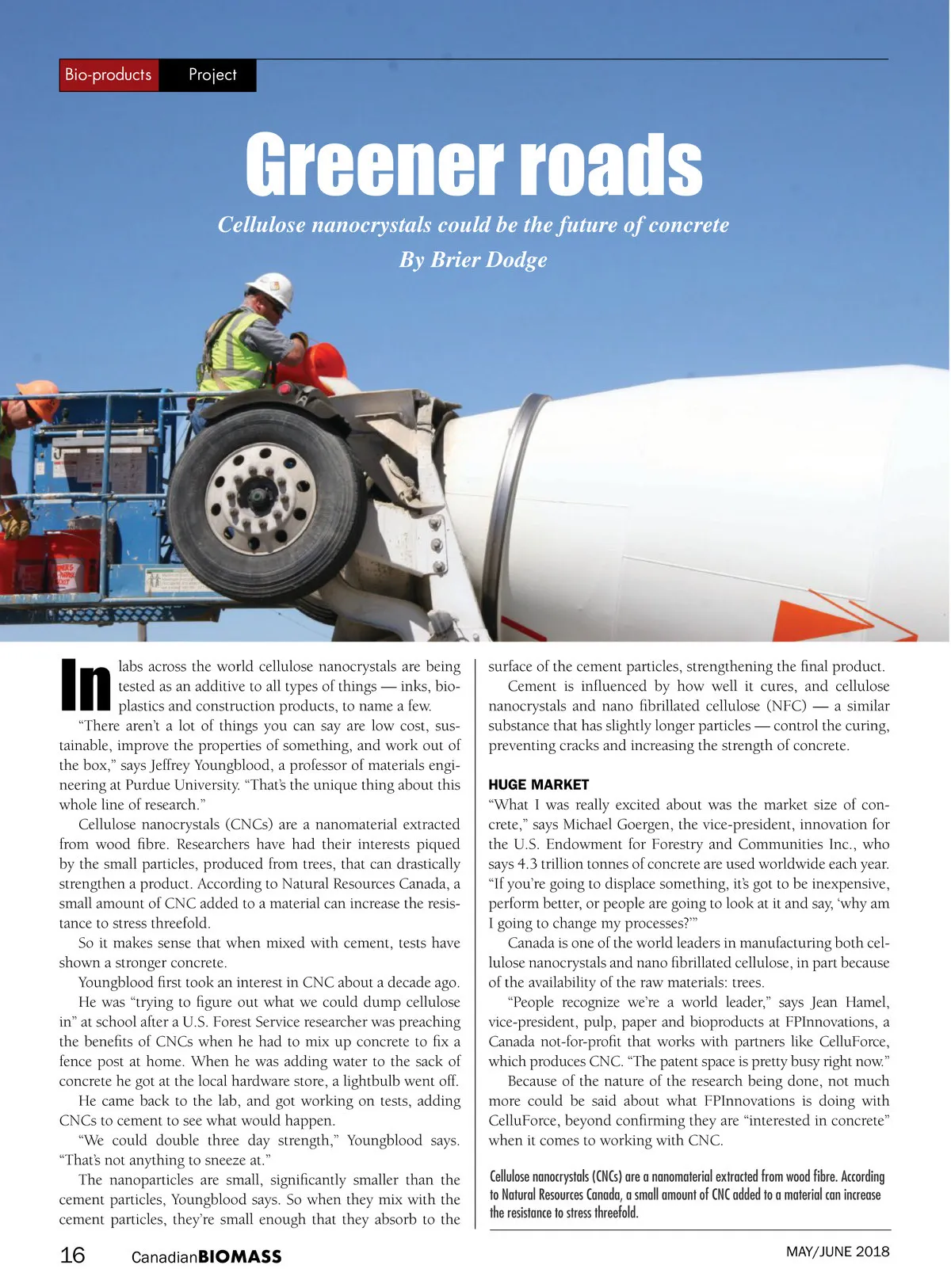
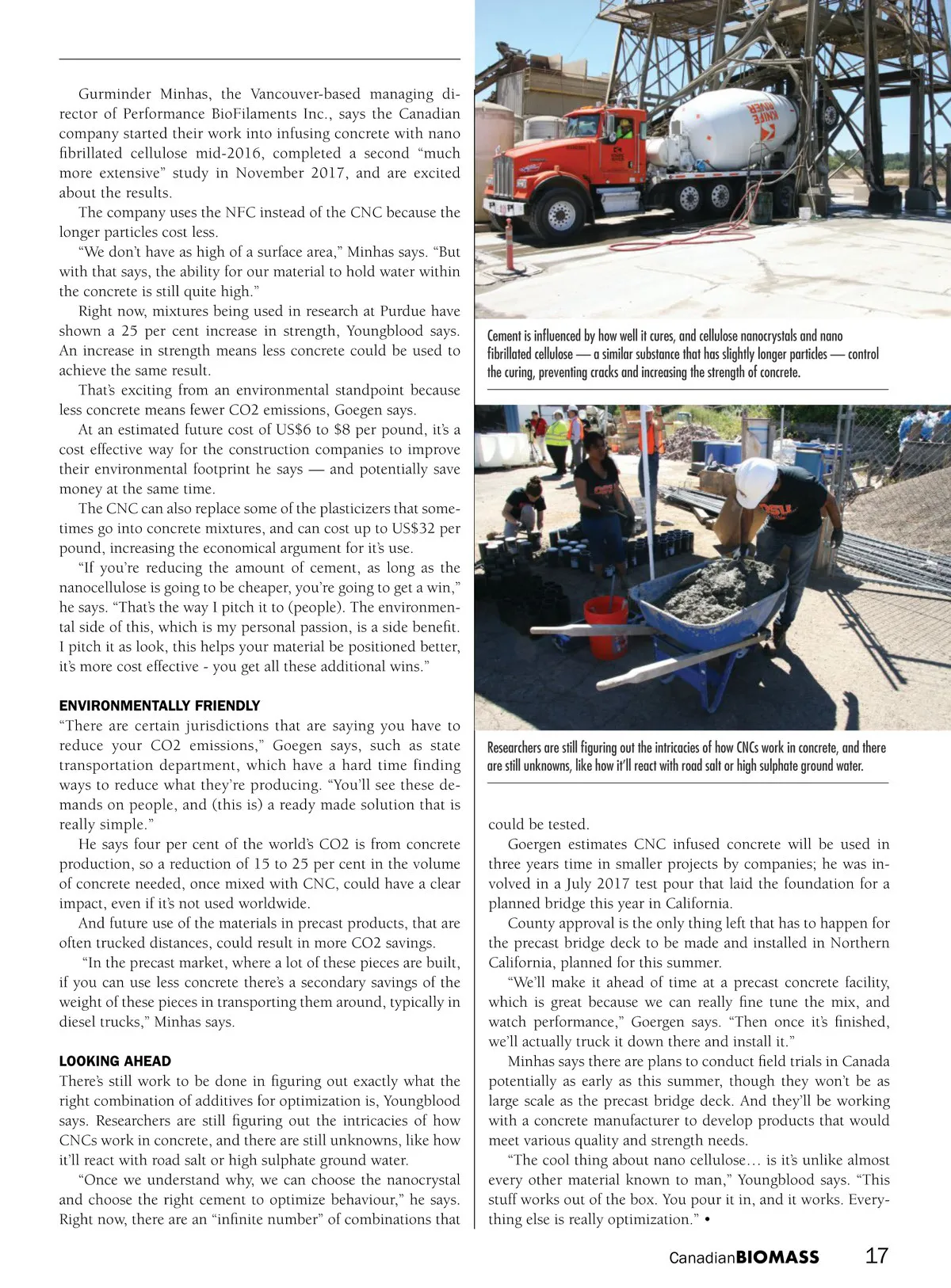
Bio-products Project Cellulose nanocrystals could be the future of concrete By Brier Dodge Greener roads labs across the world cellulose nanocrystals are being tested as an additive to all types of things — inks, bio-plastics and construction products, to name a few. “There aren’t a lot of things you can say are low cost, sus-tainable, improve the properties of something, and work out of the box,” says Jeffrey Youngblood, a professor of materials engi-neering at Purdue University. “That’s the unique thing about this whole line of research.” Cellulose nanocrystals (CNCs) are a nanomaterial extracted from wood fibre. Researchers have had their interests piqued by the small particles, produced from trees, that can drastically strengthen a product. According to Natural Resources Canada, a small amount of CNC added to a material can increase the resis-tance to stress threefold. So it makes sense that when mixed with cement, tests have shown a stronger concrete. Youngblood first took an interest in CNC about a decade ago. He was “trying to figure out what we could dump cellulose in” at school after a U.S. Forest Service researcher was preaching the benefits of CNCs when he had to mix up concrete to fix a fence post at home. When he was adding water to the sack of concrete he got at the local hardware store, a lightbulb went off. He came back to the lab, and got working on tests, adding CNCs to cement to see what would happen. “We could double three day strength,” Youngblood says. “That’s not anything to sneeze at.” The nanoparticles are small, significantly smaller than the cement particles, Youngblood says. So when they mix with the cement particles, they’re small enough that they absorb to the In surface of the cement particles, strengthening the final product. Cement is influenced by how well it cures, and cellulose nanocrystals and nano fibrillated cellulose (NFC) — a similar substance that has slightly longer particles — control the curing, preventing cracks and increasing the strength of concrete. HUGE MARKET “What I was really excited about was the market size of con-crete,” says Michael Goergen, the vice-president, innovation for the U.S. Endowment for Forestry and Communities Inc., who says 4.3 trillion tonnes of concrete are used worldwide each year. “If you’re going to displace something, it’s got to be inexpensive, perform better, or people are going to look at it and say, ‘why am I going to change my processes?’” Canada is one of the world leaders in manufacturing both cel-lulose nanocrystals and nano fibrillated cellulose, in part because of the availability of the raw materials: trees. “People recognize we’re a world leader,” says Jean Hamel, vice-president, pulp, paper and bioproducts at FPInnovations, a Canada not-for-profit that works with partners like CelluForce, which produces CNC. “The patent space is pretty busy right now.” Because of the nature of the research being done, not much more could be said about what FPInnovations is doing with CelluForce, beyond confirming they are “interested in concrete” when it comes to working with CNC. Cellulose nanocrystals (CNCs) are a nanomaterial extracted from wood fibre. According to Natural Resources Canada, a small amount of CNC added to a material can increase the resistance to stress threefold. MAY/JUNE 2018 16 Canadian BIOMASS
Canadian Biomass MayJune 2018: Page 16