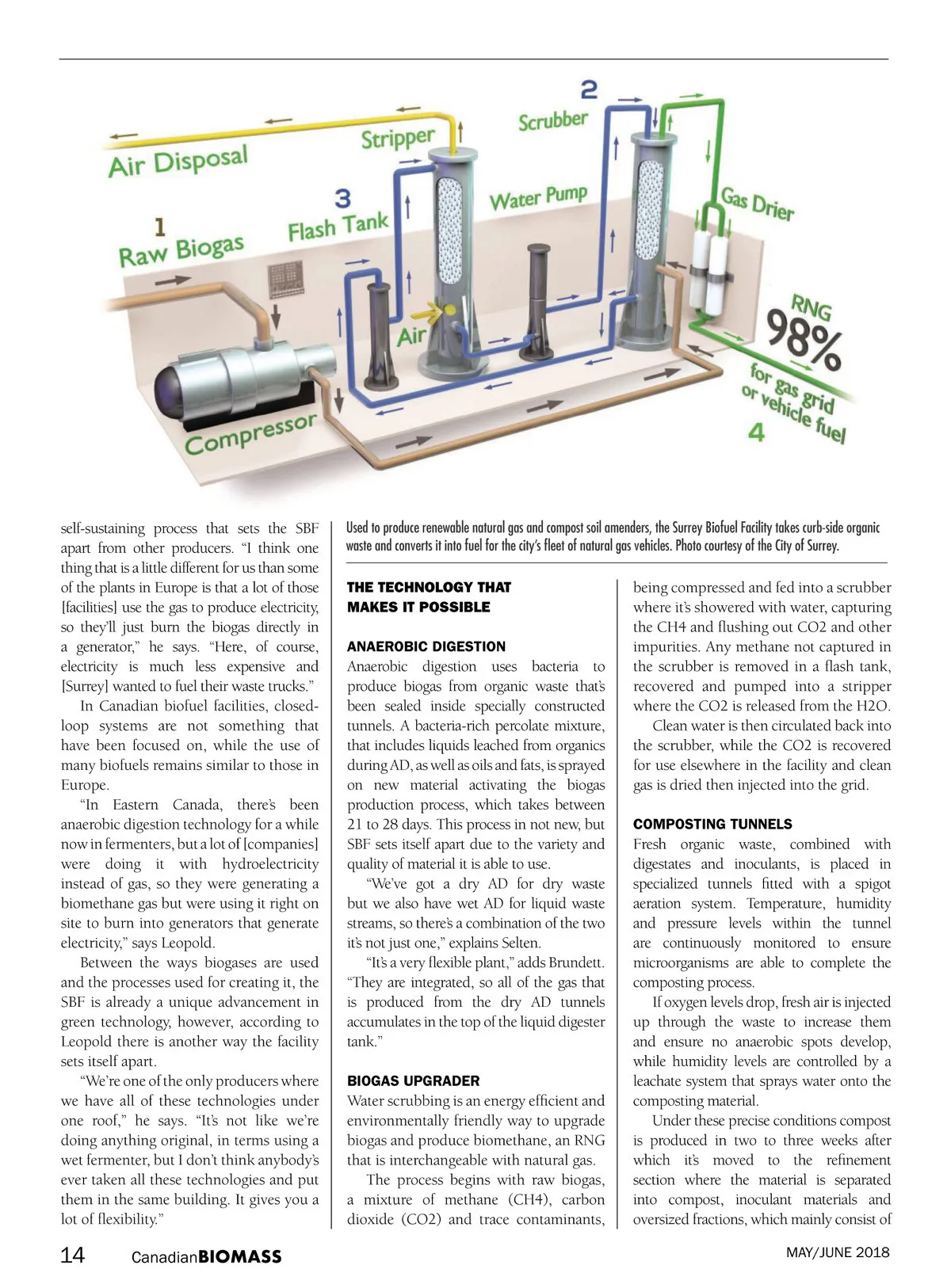
plastics that can be converted into a solid recovered fuel in the future. ODOUR ABATEMENT SYSTEM PARTNERS Vancouver-based construction company Smith Bros. & Wilson Ltd. was the general contractor for the project. Based out of the Netherlands and Germany, Waste Treatment Technologies (WTT) was the primary equipment supplier for the facility. Greenlane Biogas, a world leader in biogas upgrading solutions with offices in Burnaby, B.C., supplied the biogas upgrading system. Fortis BC provided the necessary equipment to connect the biofuel facility to the natural gas grid. The facility’s odour abatement system uses a negative air pressure system to draw air into the facility when loading doors opened. The system runs through the entire building and contains 100 per cent of the composting odour. “Our odour abatement system is state-of-the-art,” says Leopold. “We’re running the facility at 200,000 cubic metres of air flow an hour and all of that gets scrubbed.” Ammonia, released during decomposition, is the primary source of odours associated with composting, so as air is expelled from the tunnels, it is channelled through an ammonia scrubber, where sulphuric acid reacts with ammonia to produce Ammonia Sulphate, which is recovered and used as fertilizer. Next, the air is cooled and humidified by a counter-current water spray prior to being passed through a woody bio-filter where microorganisms are used to absorb any remaining odours. Finally, the air is sent up the vapour stack and is rapidly dispersed 70 metres above the ground. Odour control at the SBF is monitored continuously using electronic nose technology. SUCCESS FOR SURREY services with the City of Surrey. “Our current corporate carbon footprint is 16,000 metric tonnes a year and with the operation of this facility alone we have decreased carbon emissions by 49,000 tonnes a year which completely obliterated our corporate carbon footprint and enables us to utilize carbon credits in the open market and sell them for profit.” The project was put together at no cost to Surrey ratepayers. Funding for the facility was made possible through the federal government’s Public-Private Partnership program (P3 Canada Fund), which sees private companies and the federal government collaborate to help bring new infrastructure to Canadian communities. “Investing in innovative projects like the Surrey Biofuel Facility is vital to reducing our carbon footprint and establishing cleaner, more sustainable communities,” Ken Hardie, MP for Fleetwood–Port Kells, said in a release. To learn more about the SBF , or to book a tour of the facility visit www.surreybiofuel.ca. • With the ability to process 115,000 tonnes of organic waste a year, the 160,000 square foot SBF was designed to keep up with Surrey’s predicted growth over the next 25 years. Currently the city is able to independently produce 65,000 tonnes of organic waste per year and expects be able to fully utilize the facility on its own by 2043, until that time organic waste will also be collected from commercial sectors and nearby municipalities. The facility is only one of many initiatives the municipality has taken to meet diversion and carbon goals, and although it has only been open for a short time SBF has already taken Surrey beyond its initial goal. “Our corporate admissions policy was released in 2010 and the provisions were that we, as a city, committed to reducing corporate carbon emissions by 20 per cent by the year 2020,” explains Robert Costanzo, general manager of corporate Canadian BIOMASS 15
Canadian Biomass MayJune 2018: Page 15