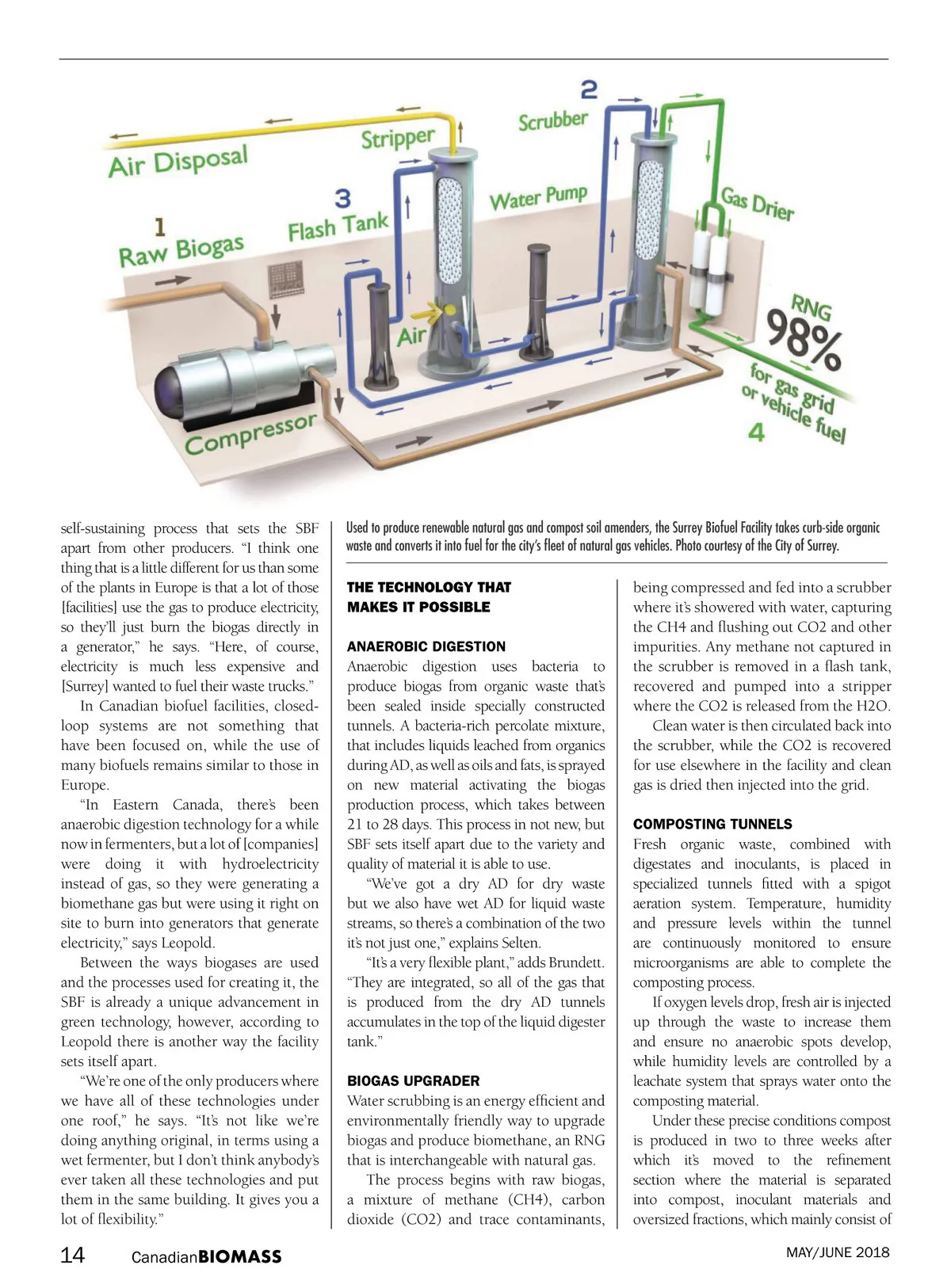
self-sustaining process that sets the SBF apart from other producers. “I think one thing that is a little different for us than some of the plants in Europe is that a lot of those [facilities] use the gas to produce electricity, so they’ll just burn the biogas directly in a generator,” he says. “Here, of course, electricity is much less expensive and [Surrey] wanted to fuel their waste trucks.” In Canadian biofuel facilities, closed-loop systems are not something that have been focused on, while the use of many biofuels remains similar to those in Europe. “In Eastern Canada, there’s been anaerobic digestion technology for a while now in fermenters, but a lot of [companies] were doing it with hydroelectricity instead of gas, so they were generating a biomethane gas but were using it right on site to burn into generators that generate electricity,” says Leopold. Between the ways biogases are used and the processes used for creating it, the SBF is already a unique advancement in green technology, however, according to Leopold there is another way the facility sets itself apart. “We’re one of the only producers where we have all of these technologies under one roof,” he says. “It’s not like we’re doing anything original, in terms using a wet fermenter, but I don’t think anybody’s ever taken all these technologies and put them in the same building. It gives you a lot of flexibility.” Used to produce renewable natural gas and compost soil amenders, the Surrey Biofuel Facility takes curb-side organic waste and converts it into fuel for the city’s fleet of natural gas vehicles. Photo courtesy of the City of Surrey. THE TECHNOLOGY THAT MAKES IT POSSIBLE ANAEROBIC DIGESTION Anaerobic digestion uses bacteria to produce biogas from organic waste that’s been sealed inside specially constructed tunnels. A bacteria-rich percolate mixture, that includes liquids leached from organics during AD, as well as oils and fats, is sprayed on new material activating the biogas production process, which takes between 21 to 28 days. This process in not new, but SBF sets itself apart due to the variety and quality of material it is able to use. “We’ve got a dry AD for dry waste but we also have wet AD for liquid waste streams, so there’s a combination of the two it’s not just one,” explains Selten. “It’s a very flexible plant,” adds Brundett. “They are integrated, so all of the gas that is produced from the dry AD tunnels accumulates in the top of the liquid digester tank.” BIOGAS UPGRADER being compressed and fed into a scrubber where it’s showered with water, capturing the CH4 and flushing out CO2 and other impurities. Any methane not captured in the scrubber is removed in a flash tank, recovered and pumped into a stripper where the CO2 is released from the H2O. Clean water is then circulated back into the scrubber, while the CO2 is recovered for use elsewhere in the facility and clean gas is dried then injected into the grid. COMPOSTING TUNNELS Water scrubbing is an energy efficient and environmentally friendly way to upgrade biogas and produce biomethane, an RNG that is interchangeable with natural gas. The process begins with raw biogas, a mixture of methane (CH4), carbon dioxide (CO2) and trace contaminants, Fresh organic waste, combined with digestates and inoculants, is placed in specialized tunnels fitted with a spigot aeration system. Temperature, humidity and pressure levels within the tunnel are continuously monitored to ensure microorganisms are able to complete the composting process. If oxygen levels drop, fresh air is injected up through the waste to increase them and ensure no anaerobic spots develop, while humidity levels are controlled by a leachate system that sprays water onto the composting material. Under these precise conditions compost is produced in two to three weeks after which it’s moved to the refinement section where the material is separated into compost, inoculant materials and oversized fractions, which mainly consist of MAY/JUNE 2018 14 Canadian BIOMASS
Canadian Biomass MayJune 2018: Page 14