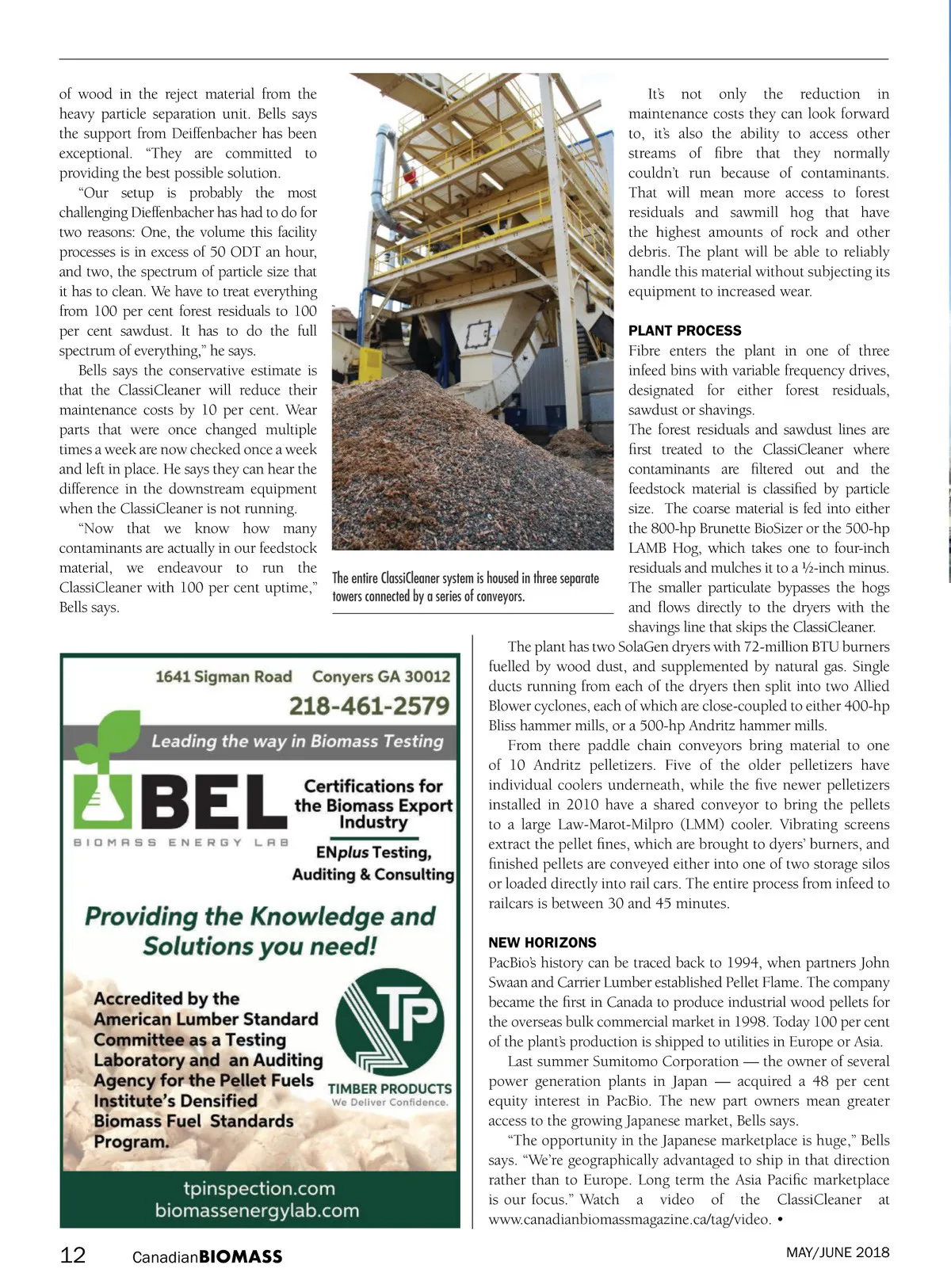
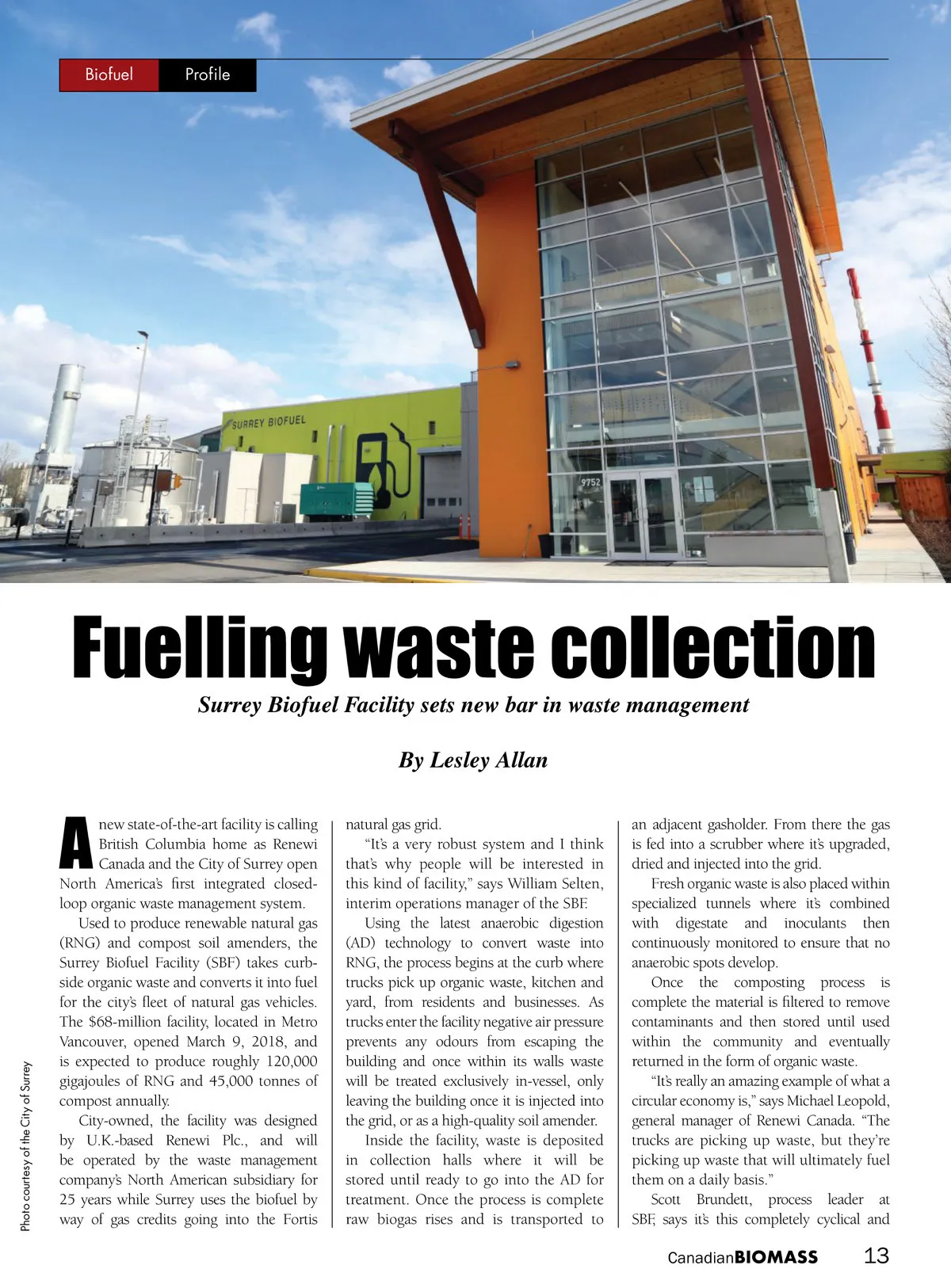
Biofuel Profile Fuelling waste collection Surrey Biofuel Facility sets new bar in waste management By Lesley Allan A Photo courtesy of the City of Surrey new state-of-the-art facility is calling British Columbia home as Renewi Canada and the City of Surrey open North America’s first integrated closed-loop organic waste management system. Used to produce renewable natural gas (RNG) and compost soil amenders, the Surrey Biofuel Facility (SBF) takes curb-side organic waste and converts it into fuel for the city’s fleet of natural gas vehicles. The $68-million facility, located in Metro Vancouver, opened March 9, 2018, and is expected to produce roughly 120,000 gigajoules of RNG and 45,000 tonnes of compost annually. City-owned, the facility was designed by U.K.-based Renewi Plc., and will be operated by the waste management company’s North American subsidiary for 25 years while Surrey uses the biofuel by way of gas credits going into the Fortis natural gas grid. “It’s a very robust system and I think that’s why people will be interested in this kind of facility,” says William Selten, interim operations manager of the SBF . Using the latest anaerobic digestion (AD) technology to convert waste into RNG, the process begins at the curb where trucks pick up organic waste, kitchen and yard, from residents and businesses. As trucks enter the facility negative air pressure prevents any odours from escaping the building and once within its walls waste will be treated exclusively in-vessel, only leaving the building once it is injected into the grid, or as a high-quality soil amender. Inside the facility, waste is deposited in collection halls where it will be stored until ready to go into the AD for treatment. Once the process is complete raw biogas rises and is transported to an adjacent gasholder. From there the gas is fed into a scrubber where it’s upgraded, dried and injected into the grid. Fresh organic waste is also placed within specialized tunnels where it’s combined with digestate and inoculants then continuously monitored to ensure that no anaerobic spots develop. Once the composting process is complete the material is filtered to remove contaminants and then stored until used within the community and eventually returned in the form of organic waste. “It’s really an amazing example of what a circular economy is,” says Michael Leopold, general manager of Renewi Canada. “The trucks are picking up waste, but they’re picking up waste that will ultimately fuel them on a daily basis.” Scott Brundett, process leader at SBF , says it’s this completely cyclical and Canadian BIOMASS 13
Canadian Biomass MayJune 2018: Page 13