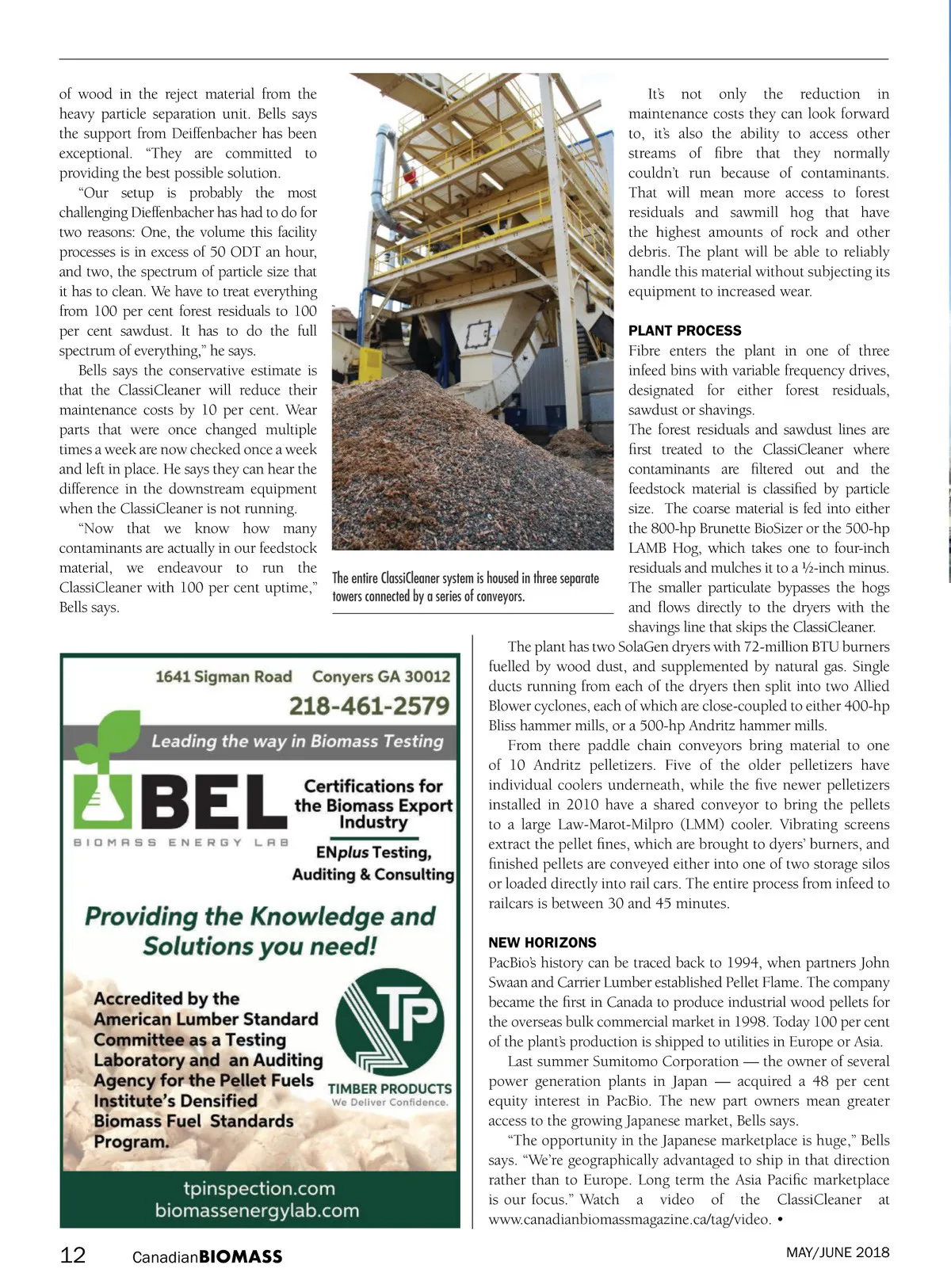
of wood in the reject material from the heavy particle separation unit. Bells says the support from Deiffenbacher has been exceptional. “They are committed to providing the best possible solution. “Our setup is probably the most challenging Dieffenbacher has had to do for two reasons: One, the volume this facility processes is in excess of 50 ODT an hour, and two, the spectrum of particle size that it has to clean. We have to treat everything from 100 per cent forest residuals to 100 per cent sawdust. It has to do the full spectrum of everything,” he says. Bells says the conservative estimate is that the ClassiCleaner will reduce their maintenance costs by 10 per cent. Wear parts that were once changed multiple times a week are now checked once a week and left in place. He says they can hear the difference in the downstream equipment when the ClassiCleaner is not running. “Now that we know how many contaminants are actually in our feedstock material, we endeavour to run the The entire ClassiCleaner system is housed in three separate ClassiCleaner with 100 per cent uptime,” towers connected by a series of conveyors. Bells says. It’s not only the reduction in maintenance costs they can look forward to, it’s also the ability to access other streams of fibre that they normally couldn’t run because of contaminants. That will mean more access to forest residuals and sawmill hog that have the highest amounts of rock and other debris. The plant will be able to reliably handle this material without subjecting its equipment to increased wear. PLANT PROCESS Fibre enters the plant in one of three infeed bins with variable frequency drives, designated for either forest residuals, sawdust or shavings. The forest residuals and sawdust lines are first treated to the ClassiCleaner where contaminants are filtered out and the feedstock material is classified by particle size. The coarse material is fed into either the 800-hp Brunette BioSizer or the 500-hp LAMB Hog, which takes one to four-inch residuals and mulches it to a ½-inch minus. The smaller particulate bypasses the hogs and flows directly to the dryers with the shavings line that skips the ClassiCleaner. The plant has two SolaGen dryers with 72-million BTU burners fuelled by wood dust, and supplemented by natural gas. Single ducts running from each of the dryers then split into two Allied Blower cyclones, each of which are close-coupled to either 400-hp Bliss hammer mills, or a 500-hp Andritz hammer mills. From there paddle chain conveyors bring material to one of 10 Andritz pelletizers. Five of the older pelletizers have individual coolers underneath, while the five newer pelletizers installed in 2010 have a shared conveyor to bring the pellets to a large Law-Marot-Milpro (LMM) cooler. Vibrating screens extract the pellet fines, which are brought to dyers’ burners, and finished pellets are conveyed either into one of two storage silos or loaded directly into rail cars. The entire process from infeed to railcars is between 30 and 45 minutes. NEW HORIZONS PacBio’s history can be traced back to 1994, when partners John Swaan and Carrier Lumber established Pellet Flame. The company became the first in Canada to produce industrial wood pellets for the overseas bulk commercial market in 1998. Today 100 per cent of the plant’s production is shipped to utilities in Europe or Asia. Last summer Sumitomo Corporation — the owner of several power generation plants in Japan — acquired a 48 per cent equity interest in PacBio. The new part owners mean greater access to the growing Japanese market, Bells says. “The opportunity in the Japanese marketplace is huge,” Bells says. “We’re geographically advantaged to ship in that direction rather than to Europe. Long term the Asia Pacific marketplace is our focus.” Watch a video of the ClassiCleaner at www.canadianbiomassmagazine.ca/tag/video. • 12 Canadian BIOMASS MAY/JUNE 2018
Canadian Biomass MayJune 2018: Page 12