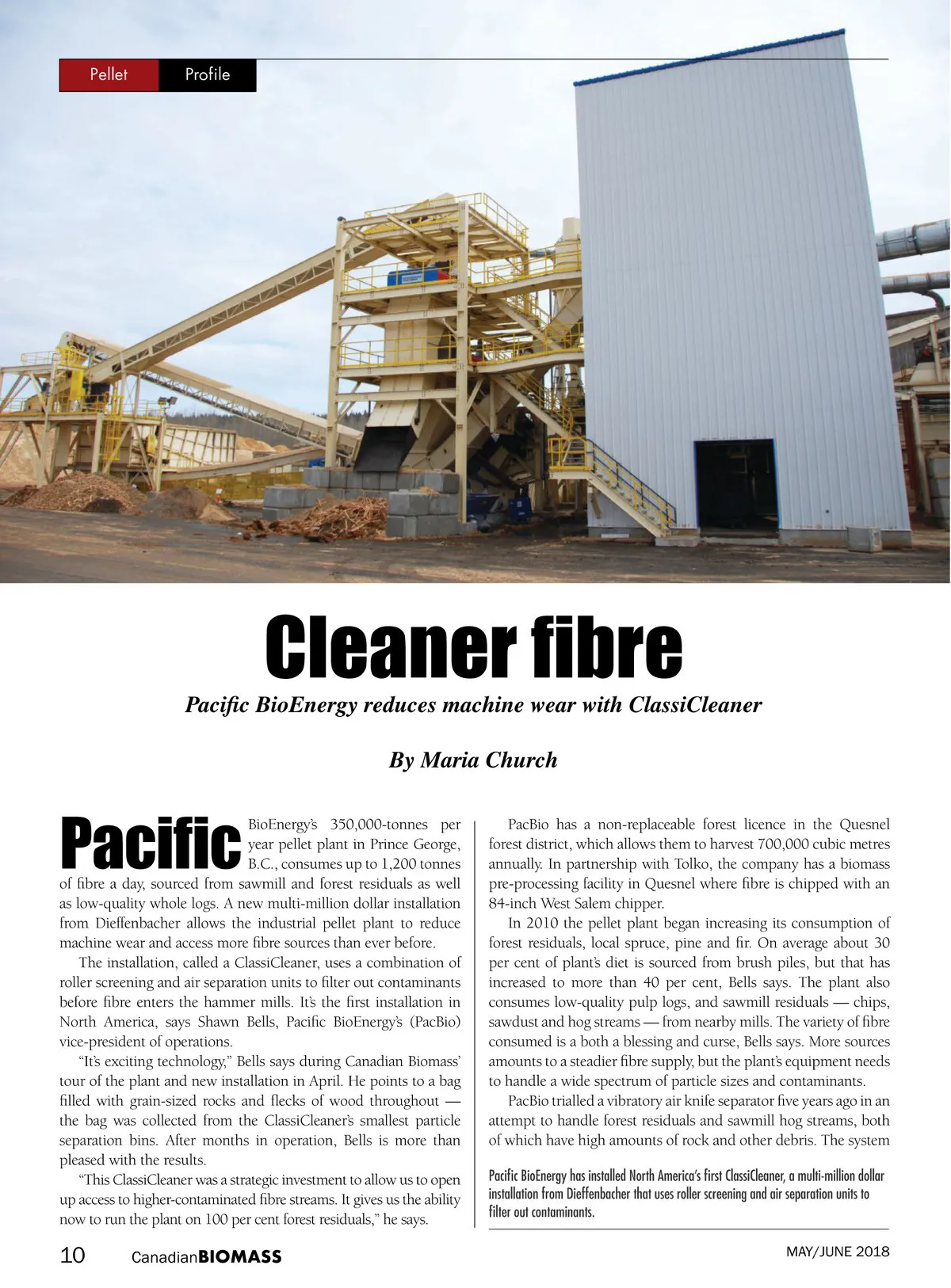
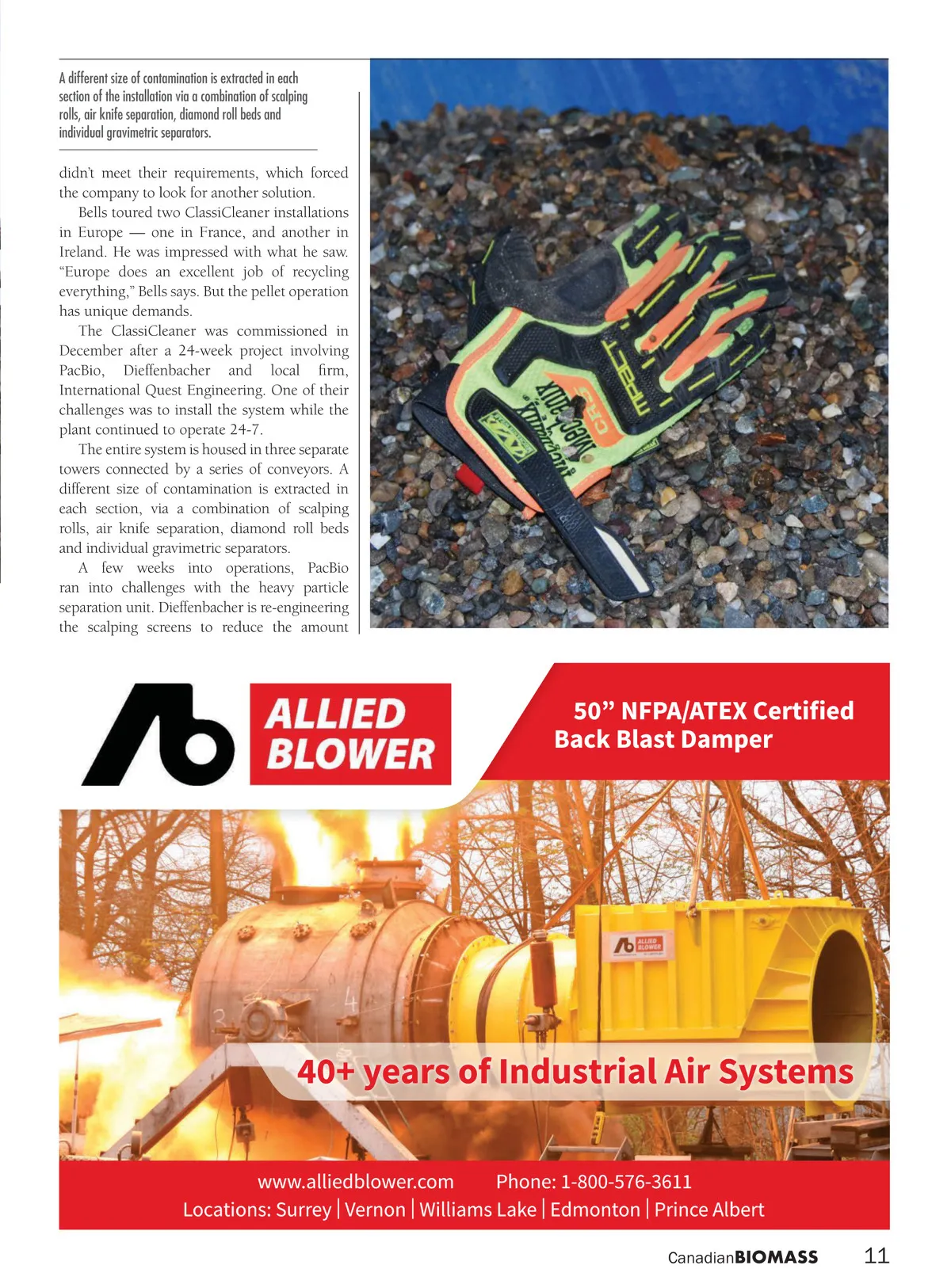
Pellet Profile Pacific BioEnergy reduces machine wear with ClassiCleaner By Maria Church BioEnergy’s 350,000-tonnes per year pellet plant in Prince George, B.C., consumes up to 1,200 tonnes of fibre a day, sourced from sawmill and forest residuals as well as low-quality whole logs. A new multi-million dollar installation from Dieffenbacher allows the industrial pellet plant to reduce machine wear and access more fibre sources than ever before. The installation, called a ClassiCleaner, uses a combination of roller screening and air separation units to filter out contaminants before fibre enters the hammer mills. It’s the first installation in North America, says Shawn Bells, Pacific BioEnergy’s (PacBio) vice-president of operations. “It’s exciting technology,” Bells says during Canadian Biomass’ tour of the plant and new installation in April. He points to a bag filled with grain-sized rocks and flecks of wood throughout — the bag was collected from the ClassiCleaner’s smallest particle separation bins. After months in operation, Bells is more than pleased with the results. “This ClassiCleaner was a strategic investment to allow us to open up access to higher-contaminated fibre streams. It gives us the ability now to run the plant on 100 per cent forest residuals,” he says. Cleaner fibre Pacific PacBio has a non-replaceable forest licence in the Quesnel forest district, which allows them to harvest 700,000 cubic metres annually. In partnership with Tolko, the company has a biomass pre-processing facility in Quesnel where fibre is chipped with an 84-inch West Salem chipper. In 2010 the pellet plant began increasing its consumption of forest residuals, local spruce, pine and fir. On average about 30 per cent of plant’s diet is sourced from brush piles, but that has increased to more than 40 per cent, Bells says. The plant also consumes low-quality pulp logs, and sawmill residuals — chips, sawdust and hog streams — from nearby mills. The variety of fibre consumed is a both a blessing and curse, Bells says. More sources amounts to a steadier fibre supply, but the plant’s equipment needs to handle a wide spectrum of particle sizes and contaminants. PacBio trialled a vibratory air knife separator five years ago in an attempt to handle forest residuals and sawmill hog streams, both of which have high amounts of rock and other debris. The system Pacific BioEnergy has installed North America’s first ClassiCleaner, a multi-million dollar installation from Dieffenbacher that uses roller screening and air separation units to filter out contaminants. MAY/JUNE 2018 10 Canadian BIOMASS
Canadian Biomass MayJune 2018: Page 10