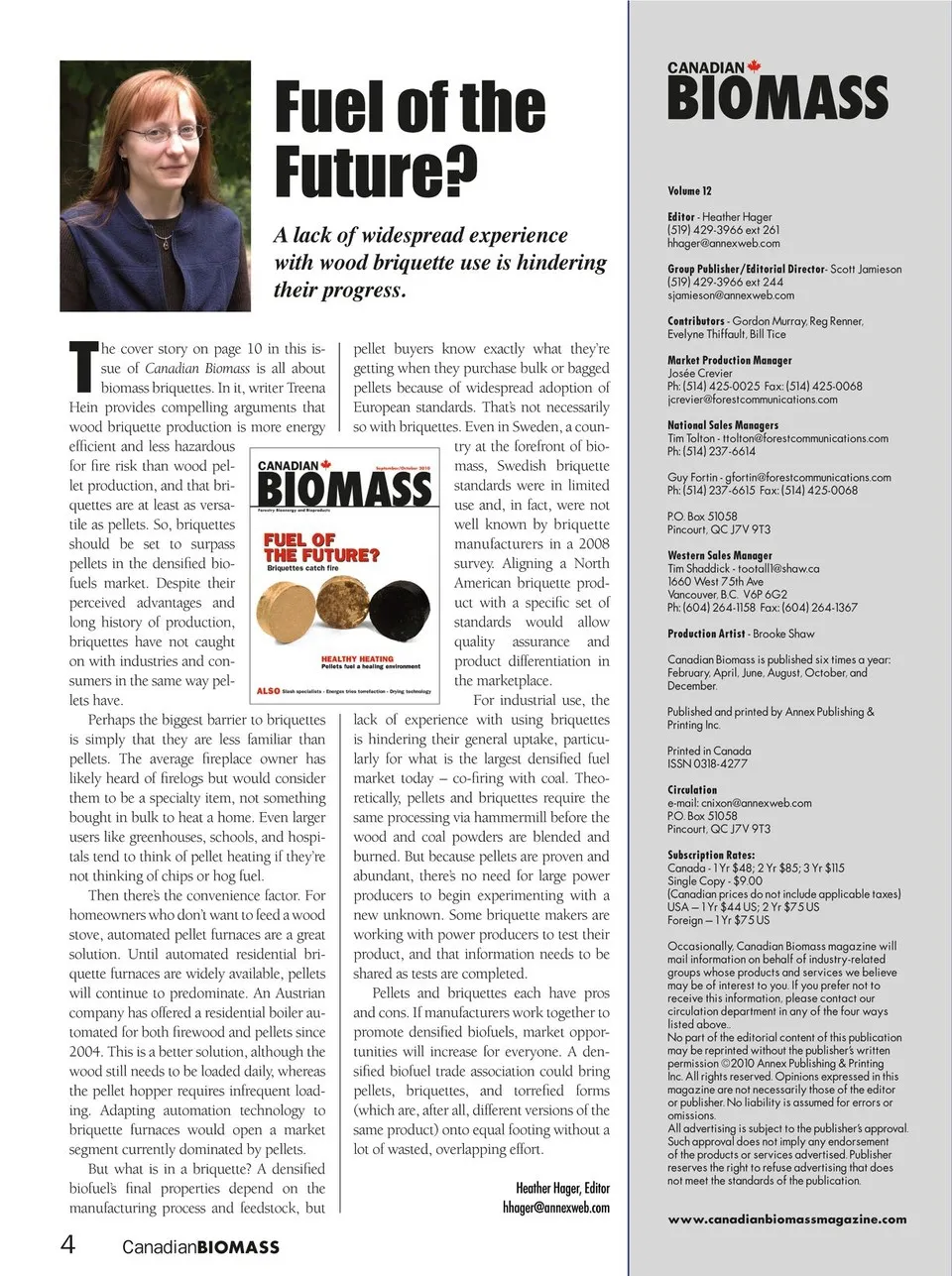
Hein provides compelling arguments that wood briquette production is more energy efficient and less hazardous for fire risk than wood pel-let production, and that bri-quettes are at least as versa-tile as pellets. So, briquettes should be set to surpass pellets in the densified bio-fuels market. Despite their perceived advantages and long history of production, briquettes have not caught on with industries and con-sumers in the same way pel-lets have. Perhaps the biggest barrier to briquettes is simply that they are less familiar than pellets. The average fireplace owner has likely heard of firelogs but would consider them to be a specialty item, not something bought in bulk to heat a home. Even larger users like greenhouses, schools, and hospi-tals tend to think of pellet heating if they’re not thinking of chips or hog fuel. Then there’s the convenience factor. For homeowners who don’t want to feed a wood stove, automated pellet furnaces are a great solution. Until automated residential bri-quette furnaces are widely available, pellets will continue to predominate. An Austrian company has offered a residential boiler au-tomated for both firewood and pellets since 2004. This is a better solution, although the wood still needs to be loaded daily, whereas the pellet hopper requires infrequent load-ing. Adapting automation technology to briquette furnaces would open a market segment currently dominated by pellets. But what is in a briquette? A densified biofuel’s final properties depend on the manufacturing process and feedstock, but 4 CanadianBIOMASS he cover story on page 10 in this is-sue of Canadian Biomass is all about biomass briquettes. In it, writer Treena pellet buyers know exactly what they’re getting when they purchase bulk or bagged pellets because of widespread adoption of European standards. That’s not necessarily so with briquettes. Even in Sweden, a coun-try at the forefront of bio-mass, Swedish briquette standards were in limited use and, in fact, were not well known by briquette manufacturers in a 2008 survey. Aligning a North American briquette prod-uct with a specific set of standards would allow quality assurance and product differentiation in the marketplace. For industrial use, the lack of experience with using briquettes is hindering their general uptake, particu-larly for what is the largest densified fuel market today – co-firing with coal. Theo-retically, pellets and briquettes require the same processing via hammermill before the wood and coal powders are blended and burned. But because pellets are proven and abundant, there’s no need for large power producers to begin experimenting with a new unknown. Some briquette makers are working with power producers to test their product, and that information needs to be shared as tests are completed. Pellets and briquettes each have pros and cons. If manufacturers work together to promote densified biofuels, market oppor-tunities will increase for everyone. A den-sified biofuel trade association could bring pellets, briquettes, and torrefied forms (which are, after all, different versions of the same product) onto equal footing without a lot of wasted, overlapping effort. Volume 12 Editor -Heather Hager (519) 429-3966 ext 261 [email protected] Group Publisher/Editorial Director-Scott Jamieson (519) 429-3966 ext 244 [email protected] Contributors -Gordon Murray, Reg Renner, Evelyne Thiffault, Bill Tice Market Production Manager Josée Crevier Ph: (514) 425-0025 Fax: (514) 425-0068 [email protected] National Sales Managers Tim Tolton [email protected] Ph: (514) 237-6614 Guy Fortin [email protected] Ph: (514) 237-6615 Fax: (514) 425-0068 P.O. Box 51058 Pincourt, QC J7V 9T3 Western Sales Manager Tim Shaddick [email protected] 1660 West 75th Ave Vancouver, B.C. V6P 6G2 Ph: (604) 264-1158 Fax: (604) 264-1367 Production Artist -Brooke Shaw Canadian Biomass is published six times a year: February, April, June, August, October, and December. Published and printed by Annex Publishing & Printing Inc. Printed in Canada ISSN 0318-4277 Circulation e-mail: [email protected] P.O. Box 51058 Pincourt, QC J7V 9T3 Subscription Rates: Canada -1 Yr $48; 2 Yr $85; 3 Yr $115 Single Copy -$9.00 (Canadian prices do not include applicable taxes) USA – 1 Yr $44 US; 2 Yr $75 US Foreign – 1 Yr $75 US Occasionally, Canadian Biomass magazine will mail information on behalf of industry-related groups whose products and services we believe may be of interest to you. If you prefer not to receive this information, please contact our circulation department in any of the four ways listed above.. No part of the editorial content of this publication may be reprinted without the publisher’s written permission ©2010 Annex Publishing & Printing Inc. All rights reserved. Opinions expressed in this magazine are not necessarily those of the editor or publisher. No liability is assumed for errors or omissions. All advertising is subject to the publisher’s approval. Such approval does not imply any endorsement of the products or services advertised. Publisher reserves the right to refuse advertising that does not meet the standards of the publication. www.canadianbiomassmagazine.com SEPTEMBER/OCTOBERT 2010
Canadian Biomass September/October 2010: Page 4