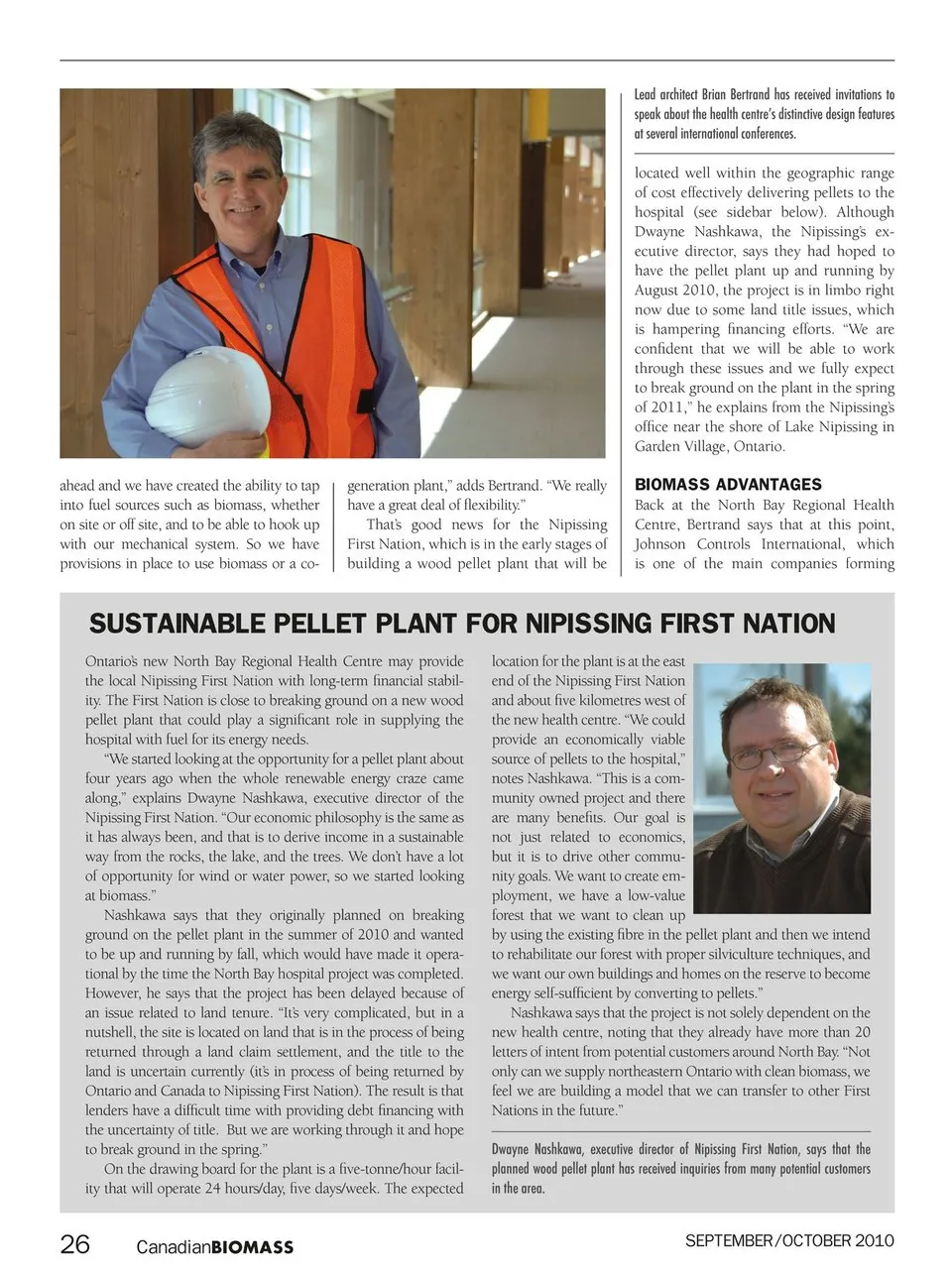
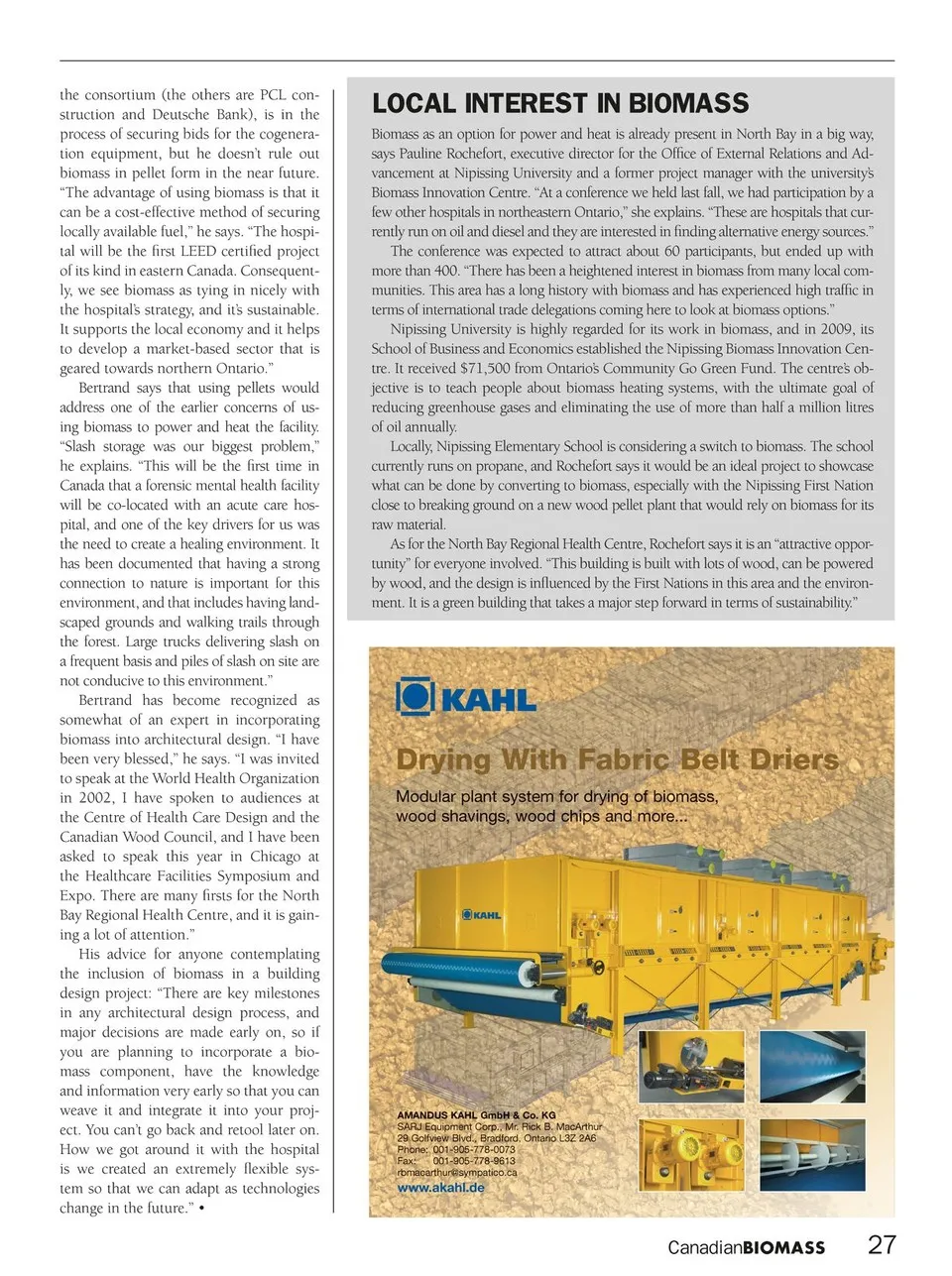
the consortium (the others are PCL con-struction and Deutsche Bank), is in the process of securing bids for the cogenera-tion equipment, but he doesn’t rule out biomass in pellet form in the near future. “The advantage of using biomass is that it can be a cost-effective method of securing locally available fuel,” he says. “The hospi-tal will be the first LEED certified project of its kind in eastern Canada. Consequent-ly, we see biomass as tying in nicely with the hospital’s strategy, and it’s sustainable. It supports the local economy and it helps to develop a market-based sector that is geared towards northern Ontario.” Bertrand says that using pellets would address one of the earlier concerns of us-ing biomass to power and heat the facility. “Slash storage was our biggest problem,” he explains. “This will be the first time in Canada that a forensic mental health facility will be co-located with an acute care hos-pital, and one of the key drivers for us was the need to create a healing environment. It has been documented that having a strong connection to nature is important for this environment, and that includes having land-scaped grounds and walking trails through the forest. Large trucks delivering slash on a frequent basis and piles of slash on site are not conducive to this environment.” Bertrand has become recognized as somewhat of an expert in incorporating biomass into architectural design. “I have been very blessed,” he says. “I was invited to speak at the World Health Organization in 2002, I have spoken to audiences at the Centre of Health Care Design and the Canadian Wood Council, and I have been asked to speak this year in Chicago at the Healthcare Facilities Symposium and Expo. There are many firsts for the North Bay Regional Health Centre, and it is gain-ing a lot of attention.” His advice for anyone contemplating the inclusion of biomass in a building design project: “There are key milestones in any architectural design process, and major decisions are made early on, so if you are planning to incorporate a bio-mass component, have the knowledge and information very early so that you can weave it and integrate it into your proj-ect. You can’t go back and retool later on. How we got around it with the hospital is we created an extremely flexible sys-tem so that we can adapt as technologies change in the future.” • LOCAL INTEREST IN BIOMASS Biomass as an option for power and heat is already present in North Bay in a big way, says Pauline Rochefort, executive director for the Office of External Relations and Ad-vancement at Nipissing University and a former project manager with the university’s Biomass Innovation Centre. “At a conference we held last fall, we had participation by a few other hospitals in northeastern Ontario,” she explains. “These are hospitals that cur-rently run on oil and diesel and they are interested in finding alternative energy sources.” The conference was expected to attract about 60 participants, but ended up with more than 400. “There has been a heightened interest in biomass from many local com-munities. This area has a long history with biomass and has experienced high traffic in terms of international trade delegations coming here to look at biomass options.” Nipissing University is highly regarded for its work in biomass, and in 2009, its School of Business and Economics established the Nipissing Biomass Innovation Cen-tre. It received $71,500 from Ontario’s Community Go Green Fund. The centre’s ob-jective is to teach people about biomass heating systems, with the ultimate goal of reducing greenhouse gases and eliminating the use of more than half a million litres of oil annually. Locally, Nipissing Elementary School is considering a switch to biomass. The school currently runs on propane, and Rochefort says it would be an ideal project to showcase what can be done by converting to biomass, especially with the Nipissing First Nation close to breaking ground on a new wood pellet plant that would rely on biomass for its raw material. As for the North Bay Regional Health Centre, Rochefort says it is an “attractive oppor-tunity” for everyone involved. “This building is built with lots of wood, can be powered by wood, and the design is influenced by the First Nations in this area and the environ-ment. It is a green building that takes a major step forward in terms of sustainability.” Drying With Fabric Belt Driers Modular plant system for drying of biomass, wood shavings, wood chips and more... AMANDUS KAHL GmbH & Co. KG SARJ Equipment Corp., Mr. Rick B. MacArthur 29 Golfview Blvd., Bradford, Ontario L3Z 2A6 Phone: 001-905-778-0073 Fax: 001-905-778-9613 [email protected] www.akahl.de CanadianBIOMASS 27
Canadian Biomass September/October 2010: Page 27