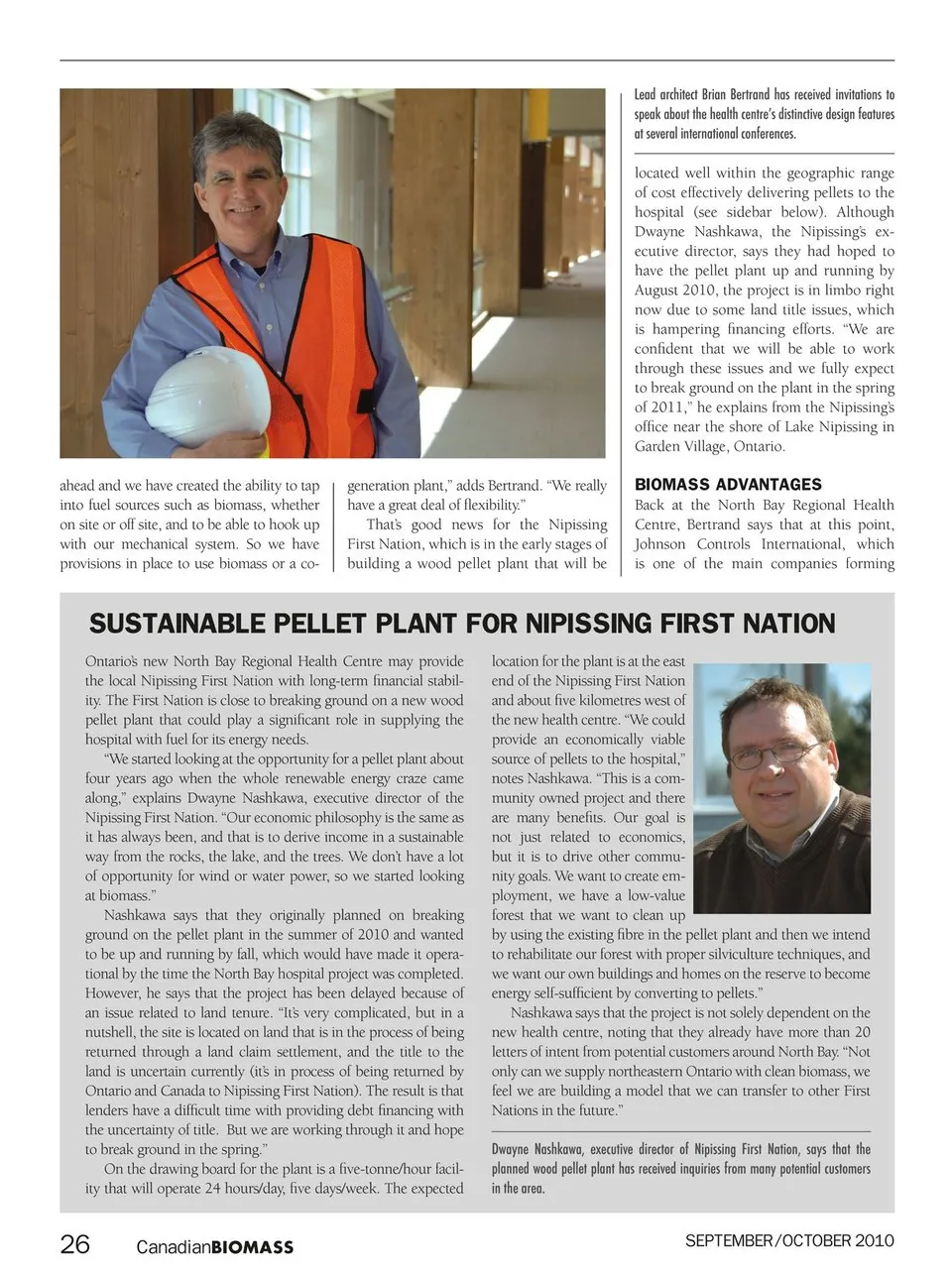
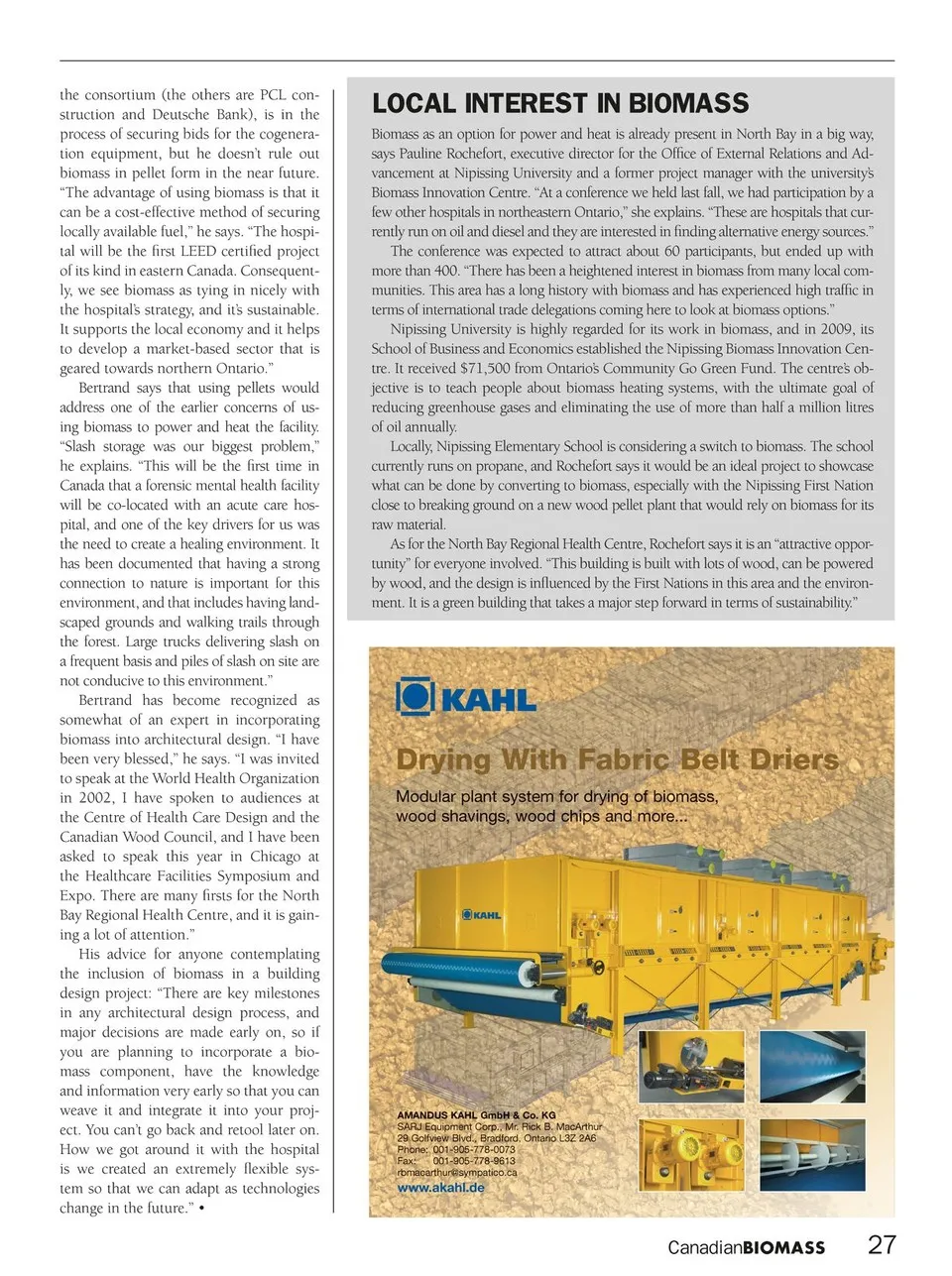
located well within the geographic range of cost effectively delivering pellets to the hospital (see sidebar below). Although Dwayne Nashkawa, the Nipissing’s ex-ecutive director, says they had hoped to have the pellet plant up and running by August 2010, the project is in limbo right now due to some land title issues, which is hampering financing efforts. “We are confident that we will be able to work through these issues and we fully expect to break ground on the plant in the spring of 2011,” he explains from the Nipissing’s office near the shore of Lake Nipissing in Garden Village, Ontario. ahead and we have created the ability to tap into fuel sources such as biomass, whether on site or off site, and to be able to hook up with our mechanical system. So we have provisions in place to use biomass or a co-generation plant,” adds Bertrand. “We really have a great deal of flexibility.” That’s good news for the Nipissing First Nation, which is in the early stages of building a wood pellet plant that will be BIOMASS ADVANTAGES Back at the North Bay Regional Health Centre, Bertrand says that at this point, Johnson Controls International, which is one of the main companies forming SUSTAINABLE PELLET PLANT FOR NIPISSING FIRST NATION Ontario’s new North Bay Regional Health Centre may provide the local Nipissing First Nation with long-term financial stabil-ity. The First Nation is close to breaking ground on a new wood pellet plant that could play a significant role in supplying the hospital with fuel for its energy needs. “We started looking at the opportunity for a pellet plant about four years ago when the whole renewable energy craze came along,” explains Dwayne Nashkawa, executive director of the Nipissing First Nation. “Our economic philosophy is the same as it has always been, and that is to derive income in a sustainable way from the rocks, the lake, and the trees. We don’t have a lot of opportunity for wind or water power, so we started looking at biomass.” Nashkawa says that they originally planned on breaking ground on the pellet plant in the summer of 2010 and wanted to be up and running by fall, which would have made it opera-tional by the time the North Bay hospital project was completed. However, he says that the project has been delayed because of an issue related to land tenure. “It’s very complicated, but in a nutshell, the site is located on land that is in the process of being returned through a land claim settlement, and the title to the land is uncertain currently (it’s in process of being returned by Ontario and Canada to Nipissing First Nation). The result is that lenders have a difficult time with providing debt financing with the uncertainty of title. But we are working through it and hope to break ground in the spring.” On the drawing board for the plant is a five-tonne/hour facil-ity that will operate 24 hours/day, five days/week. The expected 26 CanadianBIOMASS location for the plant is at the east end of the Nipissing First Nation and about five kilometres west of the new health centre. “We could provide an economically viable source of pellets to the hospital,” notes Nashkawa. “This is a com-munity owned project and there are many benefits. Our goal is not just related to economics, but it is to drive other commu-nity goals. We want to create em-ployment, we have a low-value forest that we want to clean up by using the existing fibre in the pellet plant and then we intend to rehabilitate our forest with proper silviculture techniques, and we want our own buildings and homes on the reserve to become energy self-sufficient by converting to pellets.” Nashkawa says that the project is not solely dependent on the new health centre, noting that they already have more than 20 letters of intent from potential customers around North Bay. “Not only can we supply northeastern Ontario with clean biomass, we feel we are building a model that we can transfer to other First Nations in the future.” SEPTEMBER/OCTOBER 2010
Canadian Biomass September/October 2010: Page 26