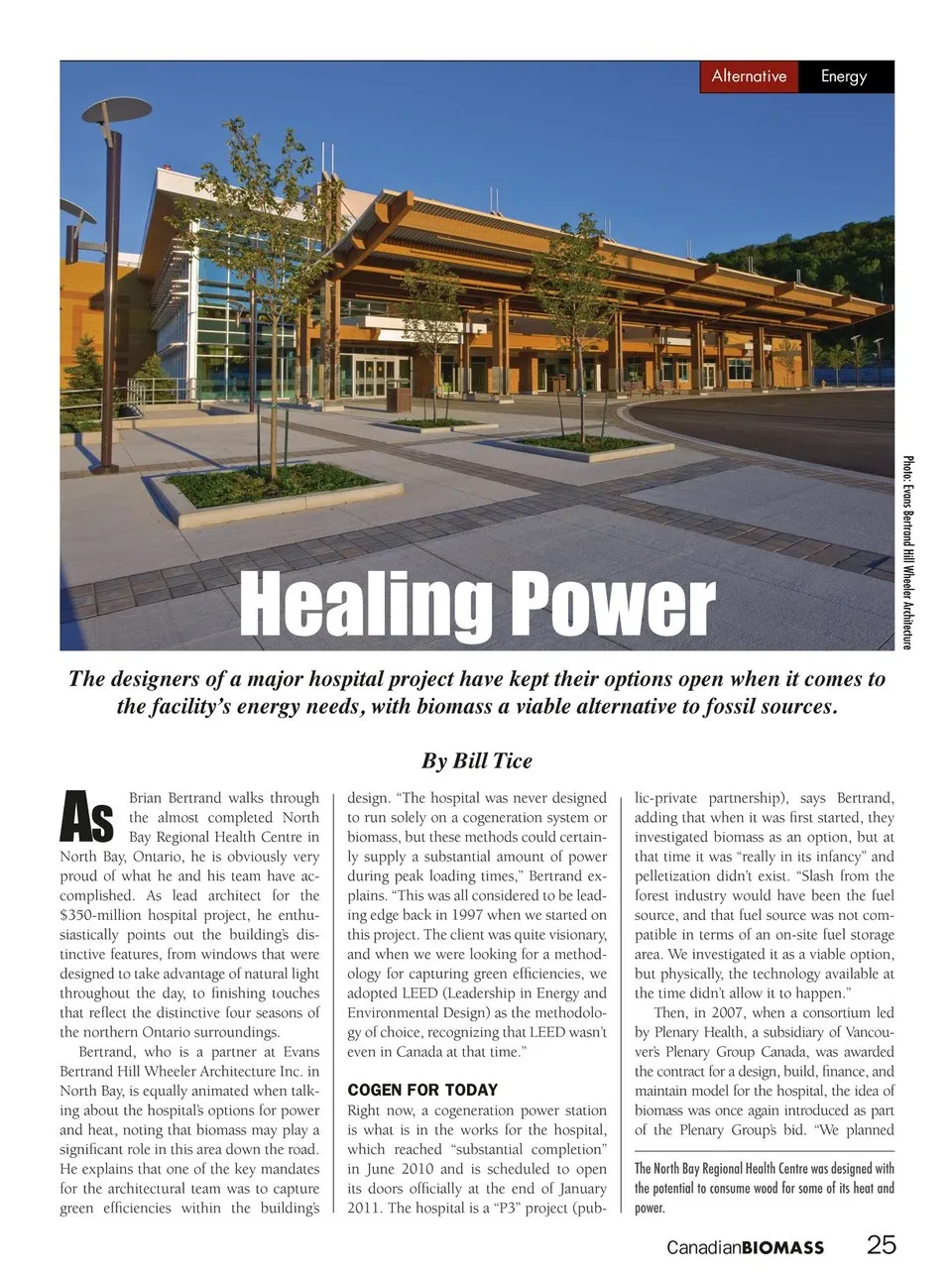
Alternative Energy Brian Bertrand walks through the almost completed North Bay Regional Health Centre in North Bay, Ontario, he is obviously very proud of what he and his team have ac-complished. As lead architect for the $350-million hospital project, he enthu-siastically points out the building’s dis-tinctive features, from windows that were designed to take advantage of natural light throughout the day, to finishing touches that reflect the distinctive four seasons of the northern Ontario surroundings. Bertrand, who is a partner at Evans Bertrand Hill Wheeler Architecture Inc. in North Bay, is equally animated when talk-ing about the hospital’s options for power and heat, noting that biomass may play a significant role in this area down the road. He explains that one of the key mandates for the architectural team was to capture green efficiencies within the building’s design. “The hospital was never designed to run solely on a cogeneration system or biomass, but these methods could certain-ly supply a substantial amount of power during peak loading times,” Bertrand ex-plains. “This was all considered to be lead-ing edge back in 1997 when we started on this project. The client was quite visionary, and when we were looking for a method-ology for capturing green efficiencies, we adopted LEED (Leadership in Energy and Environmental Design) as the methodolo-gy of choice, recognizing that LEED wasn’t even in Canada at that time.” COGEN FOR TODAY Right now, a cogeneration power station is what is in the works for the hospital, which reached “substantial completion” in June 2010 and is scheduled to open its doors officially at the end of January 2011. The hospital is a “P3” project (pub-lic-private partnership), says Bertrand, adding that when it was first started, they investigated biomass as an option, but at that time it was “really in its infancy” and pelletization didn’t exist. “Slash from the forest industry would have been the fuel source, and that fuel source was not com-patible in terms of an on-site fuel storage area. We investigated it as a viable option, but physically, the technology available at the time didn’t allow it to happen.” Then, in 2007, when a consortium led by Plenary Health, a subsidiary of Vancou-ver’s Plenary Group Canada, was awarded the contract for a design, build, finance, and maintain model for the hospital, the idea of biomass was once again introduced as part of the Plenary Group’s bid. “We planned CanadianBIOMASS 25
Canadian Biomass September/October 2010: Page 25