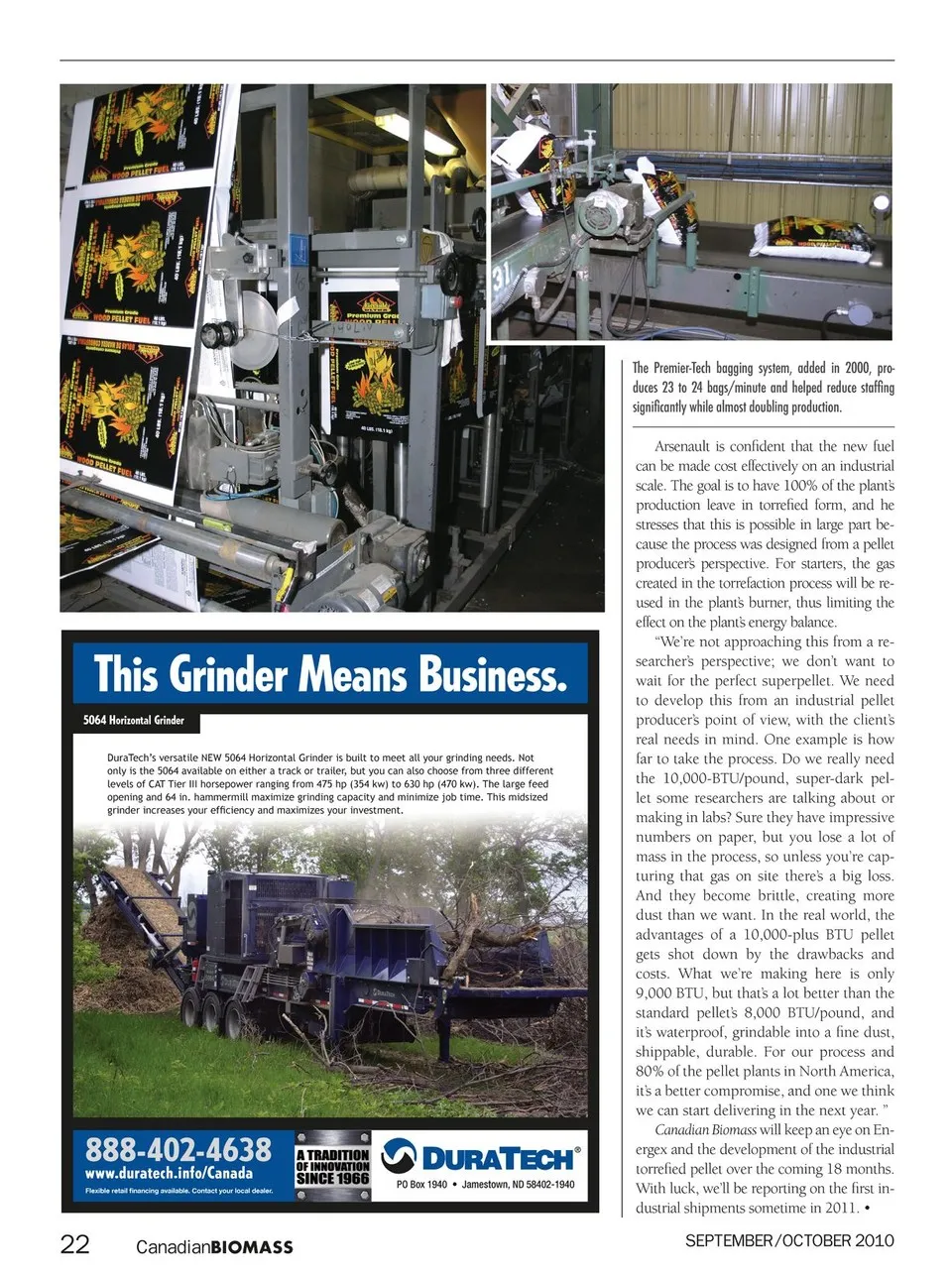
EVENTS BOARD SAFETY LEADER It has been almost 30 years since Shell built the Energex pellet plant in Lac-Mégantic, Quebec, yet the oil company’s fingerprints are still visible. Although the pellet industry continues to struggle with fire and explosion safety issues to this day, Shell seemed to have the answer back in 1982: build the plant as if it were an oil refinery. “You’ll see details here that you won’t find in other pellet plants,” John Arsenault explains while touring the fibre process-ing area. Pointing to what looks like a 1970s science project, he continues. “We have explosion detection systems like that in areas of the plant at risk, like dry fibre bins, grinders. We have Flamex spark detection systems of course, but these are differ-ent. They detect the slightest increase in pressure and immedi-ately react with Halon or another inert gas. We’re processing a fuel here, and Shell built accordingly. Explosions will happen; we know that from experience. Here, they are contained with minimal damage.” The plant also uses aggressive venting to reduce explosion risks. For instance, garage doors are made of plastic panels that blow out in the event of ex-plosive forces, and the upper windows are hinged and on fish wire to allow them to release pressure as well. Recently, the plant replaced its cyclones with new stainless steel models from Rodrigue Metal to improve longevity. These are also vented outside. The plant was built to accept a wide range of raw materials, which has allowed Energex to move from almost 100% sawdust to a mixed diet in re-cent years. After sampling for both moisture and ash, the raw material goes to either a storage silo in the case of rare dry mate-rial, or more often to storage and then into the plant via Cat or Komatsu wheel loaders. The processing equipment can handle anything up to four inches in size, and indeed, the stockpiles include sawmill trim ends, among other material. Following grinding comes drying in a new MEC 13 by 48-foot, direct-fired, triple-pass dryer, added in 2008. It’s the largest unit that could fit in the existing footprint, right in the heart of the mill. The material is ground again prior to the pellet mill, process steam is added from the biomass boiler, and the material feeds the plant’s five pellet mills. The plant can store up to 5,000 tonnes in covered stor-age on site, thanks to its original industrial customer base. Cooled pellets are sent here or to the bagging line. The origi-nal bagger line, added in 1993 to enter the residential mar-ket, required eight workers per shift to bag 80 tonnes. The existing line, added in 2000, needs just two workers to bag 150 tonnes. It features a Premier-Tech bagger working at 23 to 24 bags/minute, a Faiveley automatic palletizer, and a Muller five-sided stretch hood system for climate protection. CanadianBIOMASS 23 OCTOBER 31–NOVEMBER 3, 2010 • Gasification Technologies Conference Washington, DC www.gasification.org/eventDetail.asp?a=4&eventID=2 NOVEMBER 2-4, 2010 • Southeast Biomass Conference & Expo Atlanta, GA http://se.biomassconference.com NOVEMBER 15-16, 2010 • Community Power Conference Toronto, ON www.cpconference.ca NOVEMBER 16-18, 2010 • Midwest Biomass Conference Dubuque, IO www.midwestbiomassconference.com NOVEMBER 29–DECEMBER 1, 2010 • Canadian Renewable Fuels Summit Gatineau, QC www.crfs2010.com JANUARY 10-12, 2011 • Pacific West Biomass Conference & Expo Seattle, WA www.biomassconference.com/pacificwest Moreevents at canadianbiomassmagazine.com
Canadian Biomass September/October 2010: Page 23