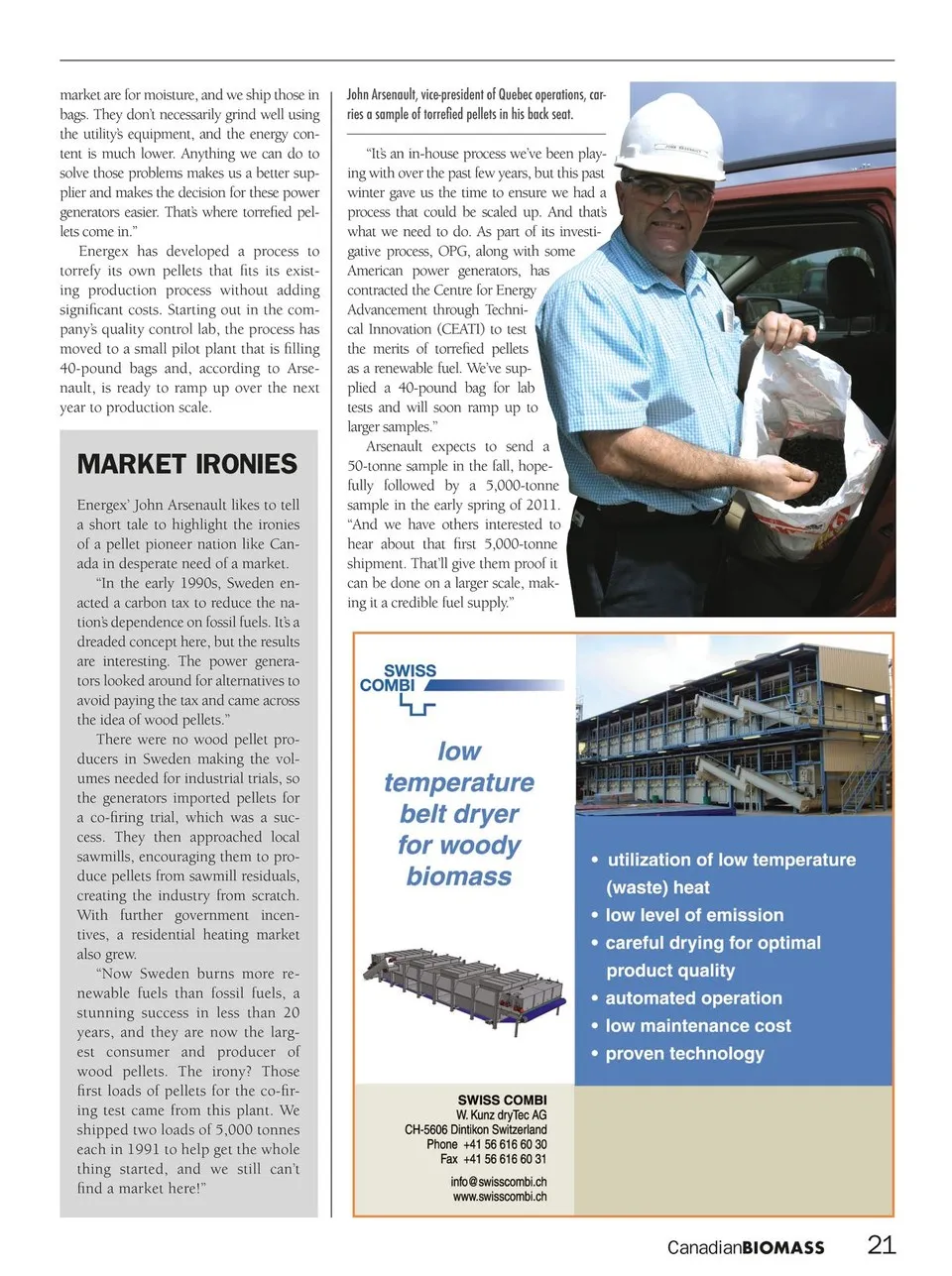
market are for moisture, and we ship those in bags. They don’t necessarily grind well using the utility’s equipment, and the energy con-tent is much lower. Anything we can do to solve those problems makes us a better sup-plier and makes the decision for these power generators easier. That’s where torrefied pel-lets come in.” Energex has developed a process to torrefy its own pellets that fits its exist-ing production process without adding significant costs. Starting out in the com-pany’s quality control lab, the process has moved to a small pilot plant that is filling 40-pound bags and, according to Arse-nault, is ready to ramp up over the next year to production scale. MARKET IRONIES Energex’ John Arsenault likes to tell a short tale to highlight the ironies of a pellet pioneer nation like Can-ada in desperate need of a market. “In the early 1990s, Sweden en-acted a carbon tax to reduce the na-tion’s dependence on fossil fuels. It’s a dreaded concept here, but the results are interesting. The power genera-tors looked around for alternatives to avoid paying the tax and came across the idea of wood pellets.” There were no wood pellet pro-ducers in Sweden making the vol-umes needed for industrial trials, so the generators imported pellets for a co-firing trial, which was a suc-cess. They then approached local sawmills, encouraging them to pro-duce pellets from sawmill residuals, creating the industry from scratch. With further government incen-tives, a residential heating market also grew. “Now Sweden burns more re-newable fuels than fossil fuels, a stunning success in less than 20 years, and they are now the larg-est consumer and producer of wood pellets. The irony? Those first loads of pellets for the co-fir-ing test came from this plant. We shipped two loads of 5,000 tonnes each in 1991 to help get the whole thing started, and we still can’t find a market here!” CanadianBIOMASS 21 “It’s an in-house process we’ve been play-ing with over the past few years, but this past winter gave us the time to ensur process that could be scaled up. And that’ what we need to do. As part of its investi-gative process, OPG, along with some American power generators, has contracted the Centre for Energy Advancement through Techni-cal Innovation (CEATI) to test the merits of torrefied pellets as a renewable fuel. We’ve sup-plied a 40-pound bag for lab tests and will soon ramp up to larger samples.” Arsenault expects to send a 50-tonne sample in the fall, hope-fully followed by a 5,000-tonne sample in the early spring of 2011. “And we have others interested to hear about that first 5,000-tonne shipment. That’ll give them proof it can be done on a larger scale, mak-ing it a credible fuel supply.”
Canadian Biomass September/October 2010: Page 21