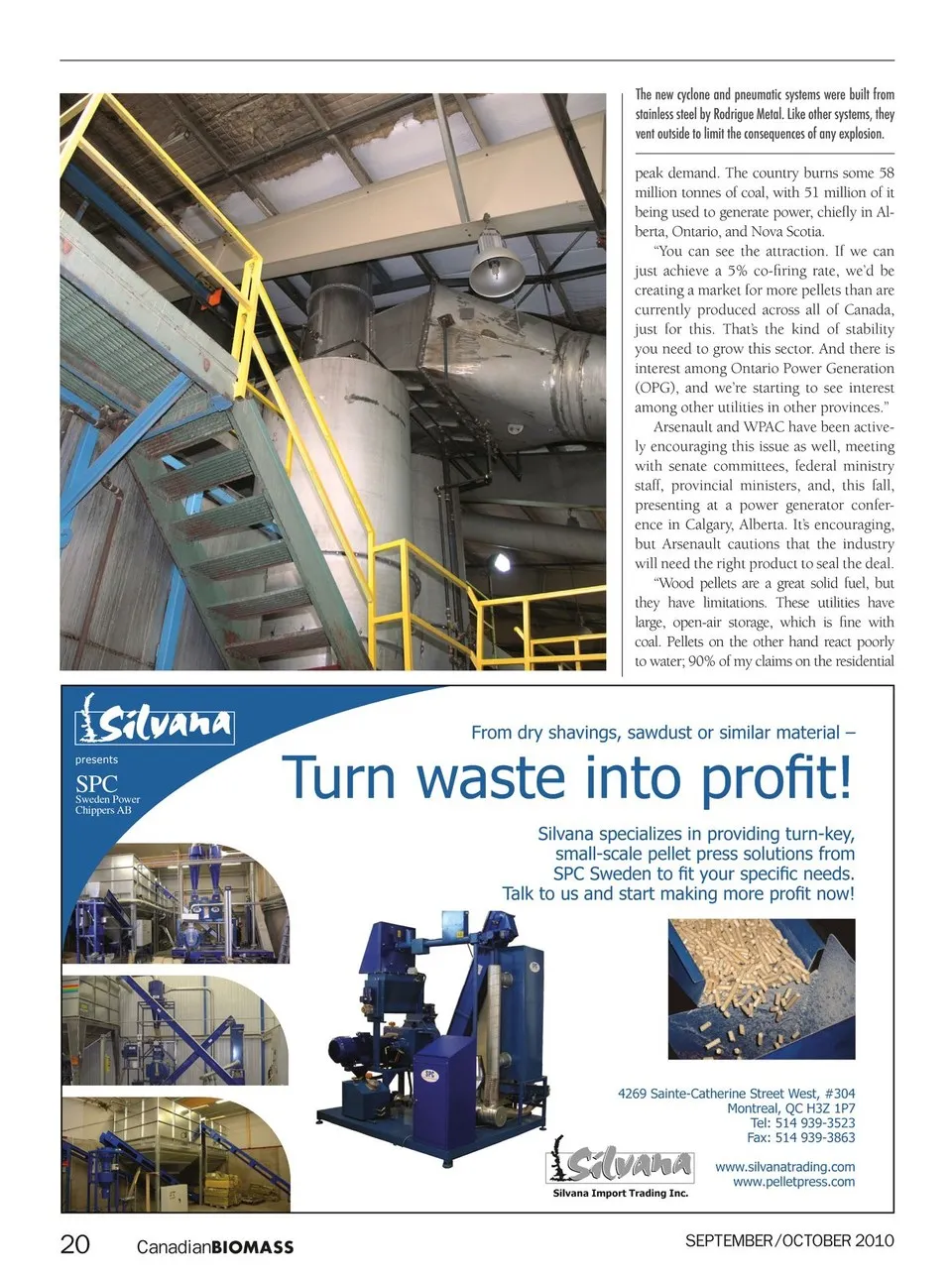
peak demand. The country burns some 58 million tonnes of coal, with 51 million of it being used to generate power, chiefly in Al-berta, Ontario, and Nova Scotia. “You can see the attraction. If we can just achieve a 5% co-firing rate, we’d be creating a market for more pellets than are currently produced across all of Canada, just for this. That’s the kind of stability you need to grow this sector. And there is interest among Ontario Power Generation (OPG), and we’re starting to see interest among other utilities in other provinces.” Arsenault and WPAC have been active-ly encouraging this issue as well, meeting with senate committees, federal ministry staff, provincial ministers, and, this fall, presenting at a power generator confer-ence in Calgary, Alberta. It’s encouraging, but Arsenault cautions that the industry will need the right product to seal the deal. “Wood pellets are a great solid fuel, but they have limitations. These utilities have large, open-air storage, which is fine with coal. Pellets on the other hand react poorly to water; 90% of my claims on the residential SPC Sweden Power Chippers AB 20 CanadianBIOMASS SEPTEMBER/OCTOBER 2010
Canadian Biomass September/October 2010: Page 20