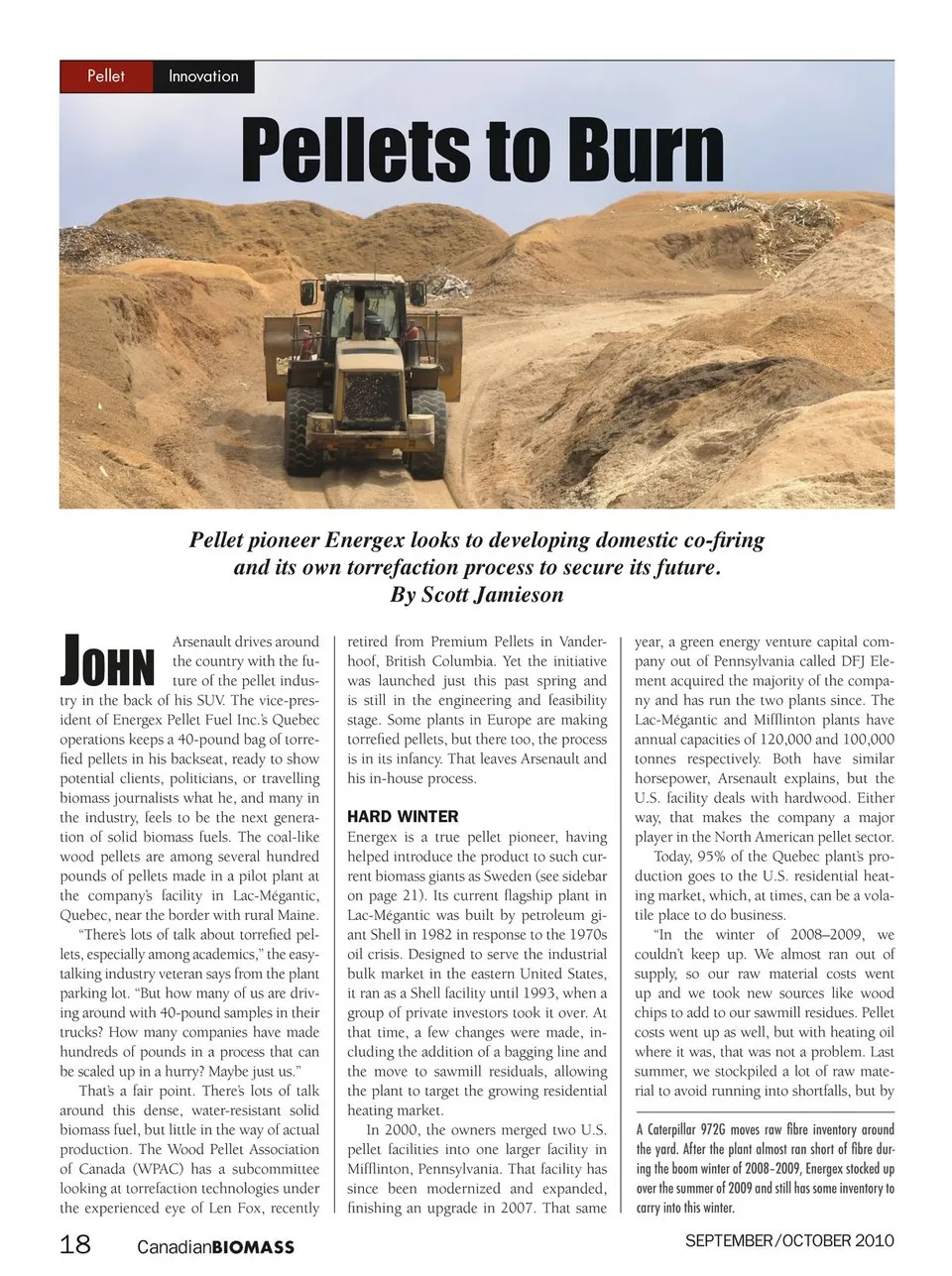
Pellet Innovation Arsenault drives around the country with the fu-ture of the pellet indus-try in the back of his SUV. The vice-pres-ident of Energex Pellet Fuel Inc.’s Quebec operations keeps a 40-pound bag of torre-fied pellets in his backseat, ready to show potential clients, politicians, or travelling biomass journalists what he, and many in the industry, feels to be the next genera-tion of solid biomass fuels. The coal-like wood pellets are among several hundred pounds of pellets made in a pilot plant at the company’s facility in Lac-Mégantic, Quebec, near the border with rural Maine. “There’s lots of talk about torrefied pel-lets, especially among academics,” the easy-talking industry veteran says from the plant parking lot. “But how many of us are driv-ing around with 40-pound samples in their trucks? How many companies have made hundreds of pounds in a process that can be scaled up in a hurry? Maybe just us.” That’s a fair point. There’s lots of talk around this dense, water-resistant solid biomass fuel, but little in the way of actual production. The Wood Pellet Association of Canada (WPAC) has a subcommittee looking at torrefaction technologies under the experienced eye of Len Fox, recently 18 CanadianBIOMASS retired from Premium Pellets in Vander-hoof, British Columbia. Yet the initiative was launched just this past spring and is still in the engineering and feasibility stage. Some plants in Europe are making torrefied pellets, but there too, the process is in its infancy. That leaves Arsenault and his in-house process. HARD WINTER Energex is a true pellet pioneer, having helped introduce the product to such cur-rent biomass giants as Sweden (see sidebar on page 21). Its current flagship plant in Lac-Mégantic was built by petroleum gi-ant Shell in 1982 in response to the 1970s oil crisis. Designed to serve the industrial bulk market in the eastern United States, it ran as a Shell facility until 1993, when a group of private investors took it over. At that time, a few changes were made, in-cluding the addition of a bagging line and the move to sawmill residuals, allowing the plant to target the growing residential heating market. In 2000, the owners merged two U.S. pellet facilities into one larger facility in Mifflinton, Pennsylvania. That facility has since been modernized and expanded, finishing an upgrade in 2007. That same year, a green energy venture capital com-pany out of Pennsylvania called DFJ Ele-ment acquired the majority of the compa-ny and has run the two plants since. The Lac-Mégantic and Mifflinton plants have annual capacities of 120,000 and 100,000 tonnes respectively. Both have similar horsepower, Arsenault explains, but the U.S. facility deals with hardwood. Either way, that makes the company a major player in the North American pellet sector. Today, 95% of the Quebec plant’s pro-duction goes to the U.S. residential heat-ing market, which, at times, can be a vola-tile place to do business. “In the winter of 2008–2009, we couldn’t keep up. We almost ran out of supply, so our raw material costs went up and we took new sources like wood chips to add to our sawmill residues. Pellet costs went up as well, but with heating oil where it was, that was not a problem. Last summer, we stockpiled a lot of raw mate-rial to avoid running into shortfalls, but by SEPTEMBER/OCTOBER 2010
Canadian Biomass September/October 2010: Page 18