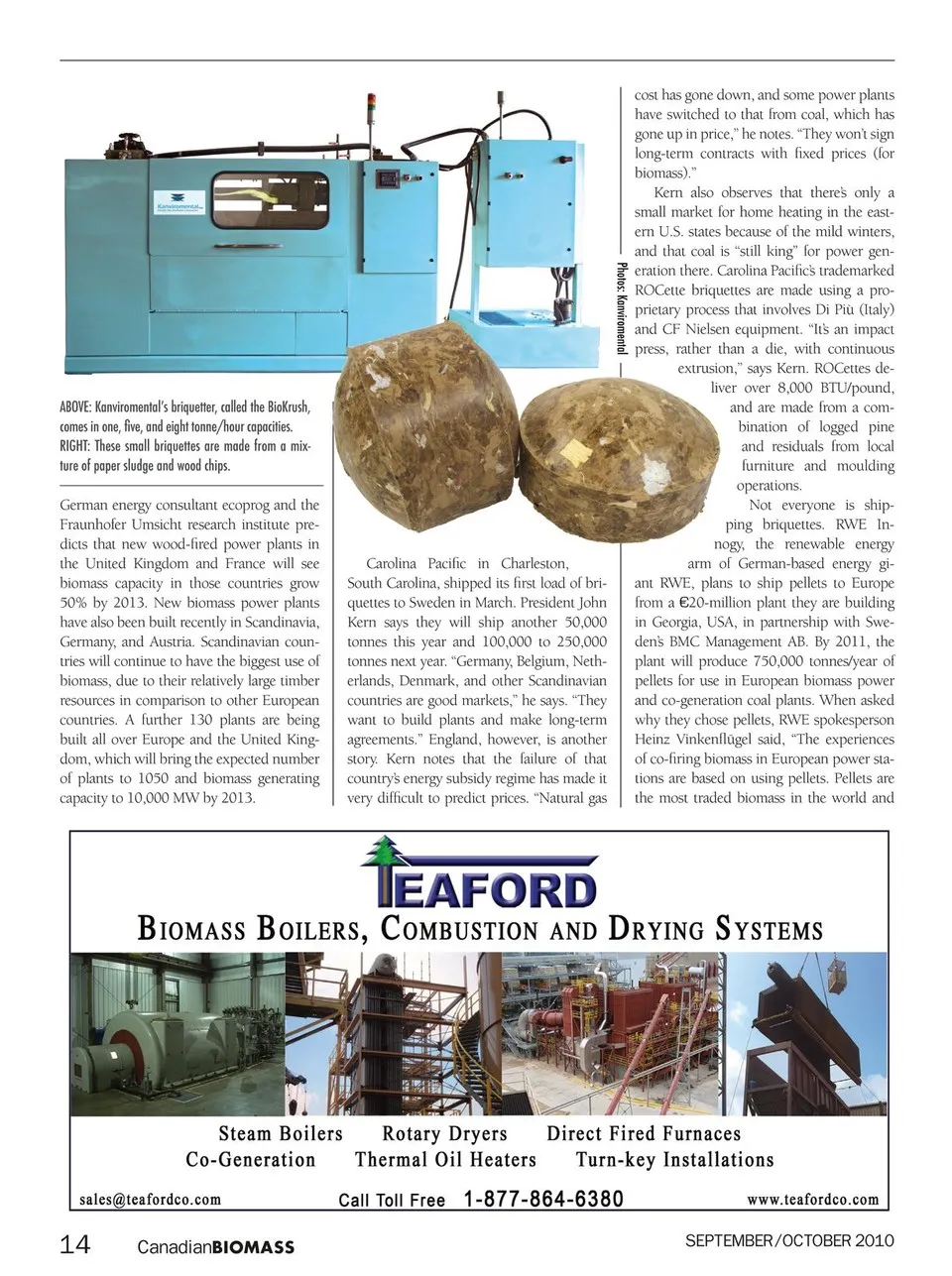
German energy consultant ecoprog and the Fraunhofer Umsicht research institute pre-dicts that new wood-fired power plants in the United Kingdom and France will see biomass capacity in those countries grow 50% by 2013. New biomass power plants have also been built recently in Scandinavia, Germany, and Austria. Scandinavian coun-tries will continue to have the biggest use of biomass, due to their relatively large timber resources in comparison to other European countries. A further 130 plants are being built all over Europe and the United King-dom, which will bring the expected number of plants to 1050 and biomass generating capacity to 10,000 MW by 2013. cost has gone down, and some power plants have switched to that from coal, which has gone up in price,” he notes. “They won’t sign long-term contracts with fixed prices (for biomass).” Kern also observes that there’s only a small market for home heating in the east-ern U.S. states because of the mild winters, and that coal is “still king” for power gen-eration there. Carolina Pacific’s trademarked ROCette briquettes are made using a pro-prietary process that involves Di Più (Italy) and CF Nielsen equipment. “It’s an impact ess, rather than a die, with continuous extrusion,” says Kern. ROCettes de-liver over 8,000 BTU/pound, and are made from a com-bination of logged pine and residuals from local furniture and moulding operations. Not everyone is ship-ping briquettes. RWE In-Carolina Pacific in Charleston, South Carolina, shipped its first load of bri-quettes to Sweden in March. President John Kern says they will ship another 50,000 tonnes this year and 100,000 to 250,000 tonnes next year. “Germany, Belgium, Neth-erlands, Denmark, and other Scandinavian countries are good markets,” he says. “They want to build plants and make long-term agreements.” England, however, is another story. Kern notes that the failure of that country’s energy subsidy regime has made it very difficult to predict prices. “Natural gas nogy, the renewable energy arm of German-based energy gi-ant RWE, plans to ship pellets to Europe from a 20-million plant they are building in Georgia, USA, in partnership with Swe-den’s BMC Management AB. By 2011, the plant will produce 750,000 tonnes/year of pellets for use in European biomass power and co-generation coal plants. When asked why they chose pellets, RWE spokesperson Heinz Vinkenflügel said, “The experiences of co-firing biomass in European power sta-tions are based on using pellets. Pellets are the most traded biomass in the world and 14 CanadianBIOMASS SEPTEMBER/OCTOBER 2010
Canadian Biomass September/October 2010: Page 14