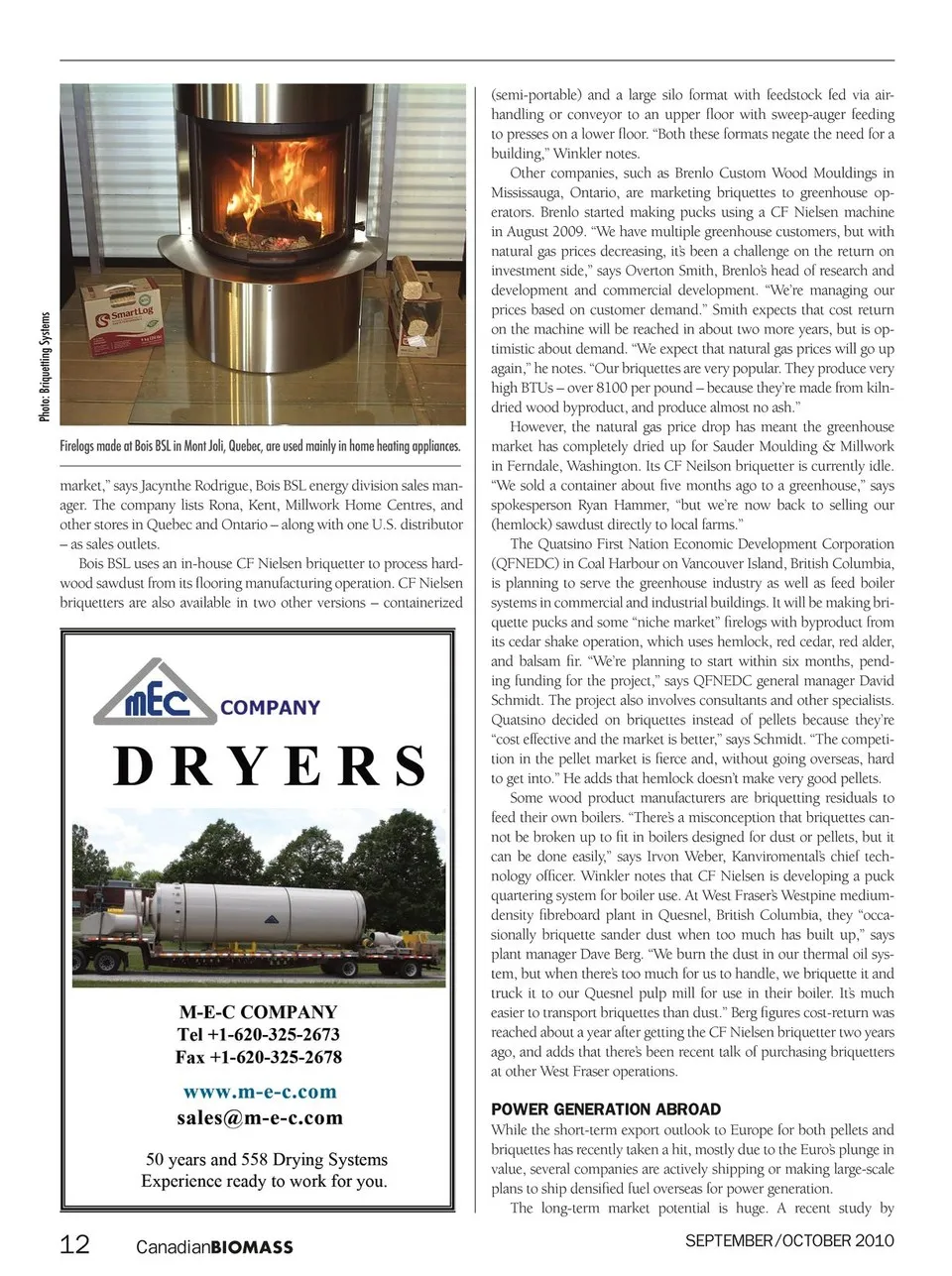
market,” says Jacynthe Rodrigue, Bois BSL energy division sales man-ager. The company lists Rona, Kent, Millwork Home Centres, and other stores in Quebec and Ontario – along with one U.S. distributor – as sales outlets. Bois BSL uses an in-house CF Nielsen briquetter to process hard-wood sawdust from its flooring manufacturing operation. CF Nielsen briquetters are also available in two other versions – containerized (semi-portable) and a large silo format with feedstock fed via air-handling or conveyor to an upper floor with sweep-auger feeding to presses on a lower floor. “Both these formats negate the need for a building,” Winkler notes. Other companies, such as Brenlo Custom Wood Mouldings in Mississauga, Ontario, are marketing briquettes to greenhouse op-erators. Brenlo started making pucks using a CF Nielsen machine in August 2009. “We have multiple greenhouse customers, but with natural gas prices decreasing, it’s been a challenge on the return on investment side,” says Overton Smith, Brenlo’s head of research and development and commercial development. “We’re managing our prices based on customer demand.” Smith expects that cost return on the machine will be reached in about two more years, but is op-timistic about demand. “We expect that natural gas prices will go up again,” he notes. “Our briquettes are very popular. They produce very high BTUs – over 8100 per pound – because they’re made from kiln-dried wood byproduct, and produce almost no ash.” However, the natural gas price drop has meant the greenhouse market has completely dried up for Sauder Moulding & Millwork in Ferndale, Washington. Its CF Neilson briquetter is currently idle. “We sold a container about five months ago to a greenhouse,” says spokesperson Ryan Hammer, “but we’re now back to selling our (hemlock) sawdust directly to local farms.” The Quatsino First Nation Economic Development Corporation (QFNEDC) in Coal Harbour on Vancouver Island, British Columbia, is planning to serve the greenhouse industry as well as feed boiler systems in commercial and industrial buildings. It will be making bri-quette pucks and some “niche market” firelogs with byproduct from its cedar shake operation, which uses hemlock, red cedar, red alder, and balsam fir. “We’re planning to start within six months, pend-ing funding for the project,” says QFNEDC general manager David Schmidt. The project also involves consultants and other specialists. Quatsino decided on briquettes instead of pellets because they’re “cost effective and the market is better,” says Schmidt. “The competi-tion in the pellet market is fierce and, without going overseas, hard to get into.” He adds that hemlock doesn’t make very good pellets. Some wood product manufacturers are briquetting residuals to feed their own boilers. “There’s a misconception that briquettes can-not be broken up to fit in boilers designed for dust or pellets, but it can be done easily,” says Irvon Weber, Kanviromental’s chief tech-nology officer. Winkler notes that CF Nielsen is developing a puck quartering system for boiler use. At West Fraser’s Westpine medium-density fibreboard plant in Quesnel, British Columbia, they “occa-sionally briquette sander dust when too much has built up,” says plant manager Dave Berg. “We burn the dust in our thermal oil sys-tem, but when there’s too much for us to handle, we briquette it and truck it to our Quesnel pulp mill for use in their boiler. It’s much easier to transport briquettes than dust.” Berg figures cost-return was reached about a year after getting the CF Nielsen briquetter two years ago, and adds that there’s been recent talk of purchasing briquetters at other West Fraser operations. POWER GENERATION ABROAD While the short-term export outlook to Europe for both pellets and briquettes has recently taken a hit, mostly due to the Euro’s plunge in value, several companies are actively shipping or making large-scale plans to ship densified fuel overseas for power generation. The long-term market potential is huge. A recent study by 12 CanadianBIOMASS SEPTEMBER/OCTOBER 2010
Canadian Biomass September/October 2010: Page 12