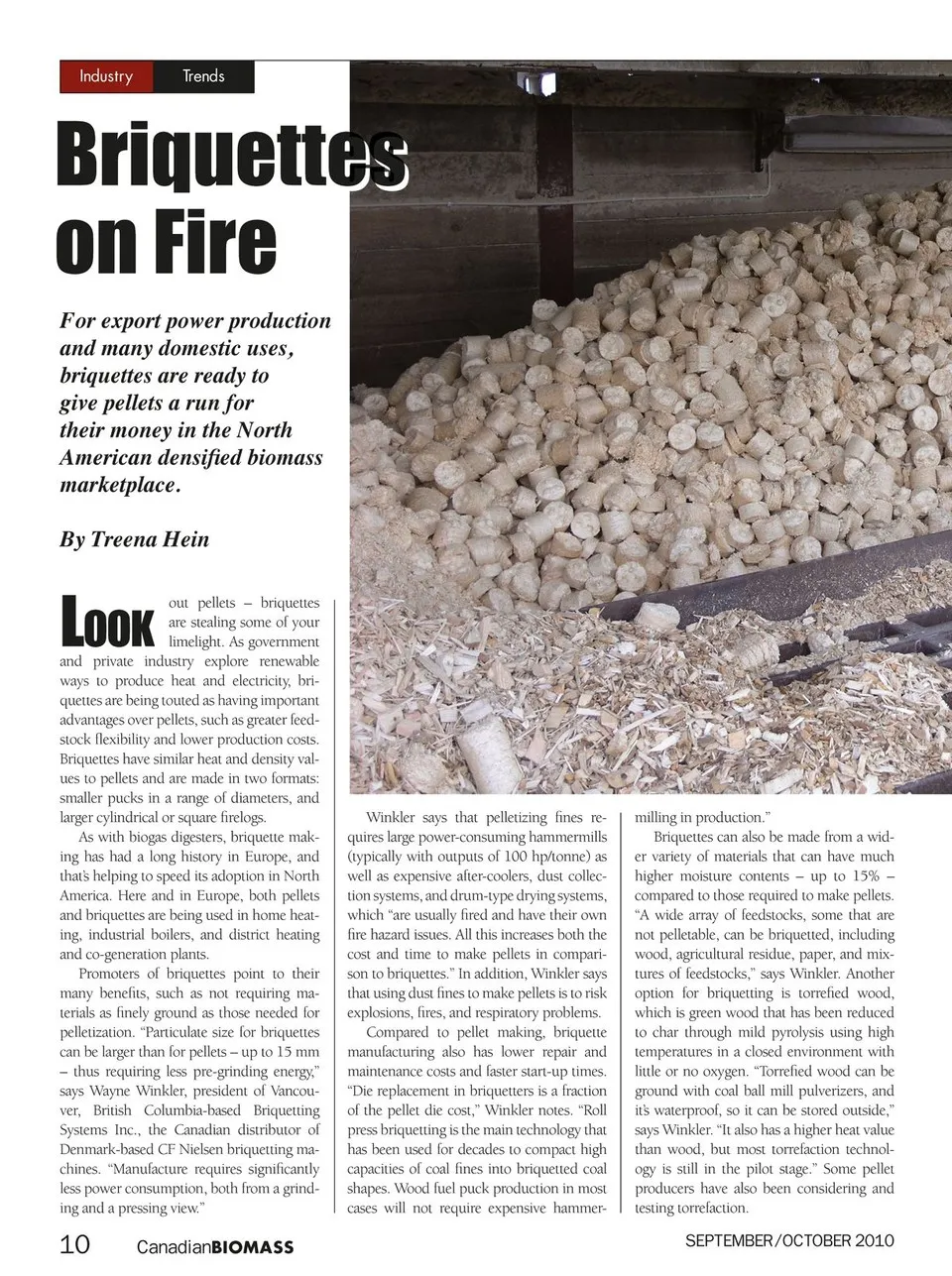
Industry Trends out pellets – briquettes are stealing some of your limelight. As government and private industry explore renewable ways to produce heat and electricity, bri-quettes are being touted as having important advantages over pellets, such as greater feed-stock flexibility and lower production costs. Briquettes have similar heat and density val-ues to pellets and are made in two formats: smaller pucks in a range of diameters, and larger cylindrical or square firelogs. As with biogas digesters, briquette mak-ing has had a long history in Europe, and that’s helping to speed its adoption in North America. Here and in Europe, both pellets and briquettes are being used in home heat-ing, industrial boilers, and district heating and co-generation plants. Promoters of briquettes point to their many benefits, such as not requiring ma-terials as finely ground as those needed for pelletization. “Particulate size for briquettes can be larger than for pellets – up to 15 mm – thus requiring less pre-grinding energy,” says Wayne Winkler, president of Vancou-ver, British Columbia-based Briquetting Systems Inc., the Canadian distributor of Denmark-based CF Nielsen briquetting ma-chines. “Manufacture requires significantly less power consumption, both from a grind-ing and a pressing view.” 10 CanadianBIOMASS Winkler says that pelletizing fines re-quires large power-consuming hammermills (typically with outputs of 100 hp/tonne) as well as expensive after-coolers, dust collec-tion systems, and drum-type drying systems, which “are usually fired and have their own fire hazard issues. All this increases both the cost and time to make pellets in compari-son to briquettes.” In addition, Winkler says that using dust fines to make pellets is to risk explosions, fires, and respiratory problems. Compared to pellet making, briquette manufacturing also has lower repair and maintenance costs and faster start-up times. “Die replacement in briquetters is a fraction of the pellet die cost,” Winkler notes. “Roll press briquetting is the main technology that has been used for decades to compact high capacities of coal fines into briquetted coal shapes. Wood fuel puck production in most cases will not require expensive hammer-milling in production.” Briquettes can also be made from a wid-er variety of materials that can have much higher moisture contents – up to 15% – compared to those required to make pellets. “A wide array of feedstocks, some that are not pelletable, can be briquetted, including wood, agricultural residue, paper, and mix-tures of feedstocks,” says Winkler. Another option for briquetting is torrefied wood, which is green wood that has been reduced to char through mild pyrolysis using high temperatures in a closed environment with little or no oxygen. “Torrefied wood can be ground with coal ball mill pulverizers, and it’s waterproof, so it can be stored outside,” says Winkler. “It also has a higher heat value than wood, but most torrefaction technol-ogy is still in the pilot stage.” Some pellet producers have also been considering and testing torrefaction. SEPTEMBER/OCTOBER 2010
Canadian Biomass September/October 2010: Page 10