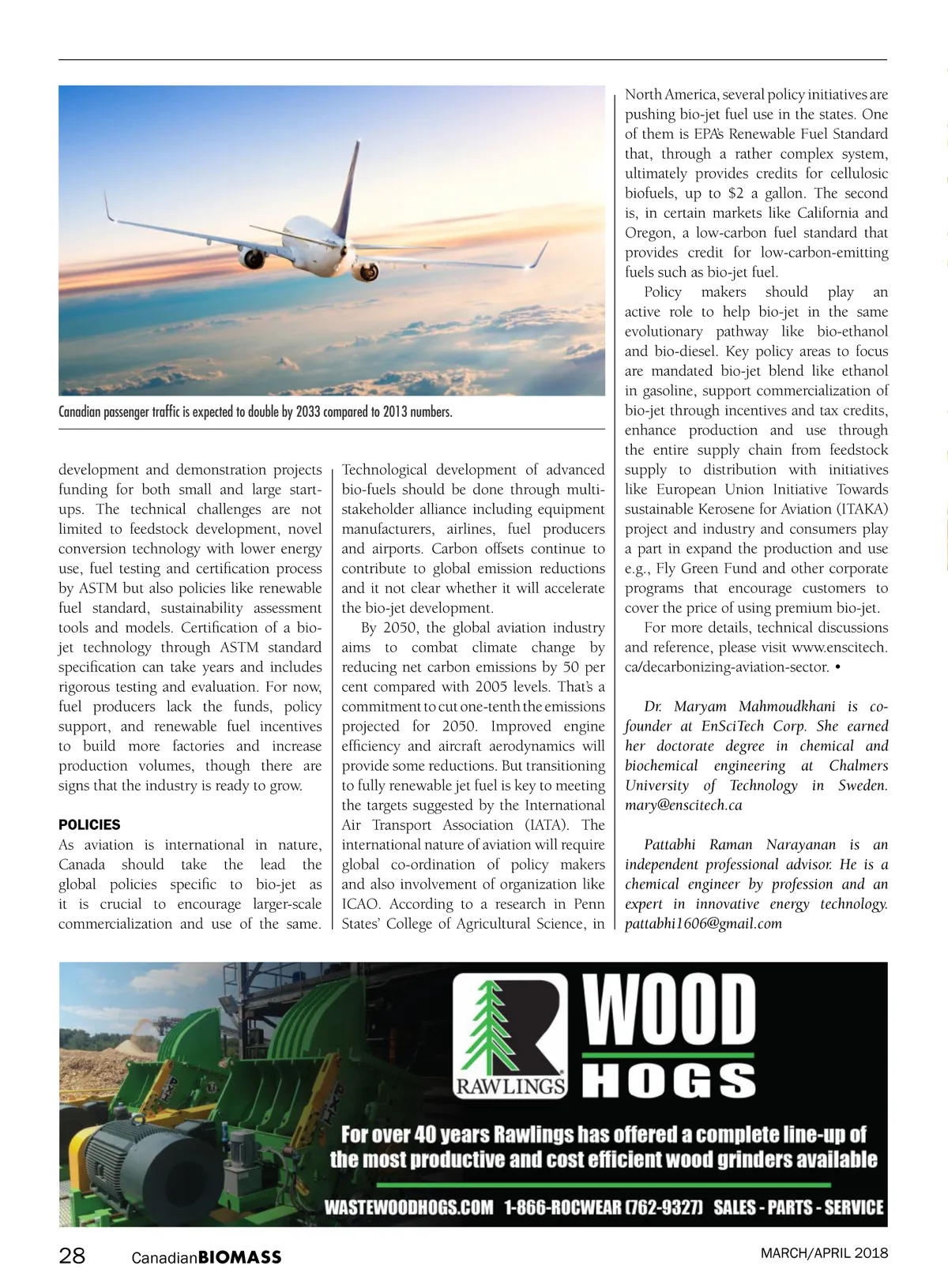
Canadian passenger traffic is expected to double by 2033 compared to 2013 numbers. development and demonstration projects funding for both small and large start-ups. The technical challenges are not limited to feedstock development, novel conversion technology with lower energy use, fuel testing and certification process by ASTM but also policies like renewable fuel standard, sustainability assessment tools and models. Certification of a bio-jet technology through ASTM standard specification can take years and includes rigorous testing and evaluation. For now, fuel producers lack the funds, policy support, and renewable fuel incentives to build more factories and increase production volumes, though there are signs that the industry is ready to grow. POLICIES As aviation is international in nature, Canada should take the lead the global policies specific to bio-jet as it is crucial to encourage larger-scale commercialization and use of the same. Technological development of advanced bio-fuels should be done through multi-stakeholder alliance including equipment manufacturers, airlines, fuel producers and airports. Carbon offsets continue to contribute to global emission reductions and it not clear whether it will accelerate the bio-jet development. By 2050, the global aviation industry aims to combat climate change by reducing net carbon emissions by 50 per cent compared with 2005 levels. That’s a commitment to cut one-tenth the emissions projected for 2050. Improved engine efficiency and aircraft aerodynamics will provide some reductions. But transitioning to fully renewable jet fuel is key to meeting the targets suggested by the International Air Transport Association (IATA). The international nature of aviation will require global co-ordination of policy makers and also involvement of organization like ICAO. According to a research in Penn States’ College of Agricultural Science, in North America, several policy initiatives are pushing bio-jet fuel use in the states. One of them is EPA’s Renewable Fuel Standard that, through a rather complex system, ultimately provides credits for cellulosic biofuels, up to $2 a gallon. The second is, in certain markets like California and Oregon, a low-carbon fuel standard that provides credit for low-carbon-emitting fuels such as bio-jet fuel. Policy makers should play an active role to help bio-jet in the same evolutionary pathway like bio-ethanol and bio-diesel. Key policy areas to focus are mandated bio-jet blend like ethanol in gasoline, support commercialization of bio-jet through incentives and tax credits, enhance production and use through the entire supply chain from feedstock supply to distribution with initiatives like European Union Initiative Towards sustainable Kerosene for Aviation (ITAKA) project and industry and consumers play a part in expand the production and use e.g., Fly Green Fund and other corporate programs that encourage customers to cover the price of using premium bio-jet. For more details, technical discussions and reference, please visit www.enscitech. ca/decarbonizing-aviation-sector. • Dr. Maryam Mahmoudkhani is co-founder at EnSciTech Corp. She earned her doctorate degree in chemical and biochemical engineering at Chalmers University of Technology in Sweden. [email protected] Pattabhi Raman Narayanan is an independent professional advisor. He is a chemical engineer by profession and an expert in innovative energy technology. [email protected] 28 Canadian BIOMASS CFI_Rawlings_quart_horiz_JanFeb18_CSA.indd MARCH/APRIL 2018 1 2018-01-03 8:10 AM
Canadian Biomass March April 2018: Page 28