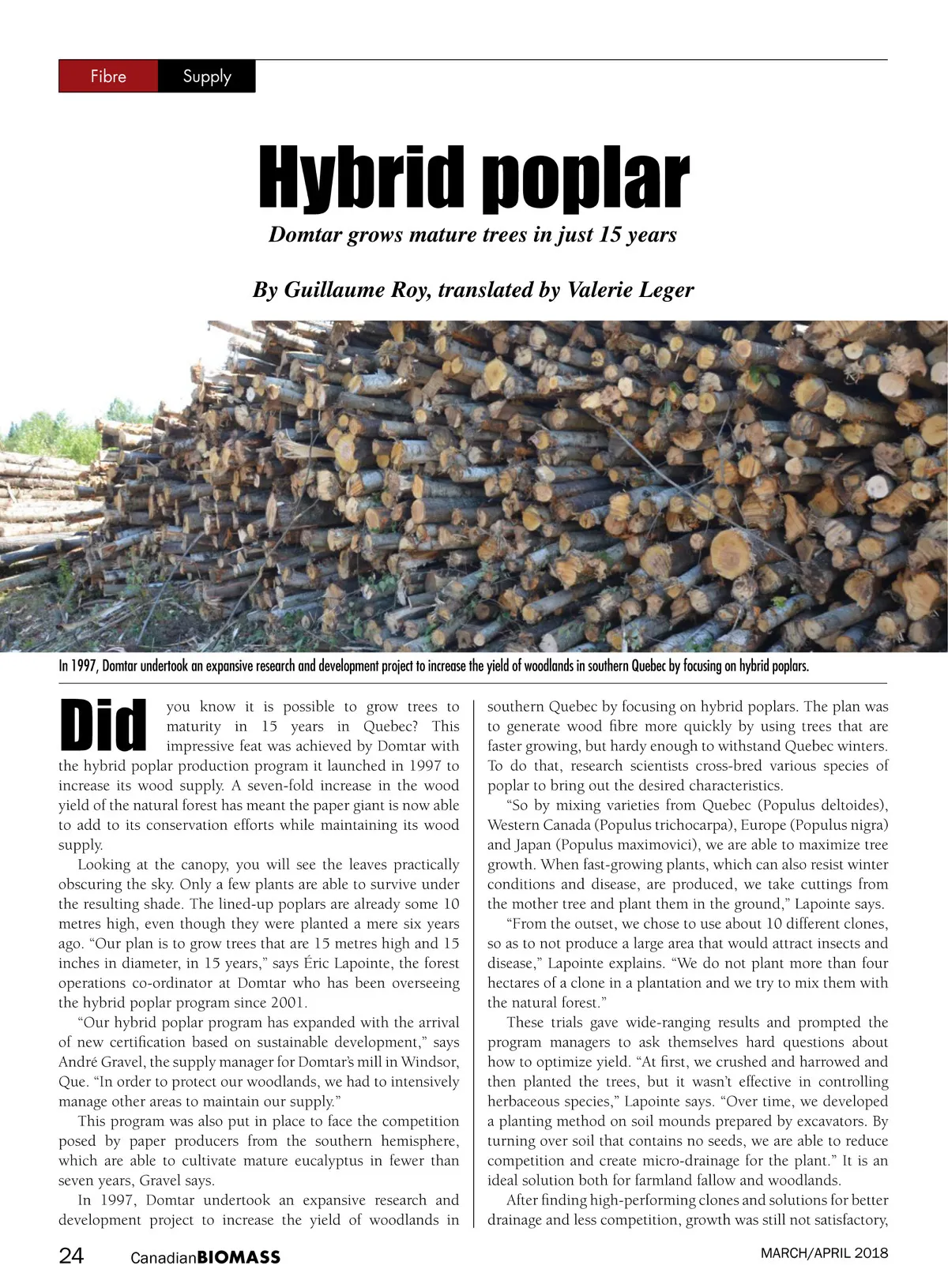
Lapointe says. “We realized soils were highly acidic and nutrient availability was very low. At times, we acted more like agronomists than foresters and to increase soil fertility, we decided to spread paper sludge, which in the past ended up in landfills,” he says. The success of the paper fertilizer was instantaneous. The trees grew roughly two metres per year afterwards. “It was the missing piece of the puzzle. Without the sludge, we would have had to nix the hybrid poplar program, since we were not able to reach desired results,” Lapointe says. The paper sludge’s impact is particularly striking in one of Domtar’s plantations where a sludge-free control forest sits next to a fertilized one. In the control forest, the poplars struggle to get through the birch trees and herbaceous species, whereas in the sludge-fertilized forest, they dominate. Today, Domtar plants 900 hybrid poplars per hectare in rows separated by 15-to 18-metre-wide trails to facilitate harvest and sludge spreading. Sludge is spread during planting and five years later. Studies are currently underway to determine if adding the sludge a second time is effective. Twenty years later, after a number of failures and challenges, Domtar is reaping the benefits of its efforts since the paper giant is now able to grow trees in 15 years that are 15 inches in diameter and 15 metres high. In other words, the company aims for a yield of 15 m3/year for a total of 225 m3/hectare at harvest, an objective that sometimes takes 21 years. “The yield is reached seven times faster than with the natural forest and more than three times faster than with quaking aspen in the Estrie region,” Lapointe says. Stepping up forest management is a large component of the objective to minimize the impact on biodiversity and protect certain areas, as was the case in Potton, in the Green Mountains, where Domtar helped protect 4,500 hectares (one part was donated, the other sold). “We do not want to plant hybrid poplars everywhere,” Lapointe says. “We aim for five per cent of the 160,000 hectares of land owned by Domtar. For the moment, we have 6,000 hectares planted with poplars and have our sights set on 8,000 hectares.” With the hybrid poplar program, Domtar is seeking to copy the Triad forest management model under which one part of the forest is protected, a second part is managed with an ecosystem-based approach and the last part is managed intensively. According to Gravel, intensive management should be an essential part of forestry planning when it comes to Quebec’s public forests. This would help garner support from forest communities and manufacturers to focus on the three sustainable development pillars — environment, economy and society. “Every time a new protected area is created in Quebec, we need to say which hectares we will set aside to produce more wood. It’s a great idea to create protected areas, but there is another side if we want to continue to create wealth. At least that is what we chose to do 20 years ago,” he says. • CFI_AlliedBlower_JanFeb18_CSA.indd 1 Canadian BIOMASS 2018-01-25 2:56 PM 25
Canadian Biomass March April 2018: Page 25