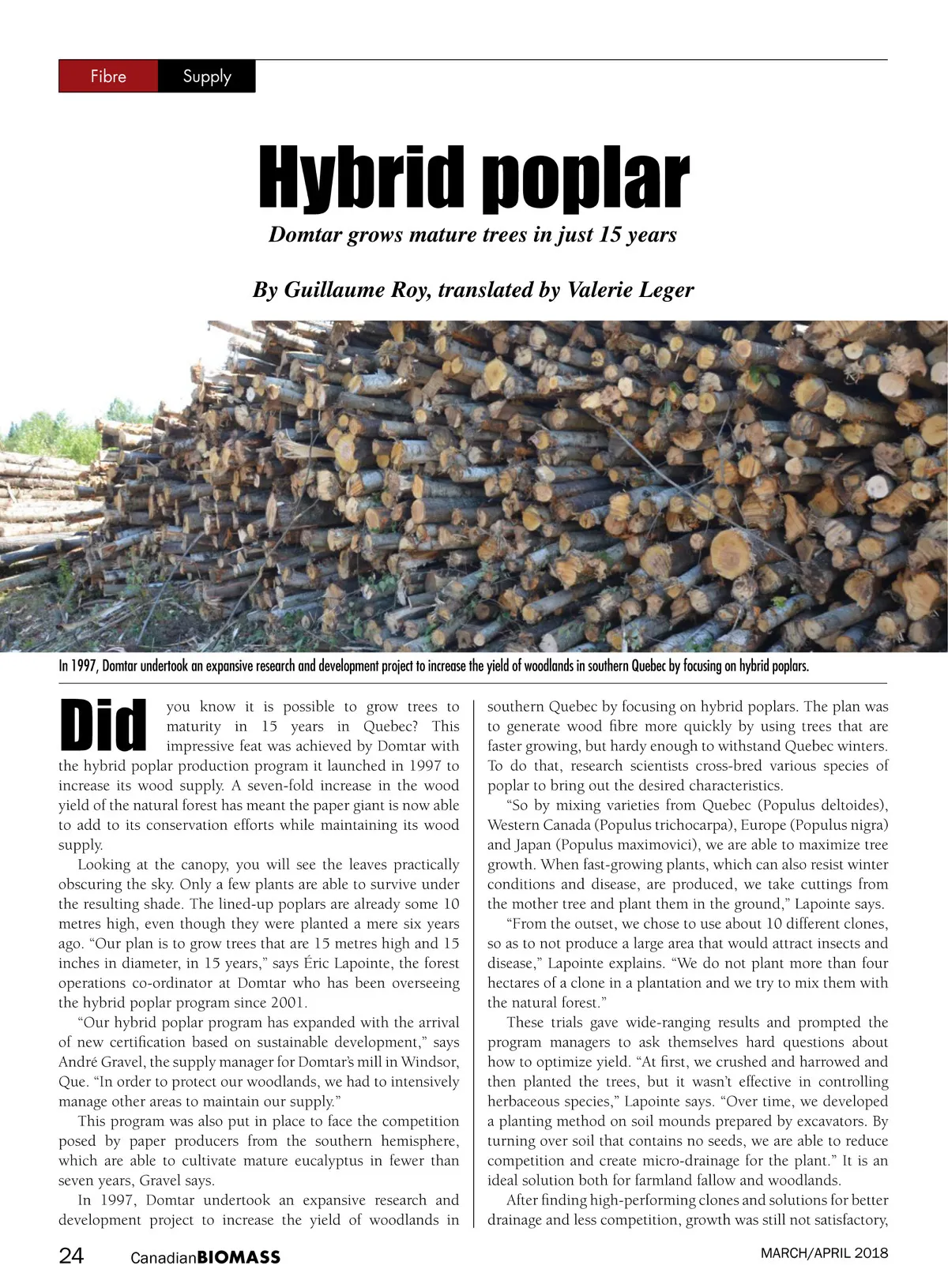
Fibre Supply Hybrid poplar Domtar grows mature trees in just 15 years By Guillaume Roy, translated by Valerie Leger Did In 1997, Domtar undertook an expansive research and development project to increase the yield of woodlands in southern Quebec by focusing on hybrid poplars. southern Quebec by focusing on hybrid poplars. The plan was to generate wood fibre more quickly by using trees that are faster growing, but hardy enough to withstand Quebec winters. To do that, research scientists cross-bred various species of poplar to bring out the desired characteristics. “So by mixing varieties from Quebec (Populus deltoides), Western Canada (Populus trichocarpa), Europe (Populus nigra) and Japan (Populus maximovici), we are able to maximize tree growth. When fast-growing plants, which can also resist winter conditions and disease, are produced, we take cuttings from the mother tree and plant them in the ground,” Lapointe says. “From the outset, we chose to use about 10 different clones, so as to not produce a large area that would attract insects and disease,” Lapointe explains. “We do not plant more than four hectares of a clone in a plantation and we try to mix them with the natural forest.” These trials gave wide-ranging results and prompted the program managers to ask themselves hard questions about how to optimize yield. “At first, we crushed and harrowed and then planted the trees, but it wasn’t effective in controlling herbaceous species,” Lapointe says. “Over time, we developed a planting method on soil mounds prepared by excavators. By turning over soil that contains no seeds, we are able to reduce competition and create micro-drainage for the plant.” It is an ideal solution both for farmland fallow and woodlands. After finding high-performing clones and solutions for better drainage and less competition, growth was still not satisfactory, MARCH/APRIL 2018 you know it is possible to grow trees to maturity in 15 years in Quebec? This impressive feat was achieved by Domtar with the hybrid poplar production program it launched in 1997 to increase its wood supply. A seven-fold increase in the wood yield of the natural forest has meant the paper giant is now able to add to its conservation efforts while maintaining its wood supply. Looking at the canopy, you will see the leaves practically obscuring the sky. Only a few plants are able to survive under the resulting shade. The lined-up poplars are already some 10 metres high, even though they were planted a mere six years ago. “Our plan is to grow trees that are 15 metres high and 15 inches in diameter, in 15 years,” says Éric Lapointe, the forest operations co-ordinator at Domtar who has been overseeing the hybrid poplar program since 2001. “Our hybrid poplar program has expanded with the arrival of new certification based on sustainable development,” says André Gravel, the supply manager for Domtar’s mill in Windsor, Que. “In order to protect our woodlands, we had to intensively manage other areas to maintain our supply.” This program was also put in place to face the competition posed by paper producers from the southern hemisphere, which are able to cultivate mature eucalyptus in fewer than seven years, Gravel says. In 1997, Domtar undertook an expansive research and development project to increase the yield of woodlands in 24 Canadian BIOMASS
Canadian Biomass March April 2018: Page 24