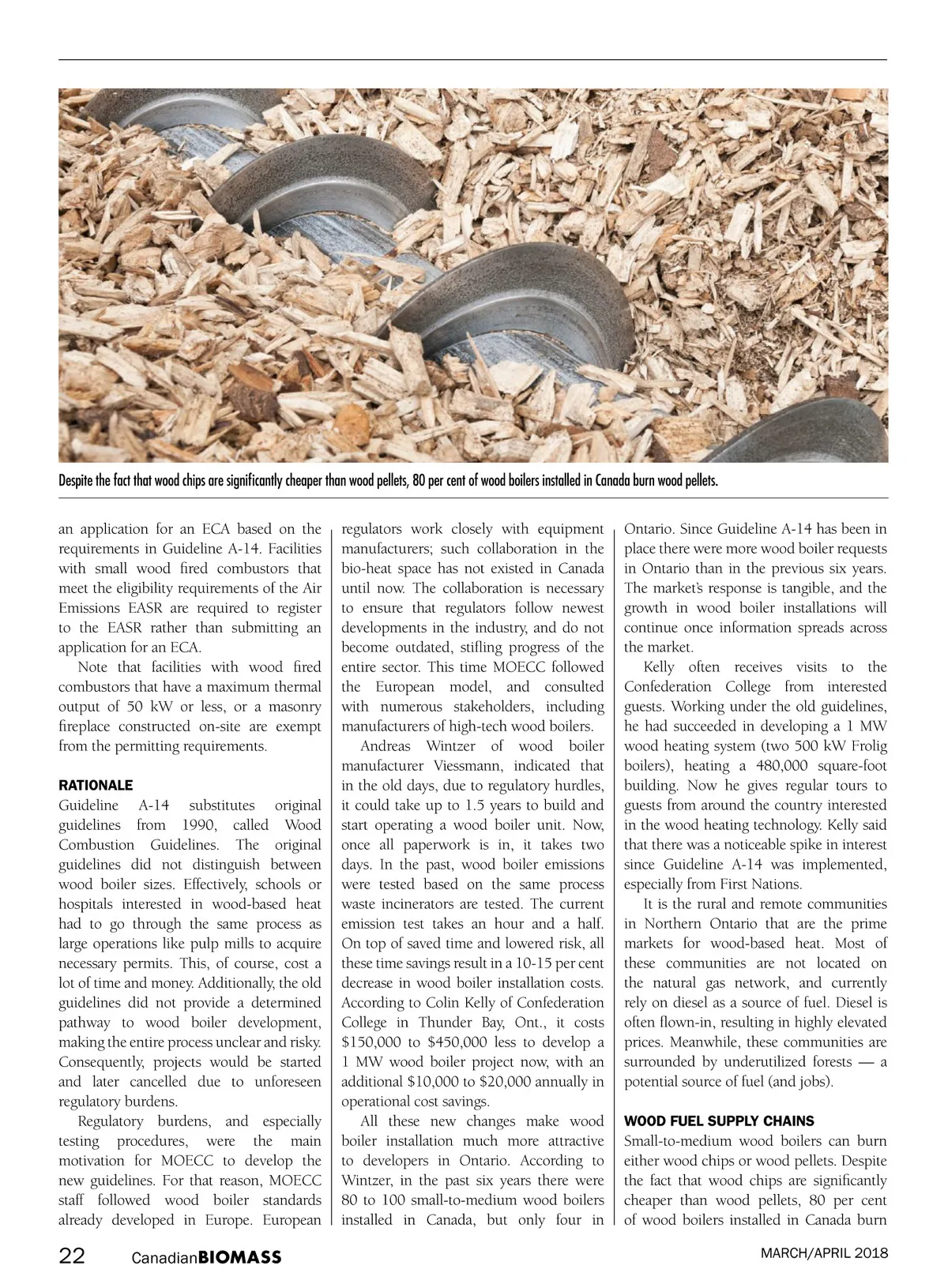
Despite the fact that wood chips are significantly cheaper than wood pellets, 80 per cent of wood boilers installed in Canada burn wood pellets. an application for an ECA based on the requirements in Guideline A-14. Facilities with small wood fired combustors that meet the eligibility requirements of the Air Emissions EASR are required to register to the EASR rather than submitting an application for an ECA. Note that facilities with wood fired combustors that have a maximum thermal output of 50 kW or less, or a masonry fireplace constructed on-site are exempt from the permitting requirements. RATIONALE Guideline A-14 substitutes original guidelines from 1990, called Wood Combustion Guidelines. The original guidelines did not distinguish between wood boiler sizes. Effectively, schools or hospitals interested in wood-based heat had to go through the same process as large operations like pulp mills to acquire necessary permits. This, of course, cost a lot of time and money. Additionally, the old guidelines did not provide a determined pathway to wood boiler development, making the entire process unclear and risky. Consequently, projects would be started and later cancelled due to unforeseen regulatory burdens. Regulatory burdens, and especially testing procedures, were the main motivation for MOECC to develop the new guidelines. For that reason, MOECC staff followed wood boiler standards already developed in Europe. European regulators work closely with equipment manufacturers; such collaboration in the bio-heat space has not existed in Canada until now. The collaboration is necessary to ensure that regulators follow newest developments in the industry, and do not become outdated, stifling progress of the entire sector. This time MOECC followed the European model, and consulted with numerous stakeholders, including manufacturers of high-tech wood boilers. Andreas Wintzer of wood boiler manufacturer Viessmann, indicated that in the old days, due to regulatory hurdles, it could take up to 1.5 years to build and start operating a wood boiler unit. Now, once all paperwork is in, it takes two days. In the past, wood boiler emissions were tested based on the same process waste incinerators are tested. The current emission test takes an hour and a half. On top of saved time and lowered risk, all these time savings result in a 10-15 per cent decrease in wood boiler installation costs. According to Colin Kelly of Confederation College in Thunder Bay, Ont., it costs $150,000 to $450,000 less to develop a 1 MW wood boiler project now, with an additional $10,000 to $20,000 annually in operational cost savings. All these new changes make wood boiler installation much more attractive to developers in Ontario. According to Wintzer, in the past six years there were 80 to 100 small-to-medium wood boilers installed in Canada, but only four in Ontario. Since Guideline A-14 has been in place there were more wood boiler requests in Ontario than in the previous six years. The market’s response is tangible, and the growth in wood boiler installations will continue once information spreads across the market. Kelly often receives visits to the Confederation College from interested guests. Working under the old guidelines, he had succeeded in developing a 1 MW wood heating system (two 500 kW Frolig boilers), heating a 480,000 square-foot building. Now he gives regular tours to guests from around the country interested in the wood heating technology. Kelly said that there was a noticeable spike in interest since Guideline A-14 was implemented, especially from First Nations. It is the rural and remote communities in Northern Ontario that are the prime markets for wood-based heat. Most of these communities are not located on the natural gas network, and currently rely on diesel as a source of fuel. Diesel is often flown-in, resulting in highly elevated prices. Meanwhile, these communities are surrounded by underutilized forests — a potential source of fuel (and jobs). WOOD FUEL SUPPLY CHAINS Small-to-medium wood boilers can burn either wood chips or wood pellets. Despite the fact that wood chips are significantly cheaper than wood pellets, 80 per cent of wood boilers installed in Canada burn MARCH/APRIL 2018 22 Canadian BIOMASS
Canadian Biomass March April 2018: Page 22