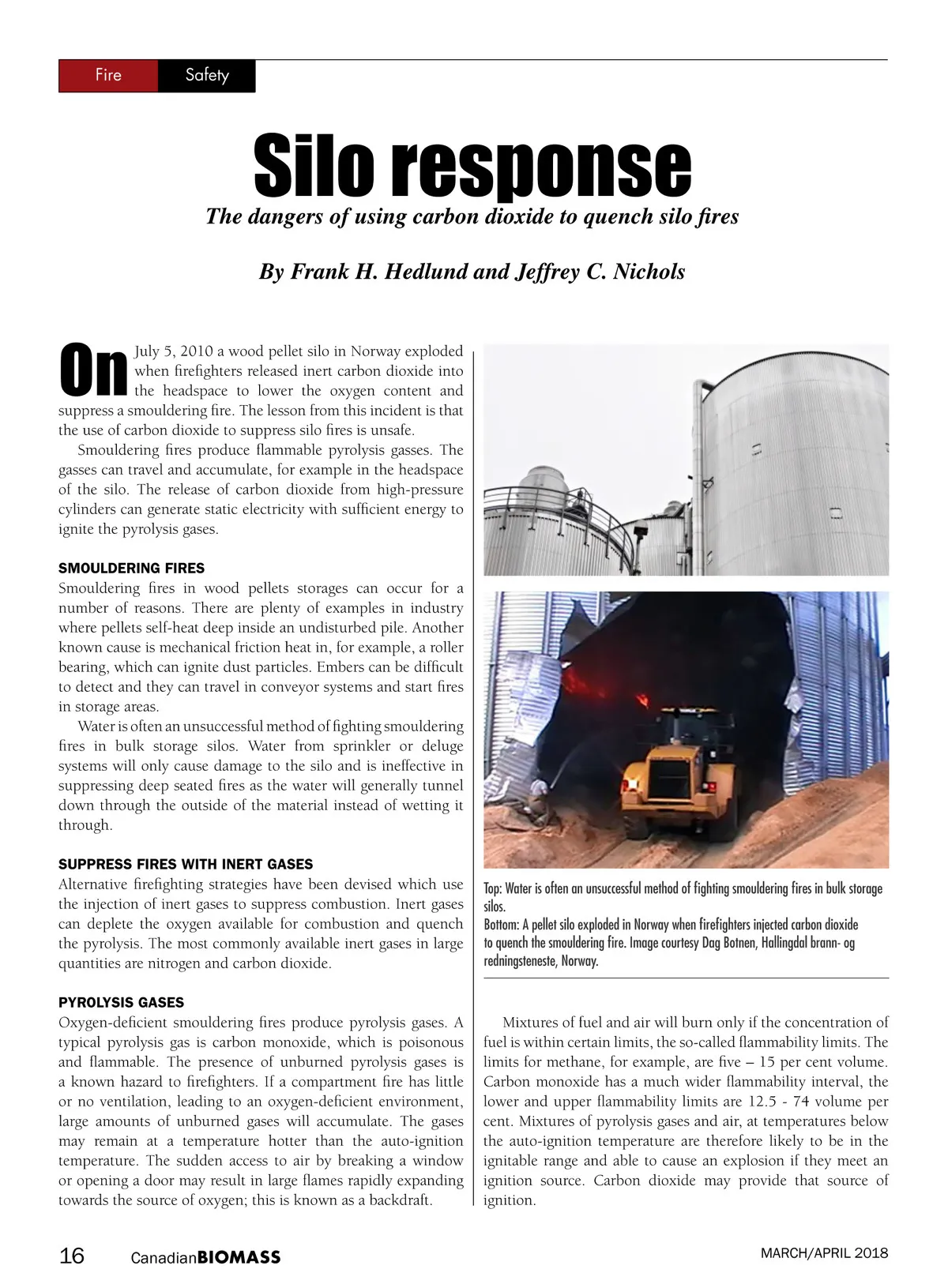
THE NORWEGIAN SILO FIRE The silo in Norway was half full, with an inventory of about 3,500 cubic metres of wood pellets. The pellets had self-ignited and started a smouldering fire deep inside the pile. The first indications of trouble came about midnight when sensors in the pile registered elevated temperatures. Later came an alarm from the silo’s fixed carbon-monoxide detector. Firefighters were quick to order a shipment of nitrogen to be able to inject into the silo to quench the fire. For a number of reasons — it was late at night and the nitrogen gas production facility was located several hundred kilometres away — the tanker truck was estimated to arrive about noon. A revised estimate pushed the arrival of the tanker to late afternoon, at the earliest. Firefighters are people of action and it is easy to imagine just how unattractive it must be for them to stand idle next to a burning silo, merely waiting for a truck to arrive. Unable to wait, firefighters began collecting CO 2 bottles from nearby power stations and industries. Only 22 bottles were available, about 220 cubic metres of CO 2 gas, just five per cent of the headspace volume. Although the effect of CO 2 injection was thought to be limited because of the limited quantities available, out of sheer frustration a CO 2 attack was decided, in the hope that it at least might attenuate the fire until nitrogen supplies arrived. A ladder on the silo led to a fixed platform, which provided access to an inspection hatch in the roof. The firefighters decided to manually discharge the CO 2 bottles though this hatch opening. When discharging the fifth CO 2 cylinder, the silo exploded. The firefighters were briefly enveloped in flames, but fortunately their personal protective equipment offered excellent protection and they suffered minor burn injuries only. Static discharges from the CO 2 bottles may have ignited the pyrolysis gasses. It is conceivable that that the firefighters themselves inadvertently introduced the source of ignition that led to the explosion, which easily could have killed them had the blast been strong enough. HAZARD UNDER-APPRECIATED dioxide fire extinguishing system. Unfortunately, there is evidence to suggest that those early lessons learned have at least partly passed out of sight. We wish to alert the pellet community that suppression of a smouldering silo fire with carbon dioxide is potentially unsafe. Firefighters have no means to determine if the atmosphere in the silo headspace is ignitable. The release of liquid carbon dioxide is associated with electrostatic discharges with sufficient energy to ignite flammable pyrolysis gases. The result may be an internal explosion with loss of life. • Frank Huess Hedlund is a risk expert at COWI and associate external professor at the Technical University of Denmark (DTU) teaching risk management. He has 25 years of experience, working for clients in industry and government carrying out risk and safety studies and industrial accident prevention work. [email protected], [email protected] Jeffrey C. Nichols is managing partner at Industrial Fire Prevention, LLC and has been applying systems for the protection of equipment and personnel in processing industries since 1979. Mr. Nichols is a member of the NFPA 664 technical committee. Through his company, Jeff has been instrumental in bringing protection to many types of processes including drying, milling, grinding, and dust collection systems in industries handling combustible dust. [email protected] STRONG! A recent paper in Biomass and Bioenergy (Carbon dioxide not suitable for extinguishment of smouldering silo fires: Static electricity may cause silo explosion -Volume 108, January 2018, pages 113-119) examines international standards, guidelines, recent editions of frequently cited pellet handbooks and other literature. The paper argues that the electrostatic hazard of CO 2 is widely under-appreciated, across countries. The situation appears particularly grave for NFPA 12 on carbon dioxide extinguishing systems, which gives ill-conceived advice on the application of CO 2 to deep-seated fires involving solids subject to smouldering. NFPA 69 and NFPA 850 should also be revised to highlight the hazard. PAST ACCIDENTS FORGOTTEN Morbark Strong. It’s more than a slogan; it’s a way of life for us. It’s our commitment to you that our heavy duty equipment is built to withstand the rigors of even your toughest jobs. All Morbark equipment is aggressive, productive and engineered to give you the power and features you need to maximize output, minimize downtime and enhance your profitability. Contact Cardinal for all your Morbark equipment, parts and service needs! www.cardinalsaw.com In the past, major explosions have been attributed to electrostatic ignition of flammable vapours during the release of CO 2 for fire-prevention purposes. The most dramatic explosion may have been an explosion of a U.S. Air Force underground tank with JP-4 in 1954, which killed 37 people. The victims were officials, technicians and contractors who were standing on the roof of the tank while carrying out acceptance tests of the tank’s novel carbon DISTRIBUTED BY ANGLIERS Administration, manufacturing, Engineering and service 7, rue du Cheminot J0Z 1A0 819.949.2281 QUÉBEC Equipment & Parts Sales 2700, rue Jean-Perrin Office 114 G2C 1S9 1.800.463.4862 NORTH BAY Parts Sales 161, Ferris Drive Unit 7 Ontario P1A 4K2 1.800.598.3044 PORT PERRY Parts Sales 171, North Port Road Unit 5 Ontario L9L 1B2 416.659.936 NOUVEAU-BRUNSWICK Parts Sales & Service 551, Ferdinand Blvd Unit 4 Dieppe E1A 7G1 1.800.931.9611 Canadian BIOMASS 17
Canadian Biomass March April 2018: Page 17