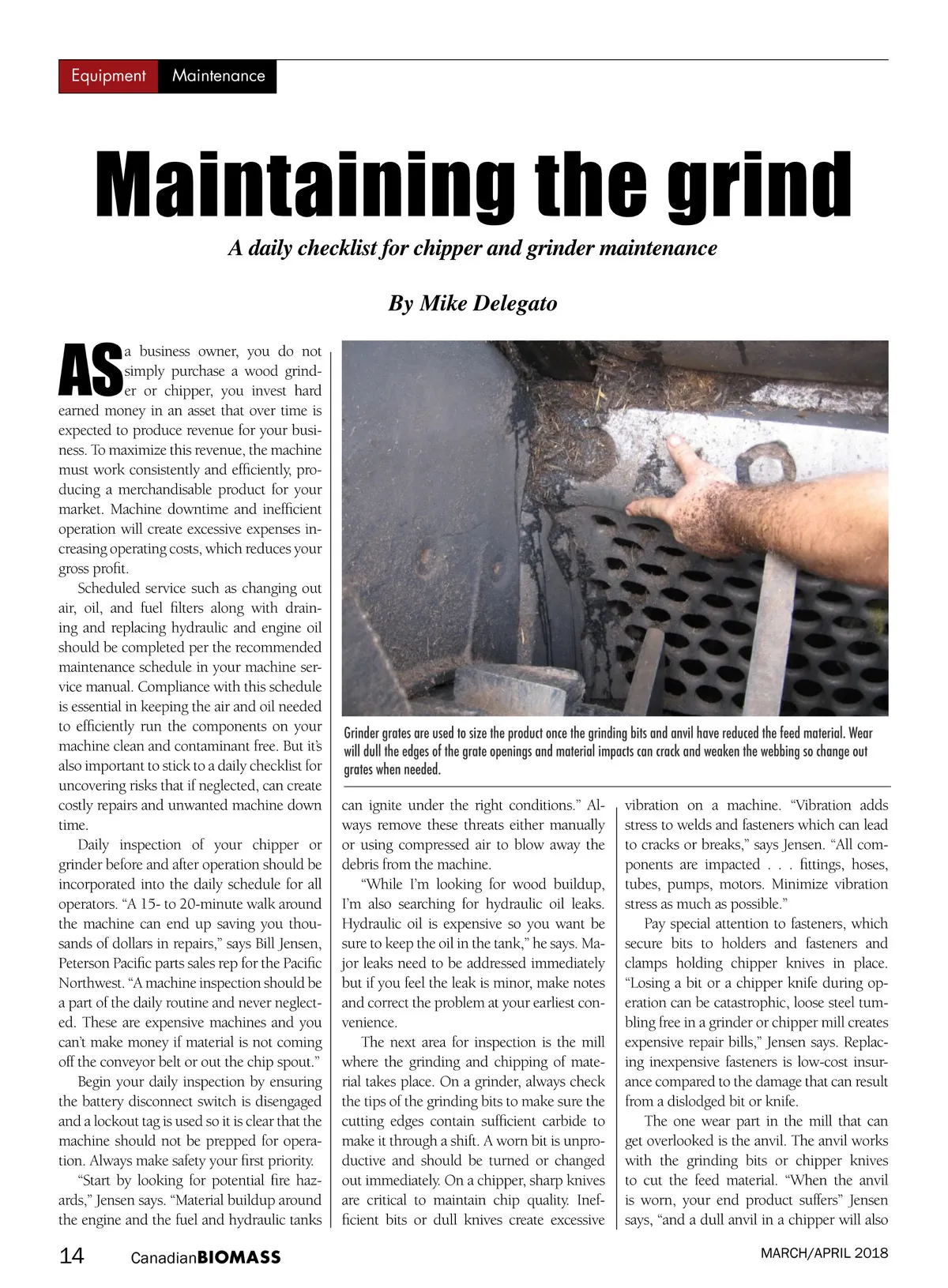
contribute to the vibration stress.” Maintain-ing the proper gap between your cutting tool and the anvil will insure efficient processing of your feed material. In the case of a grinder, an inspection of the grates is required. Grates are used to size the product once the grinding bits and anvil have reduced the feed material. Wear will dull the edges of the grate openings and material impacts can crack and weaken the webbing so change out grates when needed. Next, take a look at your in-feed convey-or for potential problems. Clean away any material buildup under the chains. Check for loose or cracked links and link pins. Consult the owner’s manual so you are fa-miliar with how to test the take-up tension. If the tension is too tight or too loose, adjust the tail pulley jacking bolts as needed. Your in-feed chain should run smooth without surges. Finally, inspect your drive belts and dis-charge belt. Again, material buildup will disrupt the smooth operation of your belts. Check inside the drive belt guard and clear away any wood debris around the sheaves. Wood fragments can lodge in banded v-belts without penetrating the fabric wrap and should be removed. A buildup of these frag-ments can cause the belts to slip and smoke in this high-speed application. As with all belts, check for proper tension and adjust accordingly. Check conveyor belts for any rips or tears and remove any material buildup under re-turn idlers. When your inspection is com-plete and you start up the machine, observe the running discharge belt to determine if the belt is tracking properly. A belt that is walking will sustain damage to the edges re-sulting in shorter belt life. Avoiding unexpected and expensive breakdowns by identifying potential issues before they occur is critical to keeping your grinder or chipper operating efficiently. A routine, 15-minute daily inspection will uncover these threats. “I tell all my custom-ers, you’re going to spend money on these machines, that’s a given,” Jensen says, “but if you spend the time and money upfront, you have a better chance of preventing that costly catastrophic failure.” • Mike Delegato is a parts marketing man-ager for Peterson Pacific Corp., a manufactur-er of grinders, disc and drum chippers, flails, screens, stackers and blower trucks based in Eugene, Ore. DAILY CHECKLIST • Ensure battery disconnect switch is disengaged and a lockout tag is used • Look for potential fire hazards (material buildup) and hydraulic oil leaks • Check grinding tips for sufficient carbide or chipper knifes for sharpness and intact fasteners • Inspect anvil for wear • Inspect grinder grates for cracks or weakening of the webbing • Clean in-feed conveyor of material buildup, check for loose or cracked chain links and test take-up tension • Clear drive belts of material buildup and adjust tension • Check conveyor belts for any rips or tears and remove any material buildup A Division of Hoffmann Inc. Implementing Bulk Material Handling Solutions Since 1947 Visit us at Biomass Expo & Wood Bioenergy 2018 Atlanta, Georgia April 2018 Standard Pivot Drive-Over Dumper STANDARD PIVOT TRUCK TIPPER Stacker Reclaimers In-Pit Hoppers [email protected] | 563.264.8066 | airoflex.com Canadian BIOMASS 15
Canadian Biomass March April 2018: Page 15