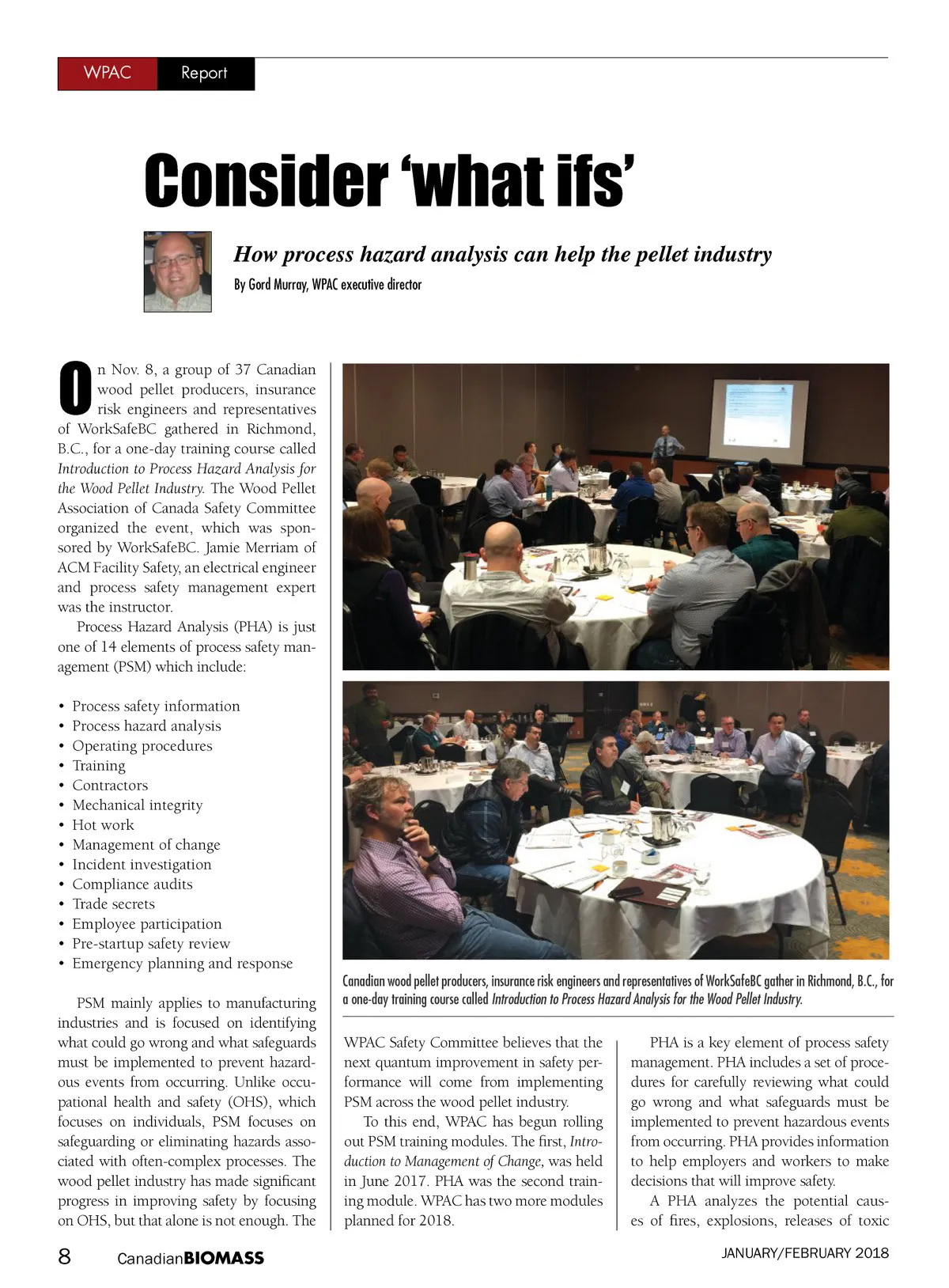
substances and other hazardous events. It considers the equipment, instrumen-tation, human actions and other factors that might affect the process. A PHA at-tempts to determine potential failure points, methods of operations and other factors that can lead to accidents. A team tasked with performing a PHA should include potentially affected operators, supervisors, engineers, and other workers who have knowledge of the process being analyzed. It is helpful to have an experienced facilitator lead the PHA. PHAs must address hazards, previous incidents, engineering and administrative controls; potential con-sequences of failure of controls; facility siting; human factors; and the range of possible safety and health effects caused by the failure of controls. There are a variety of methods for com-pleting a PHA. Common methods include: Checklists : using established codes, standards and well-understood haz-ardous operations as a checklist against which to compare a process. What if: using a team to create and an-swer a series of “what-if” type questions. Hazard and Operability Study (HAZOP): carrying out a structured, systematic re-view that identifies equipment that is be-ing used in a way that it was not designed to be, and which might create hazards or operational problems. Failure Mode and Effect Analysis (FMEA): systematically studying the con-sequences of failure (breakdown) of cer-tain operational hardware such as trans-mitters, controllers, valves, pumps, etc. Fault-Tree Analysis: creating a mod-el showing what undesirable outcomes might result from a specific initiating event (for example, a conveyor stops op-erating). It uses graphics and symbols to show the possible order of events that might result in an accident. Upon completing a PHA, employers must establish a system or set of pro-cedures that will promptly deal with the findings of the PHA team and rec-ommendations. Any actions taken to correct hazards uncovered by the PHA must be communicated to the workers in the area and to any other workers who might be affected. Follow-up is a critical part of any PHA because if rec-ommendations are not followed, acci-dents could result in serious injury, loss of life, and legal liability from the com-pany’s failure to act. Implementing process safety man-agement is significantly more complex and requires a much greater commit-ment than solely relying on occupa-tional health and safety. Successful PSM implementation will take time, perhaps even several years before PSM is fully in-grained in wood pellet operations. How-ever, the effort will go a long way toward creating a state where the wood pellet industry is completely accident free. The group of 37 participants who took the PHA course now have the respon-sibility of sharing the knowledge they gained with their industry colleagues back home and continuing with the job of implementing PSM across the wood pellet industry. • JUNE 6-8, 2018 PRINCE GEORGE, BC BIOECONOMYCONFERENCE.COM THE NEW BIOECONOMY: ADDING VALUE TO BIOMASS • Growth in the use of woody biomass in new applications • Opportunities and challenges in the low carbon economy • Governments’ role in promotion and regulation of the bioeconomy • New products, new places: new technology and local deployment Sponsored by: CBM_Bioeconomy conf_JanFeb18_CSA.indd 1 Canadian BIOMASS 2018-01-12 12:55 PM 9
Canadian Biomass January-February 2018: Page 9