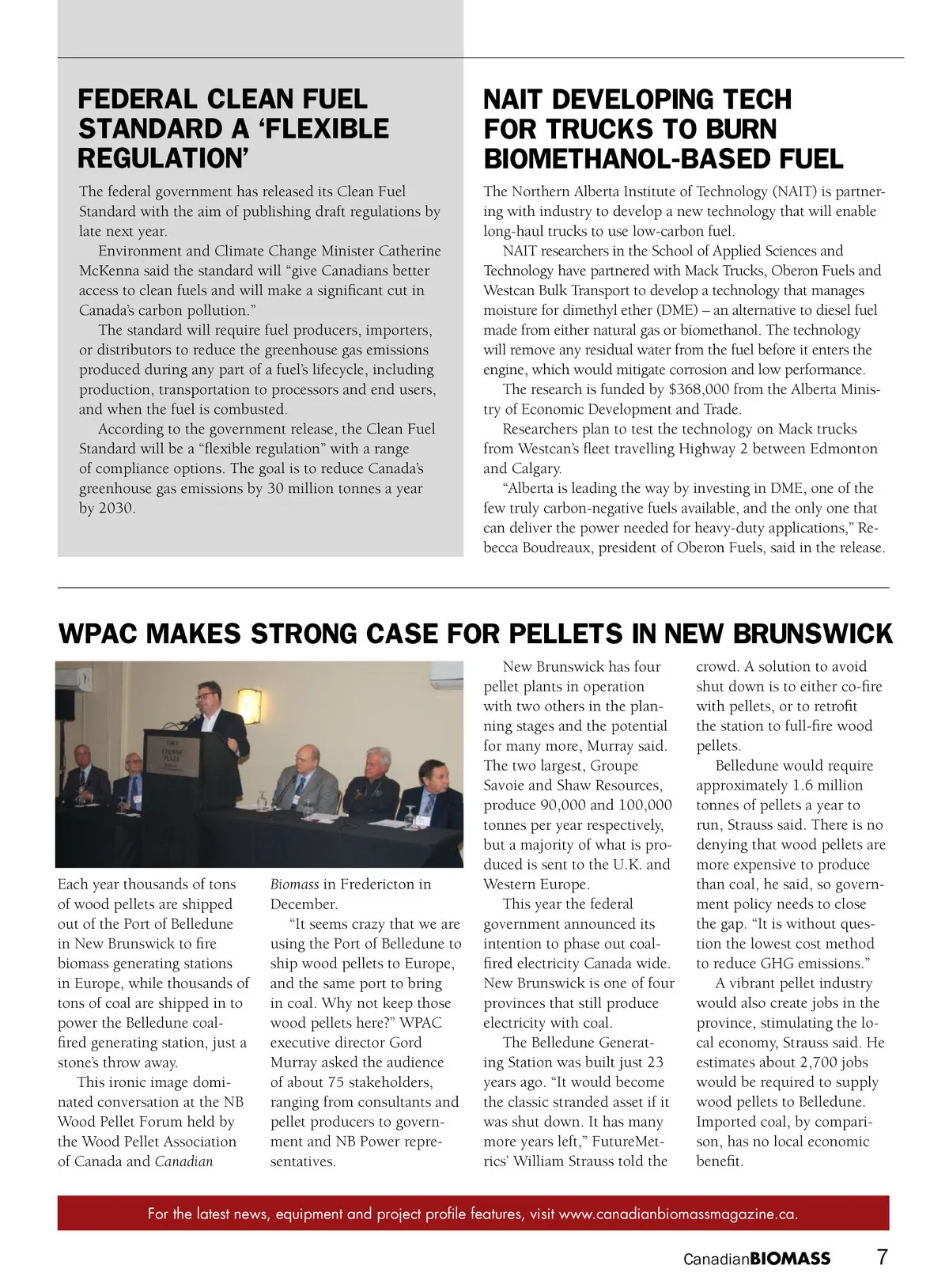
FEDERAL CLEAN FUEL STANDARD A ‘FLEXIBLE REGULATION’ The federal government has released its Clean Fuel Standard with the aim of publishing draft regulations by late next year. Environment and Climate Change Minister Catherine McKenna said the standard will “give Canadians better access to clean fuels and will make a significant cut in Canada’s carbon pollution.” The standard will require fuel producers, importers, or distributors to reduce the greenhouse gas emissions produced during any part of a fuel’s lifecycle, including production, transportation to processors and end users, and when the fuel is combusted. According to the government release, the Clean Fuel Standard will be a “flexible regulation” with a range of compliance options. The goal is to reduce Canada’s greenhouse gas emissions by 30 million tonnes a year by 2030. NAIT DEVELOPING TECH FOR TRUCKS TO BURN BIOMETHANOL-BASED FUEL The Northern Alberta Institute of Technology (NAIT) is partner-ing with industry to develop a new technology that will enable long-haul trucks to use low-carbon fuel. NAIT researchers in the School of Applied Sciences and Technology have partnered with Mack Trucks, Oberon Fuels and Westcan Bulk Transport to develop a technology that manages moisture for dimethyl ether (DME) – an alternative to diesel fuel made from either natural gas or biomethanol. The technology will remove any residual water from the fuel before it enters the engine, which would mitigate corrosion and low performance. The research is funded by $368,000 from the Alberta Minis-try of Economic Development and Trade. Researchers plan to test the technology on Mack trucks from Westcan’s fleet travelling Highway 2 between Edmonton and Calgary. “Alberta is leading the way by investing in DME, one of the few truly carbon-negative fuels available, and the only one that can deliver the power needed for heavy-duty applications,” Re-becca Boudreaux, president of Oberon Fuels, said in the release. WPAC MAKES STRONG CASE FOR PELLETS IN NEW BRUNSWICK New Brunswick has four pellet plants in operation with two others in the plan-ning stages and the potential for many more, Murray said. The two largest, Groupe Savoie and Shaw Resources, produce 90,000 and 100,000 tonnes per year respectively, but a majority of what is pro-duced is sent to the U.K. and Western Europe. This year the federal government announced its intention to phase out coal-fired electricity Canada wide. New Brunswick is one of four provinces that still produce electricity with coal. The Belledune Generat-ing Station was built just 23 years ago. “It would become the classic stranded asset if it was shut down. It has many more years left,” FutureMet-rics’ William Strauss told the crowd. A solution to avoid shut down is to either co-fire with pellets, or to retrofit the station to full-fire wood pellets. Belledune would require approximately 1.6 million tonnes of pellets a year to run, Strauss said. There is no denying that wood pellets are more expensive to produce than coal, he said, so govern-ment policy needs to close the gap. “It is without ques-tion the lowest cost method to reduce GHG emissions.” A vibrant pellet industry would also create jobs in the province, stimulating the lo-cal economy, Strauss said. He estimates about 2,700 jobs would be required to supply wood pellets to Belledune. Imported coal, by compari-son, has no local economic benefit. Each year thousands of tons of wood pellets are shipped out of the Port of Belledune in New Brunswick to fire biomass generating stations in Europe, while thousands of tons of coal are shipped in to power the Belledune coal-fired generating station, just a stone’s throw away. This ironic image domi-nated conversation at the NB Wood Pellet Forum held by the Wood Pellet Association of Canada and Canadian Biomass in Fredericton in December. “It seems crazy that we are using the Port of Belledune to ship wood pellets to Europe, and the same port to bring in coal. Why not keep those wood pellets here?” WPAC executive director Gord Murray asked the audience of about 75 stakeholders, ranging from consultants and pellet producers to govern-ment and NB Power repre-sentatives. For the latest news, equipment and project profile features, visit www.canadianbiomassmagazine.ca. Canadian BIOMASS 7
Canadian Biomass January-February 2018: Page 7