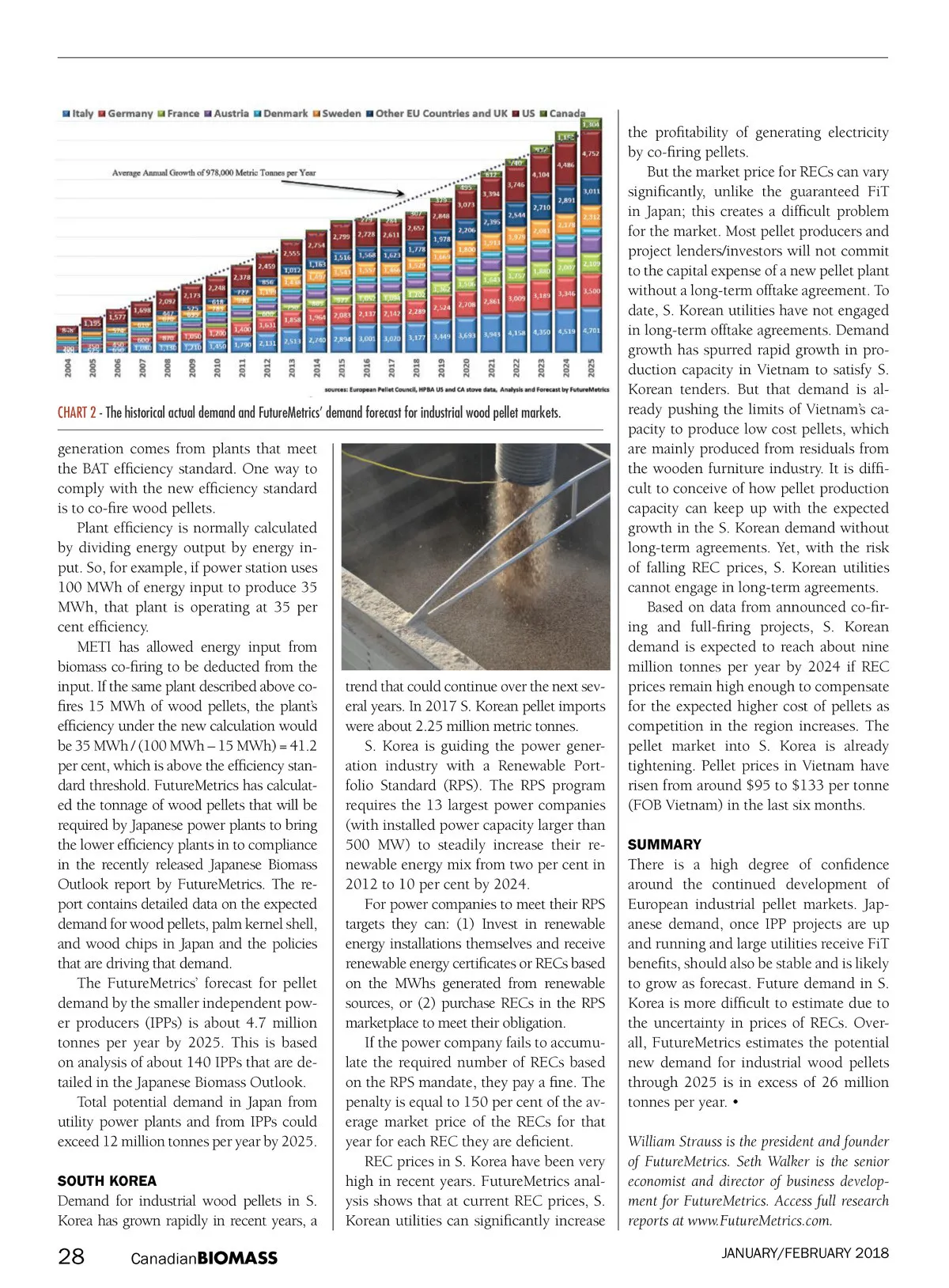
CHART 2 -The historical actual demand and FutureMetrics’ demand forecast for industrial wood pellet markets. generation comes from plants that meet the BAT efficiency standard. One way to comply with the new efficiency standard is to co-fire wood pellets. Plant efficiency is normally calculated by dividing energy output by energy in-put. So, for example, if power station uses 100 MWh of energy input to produce 35 MWh, that plant is operating at 35 per cent efficiency. METI has allowed energy input from biomass co-firing to be deducted from the input. If the same plant described above co-fires 15 MWh of wood pellets, the plant’s efficiency under the new calculation would be 35 MWh / (100 MWh – 15 MWh) = 41.2 per cent, which is above the efficiency stan-dard threshold. FutureMetrics has calculat-ed the tonnage of wood pellets that will be required by Japanese power plants to bring the lower efficiency plants in to compliance in the recently released Japanese Biomass Outlook report by FutureMetrics. The re-port contains detailed data on the expected demand for wood pellets, palm kernel shell, and wood chips in Japan and the policies that are driving that demand. The FutureMetrics’ forecast for pellet demand by the smaller independent pow-er producers (IPPs) is about 4.7 million tonnes per year by 2025. This is based on analysis of about 140 IPPs that are de-tailed in the Japanese Biomass Outlook. Total potential demand in Japan from utility power plants and from IPPs could exceed 12 million tonnes per year by 2025. SOUTH KOREA Demand for industrial wood pellets in S. Korea has grown rapidly in recent years, a trend that could continue over the next sev-eral years. In 2017 S. Korean pellet imports were about 2.25 million metric tonnes. S. Korea is guiding the power gener-ation industry with a Renewable Port-folio Standard (RPS). The RPS program requires the 13 largest power companies (with installed power capacity larger than 500 MW) to steadily increase their re-newable energy mix from two per cent in 2012 to 10 per cent by 2024. For power companies to meet their RPS targets they can: (1) Invest in renewable energy installations themselves and receive renewable energy certificates or RECs based on the MWhs generated from renewable sources, or (2) purchase RECs in the RPS marketplace to meet their obligation. If the power company fails to accumu-late the required number of RECs based on the RPS mandate, they pay a fine. The penalty is equal to 150 per cent of the av-erage market price of the RECs for that year for each REC they are deficient. REC prices in S. Korea have been very high in recent years. FutureMetrics anal-ysis shows that at current REC prices, S. Korean utilities can significantly increase the profitability of generating electricity by co-firing pellets. But the market price for RECs can vary significantly, unlike the guaranteed FiT in Japan; this creates a difficult problem for the market. Most pellet producers and project lenders/investors will not commit to the capital expense of a new pellet plant without a long-term offtake agreement. To date, S. Korean utilities have not engaged in long-term offtake agreements. Demand growth has spurred rapid growth in pro-duction capacity in Vietnam to satisfy S. Korean tenders. But that demand is al-ready pushing the limits of Vietnam’s ca-pacity to produce low cost pellets, which are mainly produced from residuals from the wooden furniture industry. It is diffi-cult to conceive of how pellet production capacity can keep up with the expected growth in the S. Korean demand without long-term agreements. Yet, with the risk of falling REC prices, S. Korean utilities cannot engage in long-term agreements. Based on data from announced co-fir-ing and full-firing projects, S. Korean demand is expected to reach about nine million tonnes per year by 2024 if REC prices remain high enough to compensate for the expected higher cost of pellets as competition in the region increases. The pellet market into S. Korea is already tightening. Pellet prices in Vietnam have risen from around $95 to $133 per tonne (FOB Vietnam) in the last six months. SUMMARY There is a high degree of confidence around the continued development of European industrial pellet markets. Jap-anese demand, once IPP projects are up and running and large utilities receive FiT benefits, should also be stable and is likely to grow as forecast. Future demand in S. Korea is more difficult to estimate due to the uncertainty in prices of RECs. Over-all, FutureMetrics estimates the potential new demand for industrial wood pellets through 2025 is in excess of 26 million tonnes per year. • William Strauss is the president and founder of FutureMetrics. Seth Walker is the senior economist and director of business develop-ment for FutureMetrics. Access full research reports at www.FutureMetrics.com. JANUARY/FEBRUARY 2018 28 Canadian BIOMASS
Canadian Biomass January-February 2018: Page 28