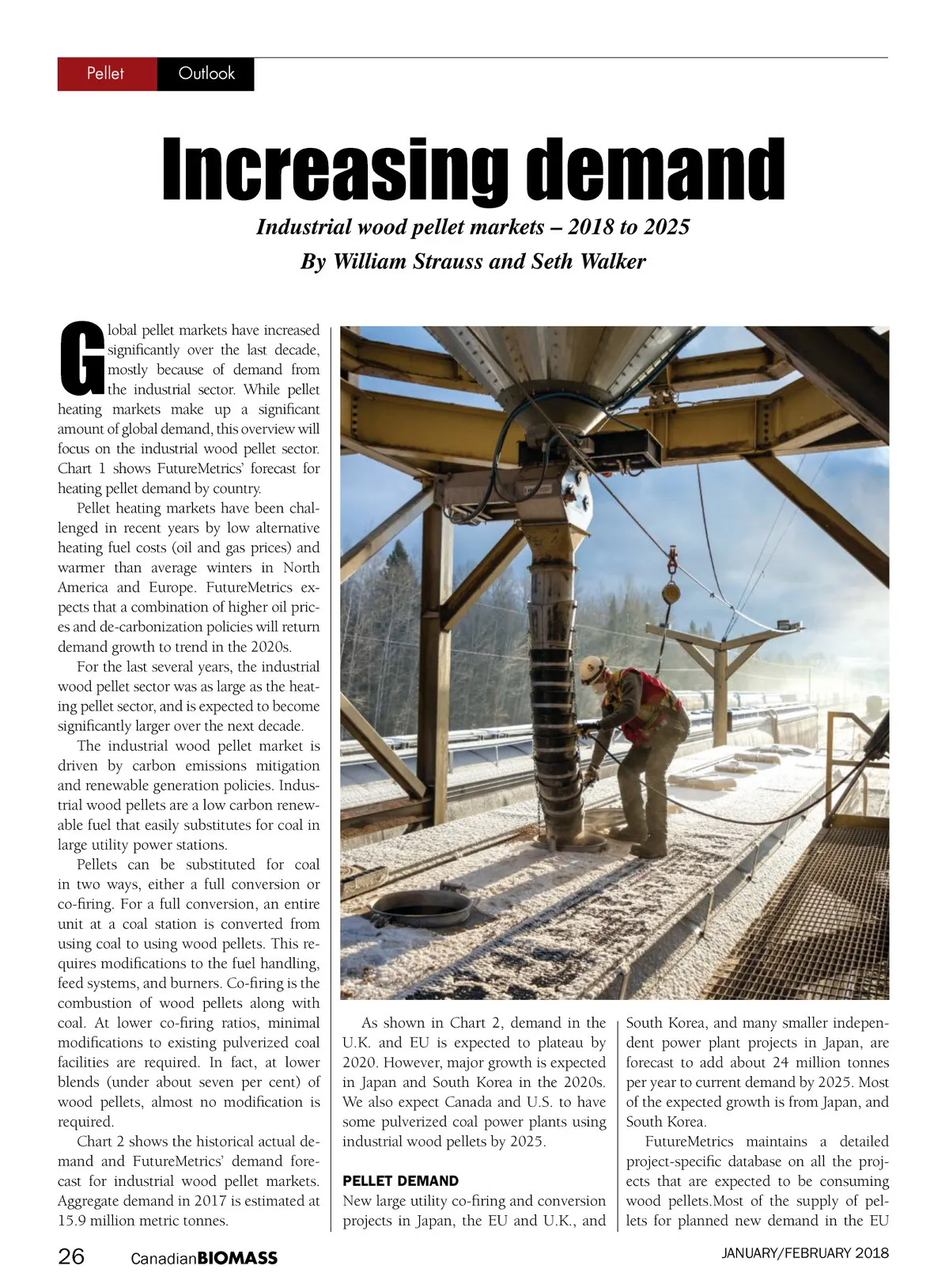
CHART 1 -FutureMetrics’ forecast for heating pellet demand by country. and U.K. has already been arranged with major existing producers. However, the Japanese and S. Korean markets offer op-portunity for new capacity that is, for the most part, not in the pipeline as of today. EUROPE AND ENGLAND per year. Each converted unit at the Drax station can consume about 2.5 million tonnes per year if they run at full capacity all year. FutureMetrics projects total new probable demand in Europe and England at 6.0 million tonnes per year. JAPAN Early growth (2010 to the present) in the industrial wood pellet sector came from western Europe and the U.K. However, growth in Europe is slowing and is ex-pected to level out in the early 2020s. The remaining growth in European industrial wood pellet demand will come from proj-ects in the Netherlands and U.K. Demand by the Dutch utilities is still uncertain, as coal plants have delayed fi-nal investment decisions around co-firing modifications until they are given assur-ances that their coal plants will be able to continue to operate. Most analysts, includ-ing FutureMetrics, expect these issues to be resolved and Dutch demand will likely grow by at least 2.5 million tonnes per year over the next three to four years. It is possi-ble that Dutch demand will increase to up to 3.5 million tonnes per year if all four of the coal stations that have been awarded subsidies proceed with their plans. Two U.K. projects, EPH’s 400MW Ly-nemouth power station conversion and MGT’s Teeside greenfield CHP plant, are currently either in commissioning or un-der construction. Drax recently announced that it will convert a fourth unit to run on pellets. How many hours that unit will run in a year is unclear at this time. However, given that the investment decision has been made, FutureMetrics estimates that unit 4 will consume an additional 900,000 tonnes Biomass demand in Japan is primarily driv-en by three policy components: The Feed in Tariff (FiT) support scheme for renew-able energy, coal thermal plant efficiency standards, and carbon emissions targets. The FiT offers independent power pro-ducers (IPPs) a set price for renewable energy over an extended contract period – 20 years for biomass energy. Currently, under the FiT, electricity generated from “general wood,” which includes pellets, imported woodchips, and palm kernel shell (PKS), receives a subsidy of 21 ¥/ kWh, down from 24 ¥/kWh prior to Sept. 30, 2017. However, the scores of biomass IPPs that have received the higher FiT are locked in at that rate (about $0.214/kWh at current exchange rates). Japan’s Ministry of Economy Trade and Industry (METI) has produced a so-called “Best Energy Mix” for 2030. In that plan, biomass power accounts for 4.1 per cent of Japan’s total electricity production in 2030. This is equivalent to over 26 million metric tonnes of pellets (if all the biomass were wood pellets). In 2016, METI released a paper de-scribing best available technology (BAT) efficiency standards for thermal plants. The paper develops minimum efficien-cy standards for power generators. As of 2016, only about one-third of Japan’s coal Our competitors say we’re old and slow to change. That our machines are ugly. That we’re not on the cutting edge. We say, “Yup.” “Old” means we’ve been around for over 100 years—and we’ll be here for 100 more. “Slow to change” means we don’t do fads. Oh, we’ll turn on a dime to make changes that our customers need. But fads? Nah. We’d rather protect your investment. “Not cutting edge” means we’re proven. We build what works and we stick with it. And “ugly”? Well. You don’t need to be pretty to make a damn good pellet mill. GLOBAL BIOMASS GROUP Your Partner in Productivity CPM Biomass Group CPM/Europe BV 1-800-428-0846 www.cpm.net +31 75 65 12 611 www.cpmeurope.nl CPM BIOMASS • CANADIAN BIOMASS ORDER 828 • LINE 1 • INSERTION JAN/FEB Canadian BIOMASS 1/3 PAGE • 2 1/8X10 • DEADLINE 1/20/16 CREATIVE: BIO PRETTY PELLET 27
Canadian Biomass January-February 2018: Page 27