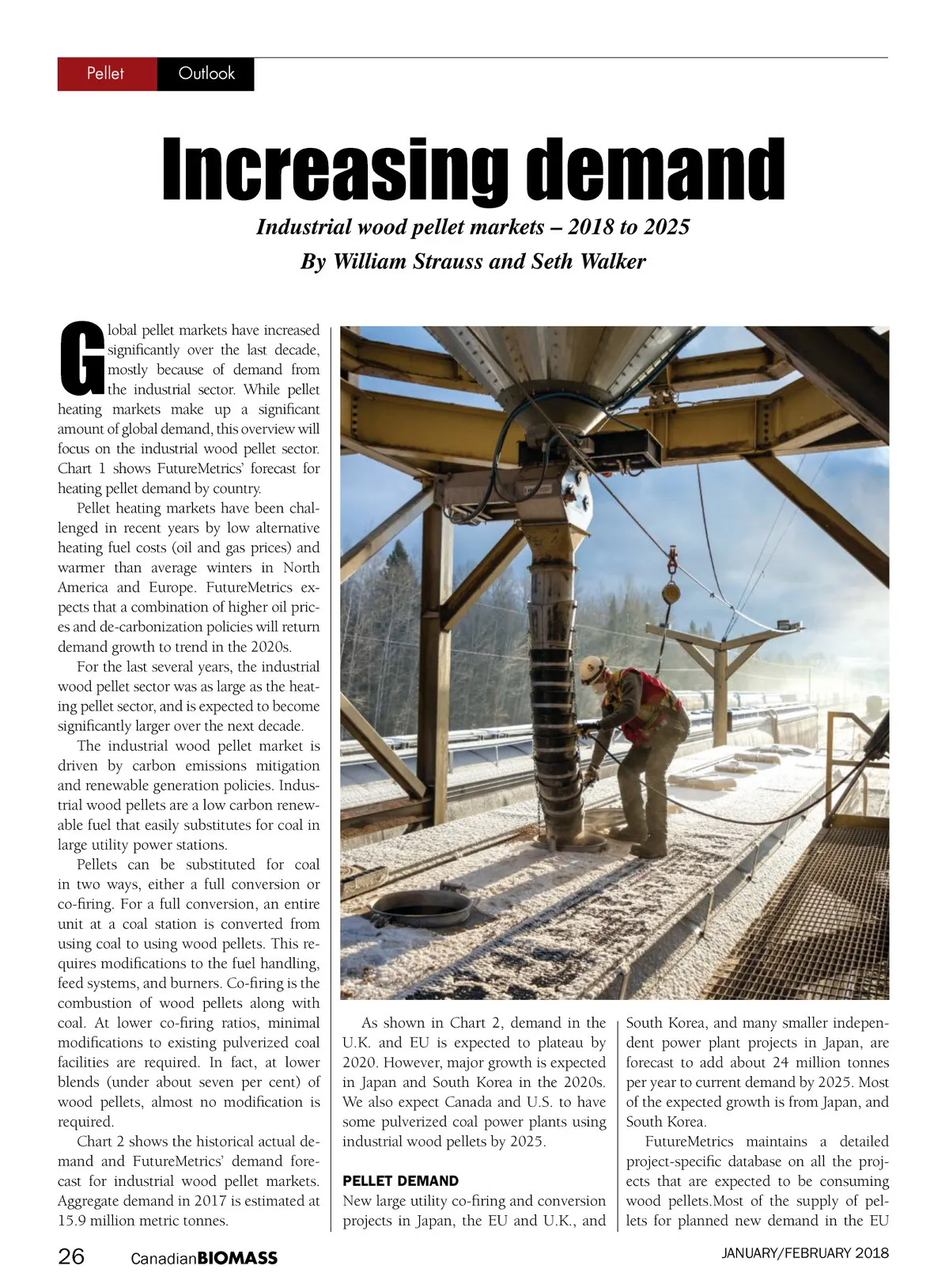
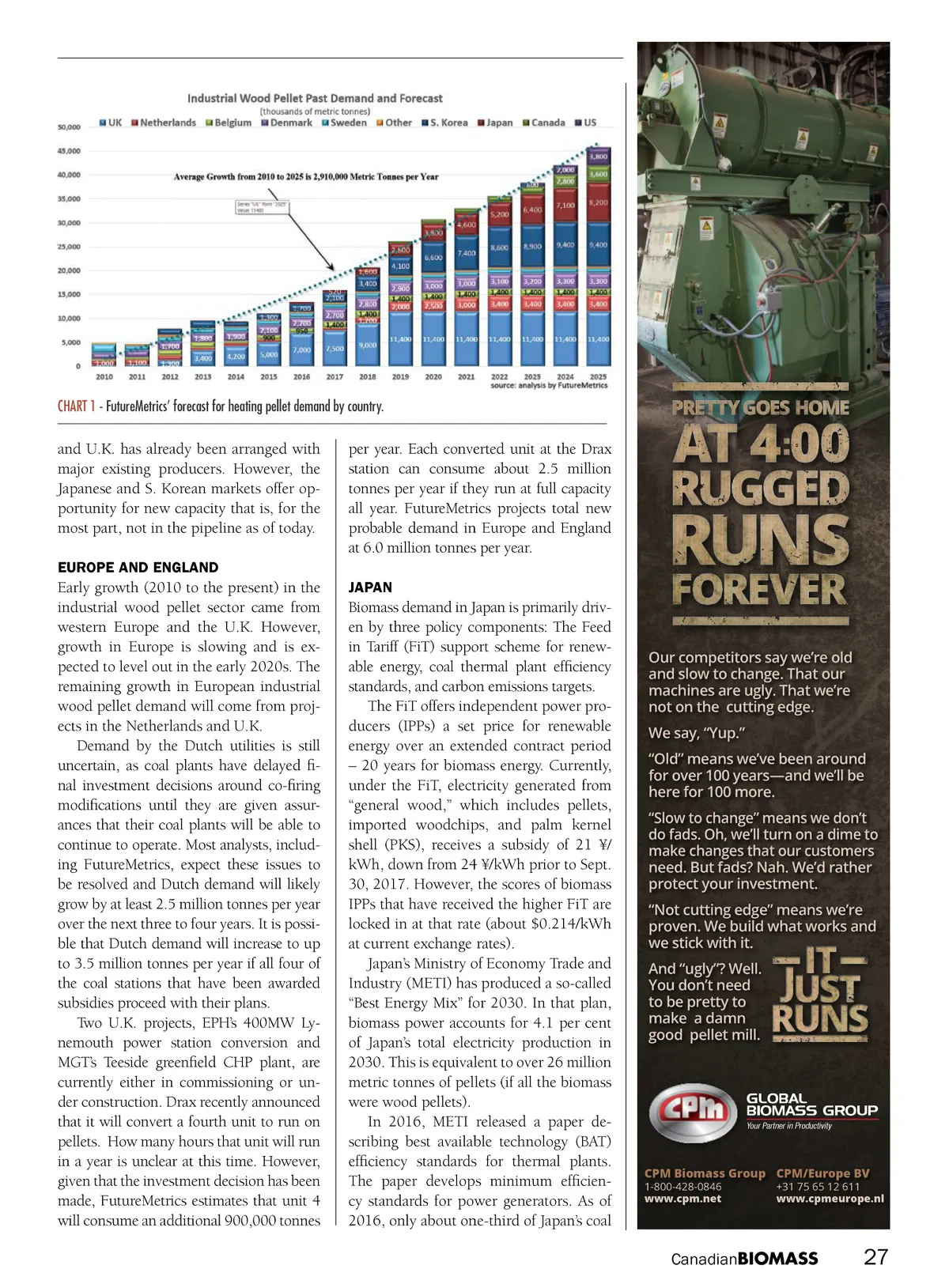
Pellet Outlook Increasing demand Industrial wood pellet markets – 2018 to 2025 By William Strauss and Seth Walker lobal pellet markets have increased significantly over the last decade, mostly because of demand from the industrial sector. While pellet heating markets make up a significant amount of global demand, this overview will focus on the industrial wood pellet sector. Chart 1 shows FutureMetrics’ forecast for heating pellet demand by country. Pellet heating markets have been chal-lenged in recent years by low alternative heating fuel costs (oil and gas prices) and warmer than average winters in North America and Europe. FutureMetrics ex-pects that a combination of higher oil pric-es and de-carbonization policies will return demand growth to trend in the 2020s. For the last several years, the industrial wood pellet sector was as large as the heat-ing pellet sector, and is expected to become significantly larger over the next decade. The industrial wood pellet market is driven by carbon emissions mitigation and renewable generation policies. Indus-trial wood pellets are a low carbon renew-able fuel that easily substitutes for coal in large utility power stations. Pellets can be substituted for coal in two ways, either a full conversion or co-firing. For a full conversion, an entire unit at a coal station is converted from using coal to using wood pellets. This re-quires modifications to the fuel handling, feed systems, and burners. Co-firing is the combustion of wood pellets along with coal. At lower co-firing ratios, minimal modifications to existing pulverized coal facilities are required. In fact, at lower blends (under about seven per cent) of wood pellets, almost no modification is required. Chart 2 shows the historical actual de-mand and FutureMetrics’ demand fore-cast for industrial wood pellet markets. Aggregate demand in 2017 is estimated at 15.9 million metric tonnes. G As shown in Chart 2, demand in the U.K. and EU is expected to plateau by 2020. However, major growth is expected in Japan and South Korea in the 2020s. We also expect Canada and U.S. to have some pulverized coal power plants using industrial wood pellets by 2025. PELLET DEMAND New large utility co-firing and conversion projects in Japan, the EU and U.K., and South Korea, and many smaller indepen-dent power plant projects in Japan, are forecast to add about 24 million tonnes per year to current demand by 2025. Most of the expected growth is from Japan, and South Korea. FutureMetrics maintains a detailed project-specific database on all the proj-ects that are expected to be consuming wood pellets.Most of the supply of pel-lets for planned new demand in the EU JANUARY/FEBRUARY 2018 26 Canadian BIOMASS
Canadian Biomass January-February 2018: Page 26