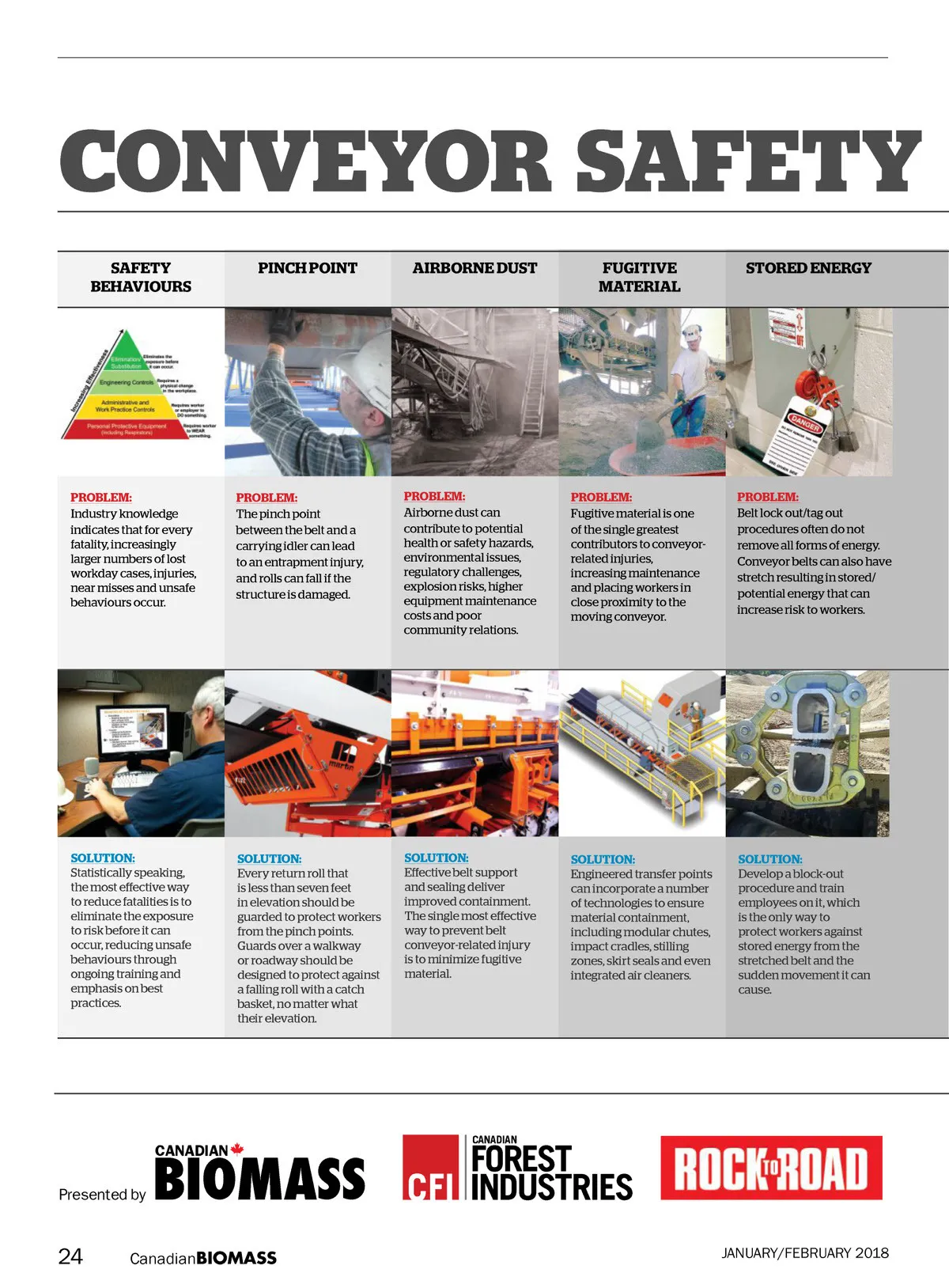
CONVEYOR SAFETY SAFETY BEHAVIOURS PINCH POINT AIRBORNE DUST FUGITIVE MATERIAL STORED ENERGY PROBLEM: Industry knowledge indicates that for every fatality, increasingly larger numbers of lost workday cases, injuries, near misses and unsafe behaviours occur. PROBLEM: The pinch point between the belt and a carrying idler can lead to an entrapment injury, and rolls can fall if the structure is damaged. PROBLEM: Airborne dust can contribute to potential health or safety hazards, environmental issues, regulatory challenges, explosion risks, higher equipment maintenance costs and poor community relations. PROBLEM: Fugitive material is one of the single greatest contributors to conveyor-related injuries, increasing maintenance and placing workers in close proximity to the moving conveyor. PROBLEM: Belt lock out/tag out procedures often do not remove all forms of energy. Conveyor belts can also have stretch resulting in stored/ potential energy that can increase risk to workers. SOLUTION: Statistically speaking, the most effective way to reduce fatalities is to eliminate the exposure to risk before it can occur, reducing unsafe behaviours through ongoing training and emphasis on best practices. SOLUTION: Every return roll that is less than seven feet in elevation should be guarded to protect workers from the pinch points. Guards over a walkway or roadway should be designed to protect against a falling roll with a catch basket, no matter what their elevation. SOLUTION: Effective belt support and sealing deliver improved containment. The single most effective way to prevent belt conveyor-related injury is to minimize fugitive material. SOLUTION: Engineered transfer points can incorporate a number of technologies to ensure material containment, including modular chutes, impact cradles, stilling zones, skirt seals and even integrated air cleaners. SOLUTION: Develop a block-out procedure and train employees on it, which is the only way to protect workers against stored energy from the stretched belt and the sudden movement it can cause. Presented by BIOMASS CANADIAN FOREST CFI INDUSTRIES JANUARY/FEBRUARY 2018 CANADIAN 24 Canadian BIOMASS
Canadian Biomass January-February 2018: Page 24