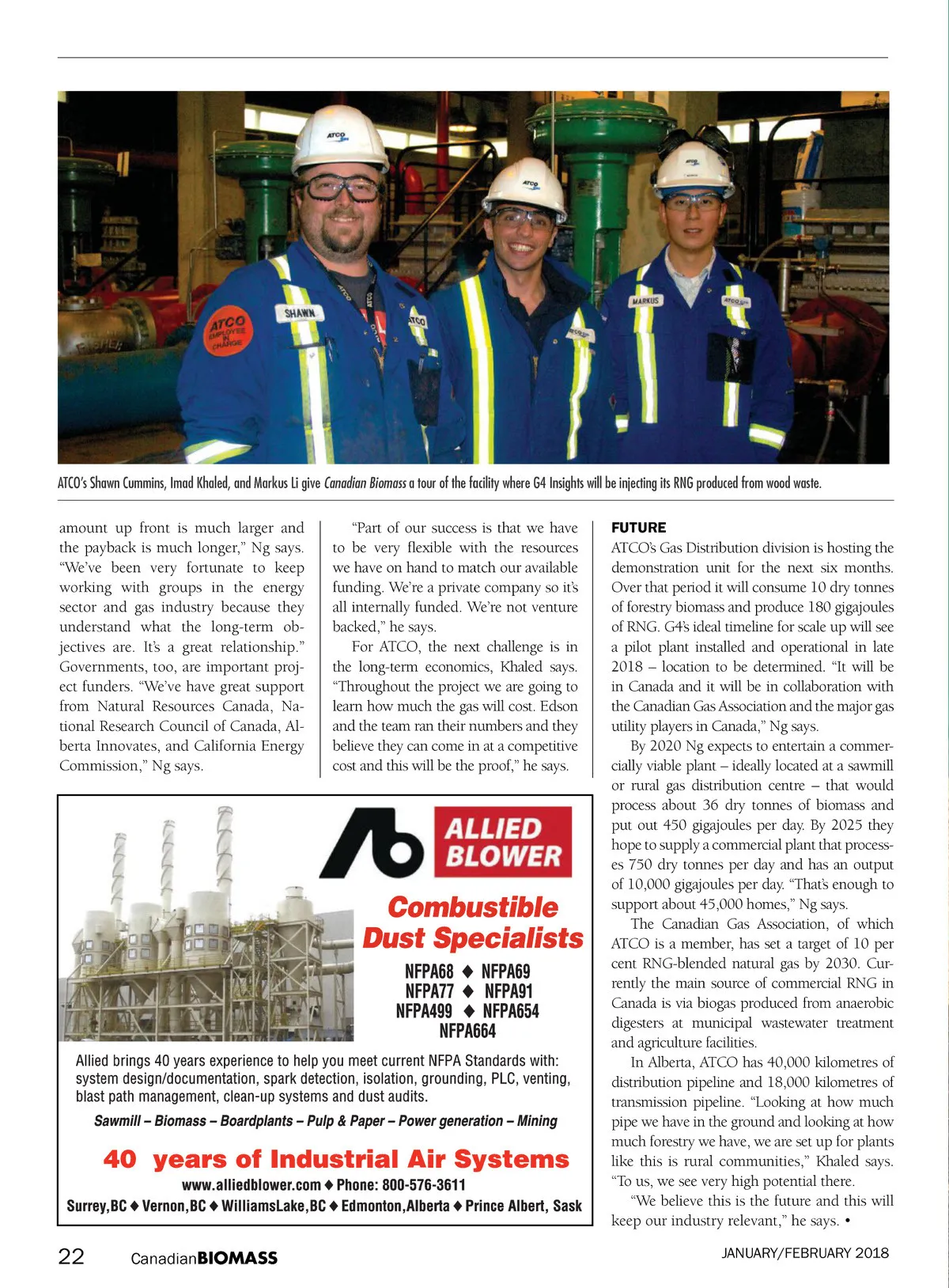
ATCO’s Shawn Cummins, Imad Khaled, and Markus Li give Canadian Biomass a tour of the facility where G4 Insights will be injecting its RNG produced from wood waste. amount up front is much larger and the payback is much longer,” Ng says. “We’ve been very fortunate to keep working with groups in the energy sector and gas industry because they understand what the long-term ob-jectives are. It’s a great relationship.” Governments, too, are important proj-ect funders. “We’ve have great support from Natural Resources Canada, Na-tional Research Council of Canada, Al-berta Innovates, and California Energy Commission,” Ng says. “Part of our success is that we have to be very flexible with the resources we have on hand to match our available funding. We’re a private company so it’s all internally funded. We’re not venture backed,” he says. For ATCO, the next challenge is in the long-term economics, Khaled says. “Throughout the project we are going to learn how much the gas will cost. Edson and the team ran their numbers and they believe they can come in at a competitive cost and this will be the proof,” he says. FUTURE ATCO’s Gas Distribution division is hosting the demonstration unit for the next six months. Over that period it will consume 10 dry tonnes of forestry biomass and produce 180 gigajoules of RNG. G4’s ideal timeline for scale up will see a pilot plant installed and operational in late 2018 – location to be determined. “It will be in Canada and it will be in collaboration with the Canadian Gas Association and the major gas utility players in Canada,” Ng says. By 2020 Ng expects to entertain a commer-cially viable plant – ideally located at a sawmill or rural gas distribution centre – that would process about 36 dry tonnes of biomass and put out 450 gigajoules per day. By 2025 they hope to supply a commercial plant that process-es 750 dry tonnes per day and has an output of 10,000 gigajoules per day. “That’s enough to support about 45,000 homes,” Ng says. The Canadian Gas Association, of which ATCO is a member, has set a target of 10 per cent RNG-blended natural gas by 2030. Cur-rently the main source of commercial RNG in Canada is via biogas produced from anaerobic digesters at municipal wastewater treatment and agriculture facilities. In Alberta, ATCO has 40,000 kilometres of distribution pipeline and 18,000 kilometres of transmission pipeline. “Looking at how much pipe we have in the ground and looking at how much forestry we have, we are set up for plants like this is rural communities,” Khaled says. “To us, we see very high potential there. “We believe this is the future and this will keep our industry relevant,” he says. • JANUARY/FEBRUARY 2018 22 Canadian BIOMASS 2014-11-18 2:22 PM allied blower biomass novdec14.indd 1
Canadian Biomass January-February 2018: Page 22