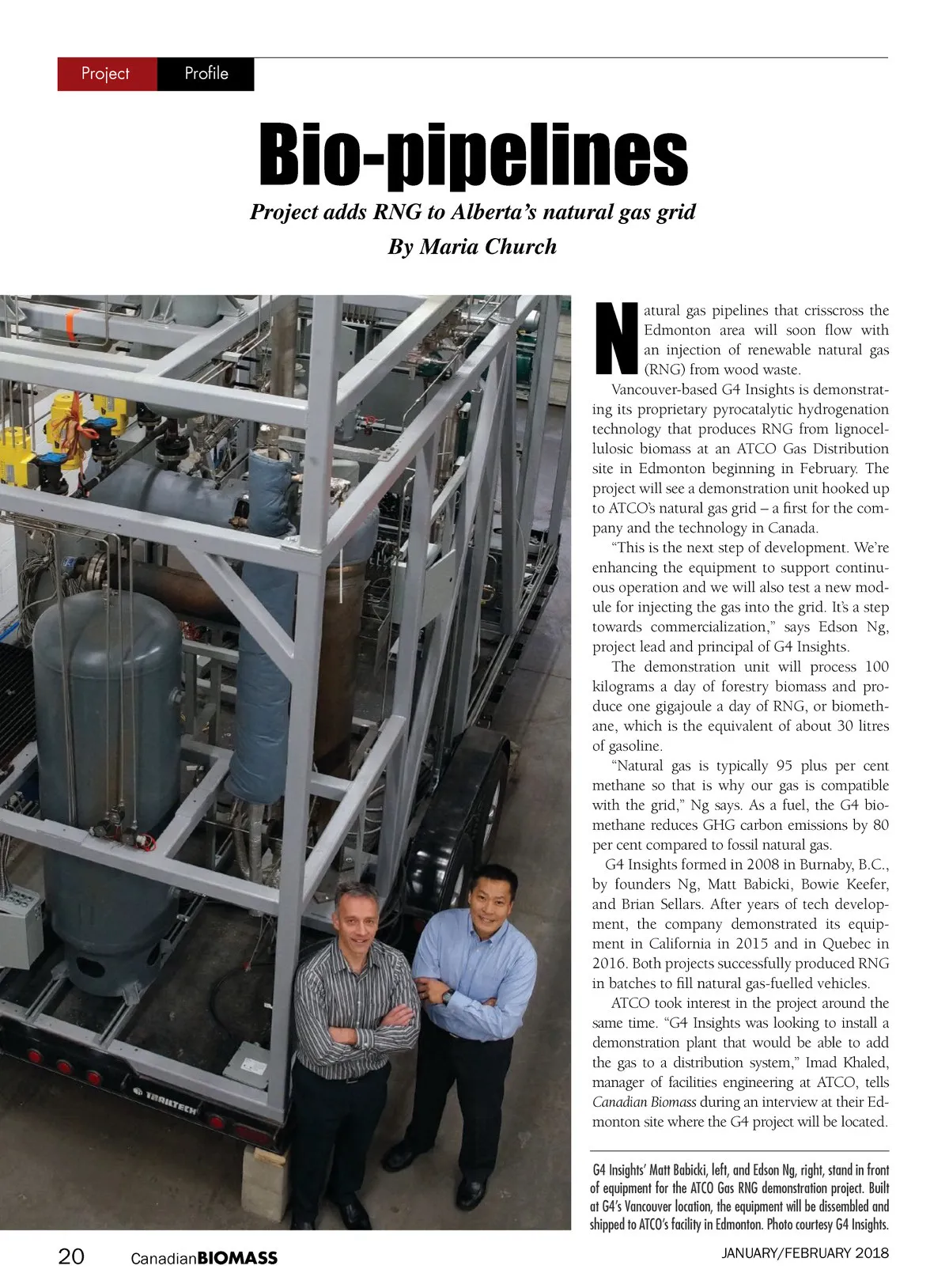
“The amount of gas they are going to produce is like a grain drop in an ocean. Our site here flows massive volumes of gas to the city,” Khaled says. “The advan-tage of this site is the fact that we have all the space, and all of the equipment.” The site includes the G4 plant that produces the gas, a trailer for the operator on site, a sea-can to store the wood, and a natural gas generator as a power source, all of which is located about 20 feet away from ATCO’s main distribution building for the Edmonton area. A small pipe runs from the plant into the distribution build-ing and attaches to one of the natural gas lines. Once testing is complete, small amounts of the RNG will be injected into those main pipelines. G4’s equipment is built and tested at its Vancouver office. The equipment destined for the ATCO site will be disassembled, trucked to Edmonton and then fully in-stalled in February. RNG will be produced on site by March. A full-time G4 opera-tor will run the plant, and ATCO’s Shawn Cummins will monitor the gas. “I’m looking forward to working with them and learning about the equipment,” Cummins says. TECHNOLOGY is generated through a burner fuelled by the waste biochar. The only input into the system is wood chips, and the only products are methane, bio ash solids and CO2. “The bio ash is min-eral rich which can be returned to the forest as a fertilizer enhancement and the emitted CO2 is carbon neutral because it is created by the combustion of biochar,” Ng says. “The great news here is that the energy conversion efficiency is about 70 per cent. So 70 per cent of the energy in the wood go-ing into the process is available as renewable natural gas going into the grid,” he says. CHALLENGES From conception in 2008 G4 has jumped numerous hurdles to get to this demonstra-tion phase. As with almost all clean energy technology, the cost of development is high. “These projects are outside the win-dow of typical venture capitalists. The A Division of Hoffmann Inc. Implementing Bulk Material Handling Solutions Since 1947 G4’s pyrocatalytic hydrogenation pro-cess uses moderate heat and a catalyst to convert biomass into methane and water. This is unlike a wood gasification process, which uses high heat to create syngas. Syn-gas must then be converted into methane. The G4 plant is fed by wood residuals ei-ther from sawmills or harvesting operations (tree tops and branches) that have been pro-cessed through a hammer mill to create par-ticles roughly five-millimetres long. Wood particles are first treated to fast pyrolysis – a process that rapidly heats the particles, vapourizing them to create py-rolysis gas. “In that volatile gas state, we flow the pyrolysis gas over a catalyst in the gas conditioning section. The catalyst, combined with the pyrolysis gas, plus add-ed hydrogen, that sets the perfect condi-tion to form methane,” Ng says. The process happens in a single step. Hydrogen is added internally through steam methane reforming – a process that creates hydrogen from methane. So a portion of the end product methane is recycled back into the system and con-verted into hydrogen. Heat for the system Visit us at Biomass Expo & Wood Bioenergy 2018 Atlanta, Georgia April 2018 Standard Pivot Drive-Over Dumper STANDARD PIVOT TRUCK TIPPER Stacker Reclaimers In-Pit Hoppers [email protected] | 563.264.8066 | airoflex.com Canadian BIOMASS 21
Canadian Biomass January-February 2018: Page 21